Paderborn University builds a reprogrammable photonic quantum computer
The Gaussian boson sampler, led by Christine Silberhorn, can be reprogrammed for different experiments, and its first results appear in PRX Quantum.
By Letizia Giugliano
2 min read
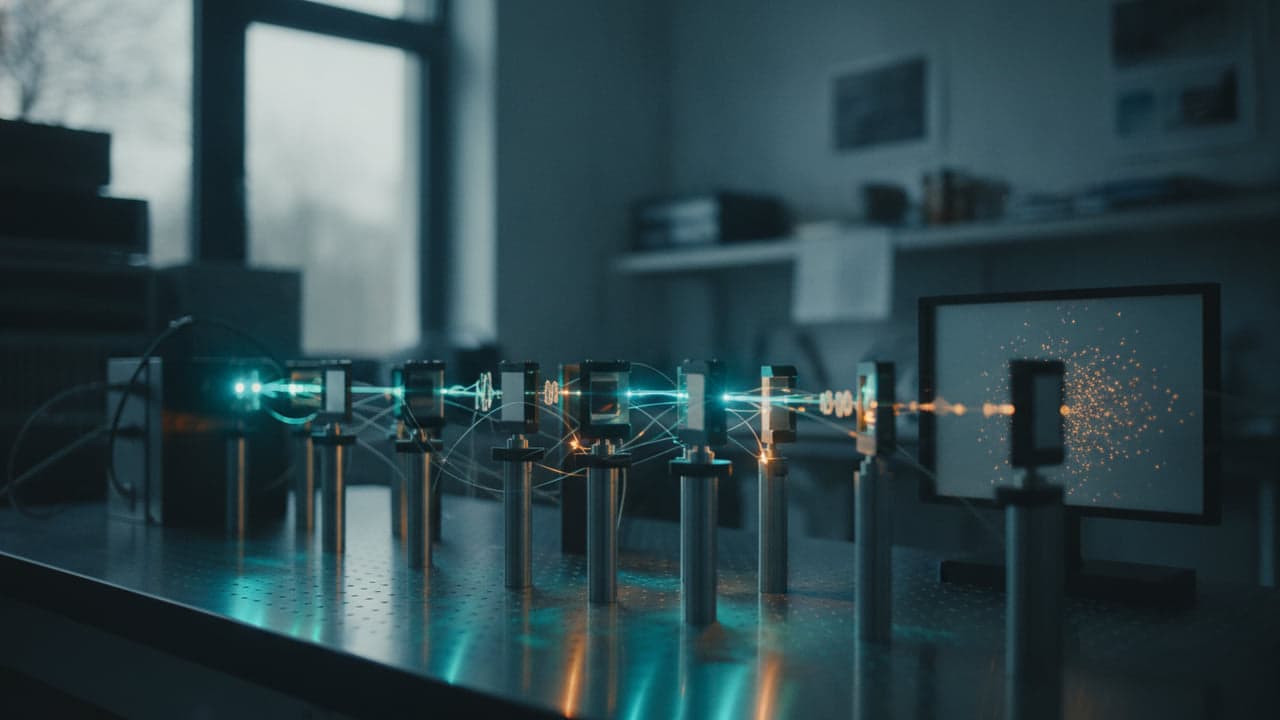
Physicists at Paderborn University in North Rhine-Westphalia have built a photonic quantum computer that processes information with particles of light. The machine, the Paderborn Quantum Sampler (PaQS), is a Gaussian boson sampler: it pushes photons through a complex optical network and samples the light patterns that come out. Simulating those patterns on a conventional supercomputer could take many thousands of years once the network grows large enough.
Photons instead of bits in a Paderborn laboratory
Conventional computers store data in bits, each one a 0 or a 1. PaQS uses photons, massless particles that travel at the speed of light in a vacuum and belong to the class of bosons. Christine Silberhorn, a professor at the university's Institute of Photonic Quantum Systems (PhoQS), led the work. The invention is not a single-task demonstrator: the team built the optical equipment, joined its parts and wrote the analysis methods around it. Michael Stefszky, who heads the Quantum Computing research group and coordinated the project, argued that the results show how much more than raw size goes into a working machine. The German project was first reported by Interesting Engineering.
“The results underscore that building useful quantum computers involves far more than simply scaling up a system.”
— Michael Stefszky, head of the Quantum Computing research group, Paderborn University
Squeezed light, photon statistics and entanglement
The experiment asked a narrow question: which properties of light actually drive performance? The researchers looked at how photons behave, how those properties can be controlled, and how particles can be linked through quantum entanglement. They combined laboratory runs, data analysis and computer models, and brought together specialists in integrated photonics, computer science and theoretical quantum optics. Stefszky said that a precise understanding of how squeezed light, photon statistics and entanglement influence computational performance "is essential for the development of the next generation of quantum technologies." Squeezed light is a state in which the noise in one property of the light is reduced below the usual quantum limit.
Programmable, so the same machine runs different tests
Instead of performing one fixed calculation, PaQS can be adjusted to test different ways of processing light. That flexibility is the practical innovation here: it lets the group compare quantum properties across runs on the same hardware. The catch is verification. As the number of possible output patterns grows and the optical network becomes more complex, predicting the result becomes harder, and a classical supercomputer would need thousands of years to reproduce a sufficiently large system. The paper is published in PRX Quantum.
PhoQuant, three industry partners and the next version
PaQS was developed inside PhoQuant, a research initiative run with the Fraunhofer Institute for Applied Optics and Precision Engineering (IOF), Swabian Instruments and Menlo Systems. The team is now upgrading the sampler to handle more complex calculations. Light-based machines, the researchers suggest, could later serve chemistry, energy and secure communications; no schedule for those uses is given. What the next version has to prove is whether the programmability holds as the optical network grows.
Read also on The Patent: An ESP32 takes the place of the tube in a DIY valve-sound box
AI-assisted article