Barcelona's ICFO microscope reads all 10 spin states of strontium atoms
ICFO's instrument separates the spin states of strontium-87 atoms in a single shot, turning a fermionic gas into a picture of multicolored dots.
By Giovanni Sapere
3 min read
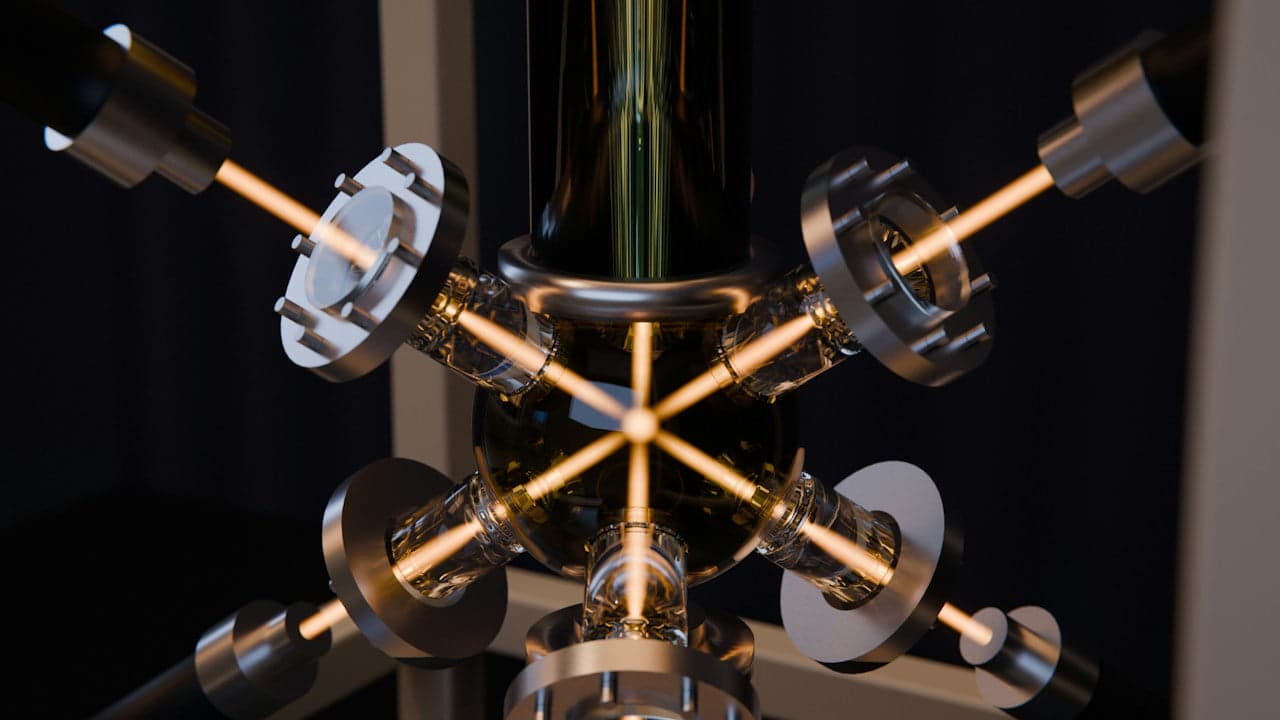
Researchers at ICFO in Barcelona have imaged a cloud of strontium-87 atoms and told apart all 10 of its spin states in one experimental run. The group of ICREA professor Leticia Tarruell reports the result in Physical Review X, with DOI 10.1103/v9sh-cq7r. Phys.org covered the paper on 17 November 2026, describing images that look like multicolored confetti, one color per spin state.
Ten colors from one cloud of strontium-87
The Ultracold Quantum Gases group at ICFO built its quantum-gas microscope in 2024, when it imaged individual atoms in strontium gases for the first time. That demonstration used strontium-84, a boson with no spin at all.
The new experiment switches isotope. Strontium-87 is a fermion with 10 different spin states, and the team resolved every one of them. Carlos Gas-Ferrer, Antonio Rubio-Abadal, Sandra Buob, Leonardo Bezzo and Jonatan Höschele worked on the apparatus, led by Tarruell. Gas-Ferrer is first author of the article.
Read also on The Patent: Cornell chip cools trapped ions to quantum ground state in 150 microseconds
Each bright spot in the image is a single atom, and the color assigned to that spot identifies its spin. Read together, the frames show the population of all 10 states. The paper describes it as the first quantum-gas microscope able to detect individual atoms with so many available spins in a single shot.
“The key ingredient for making this experiment was the red narrow-line transition of strontium.”
— Carlos Gas-Ferrer, first author, ICFO
“The transition is gentle enough to allow us to resolve the spin, while being strong enough to induce a fluorescence signal.”
— Carlos Gas-Ferrer, first author, ICFO
How a narrow-line transition keeps nine states dark
The key to the measurement is a property of strontium itself. Gas-Ferrer points to the red narrow-line transition of the element: "The key ingredient for making this experiment was the red narrow-line transition of strontium."
A laser tuned to the right frequency excites only the atoms sitting in one chosen spin state. Those atoms absorb the light, then emit fluorescence photons that the microscope collects. Atoms in the other states are not addressed and stay dark. "The transition is gentle enough to allow us to resolve the spin, while being strong enough to induce a fluorescence signal," Gas-Ferrer says.
Getting from one state to ten takes a sequence. The laser reads the first state and the camera records an image in one color. The atoms in the next state are then transferred into that same addressable state, excited and imaged with a new color. The protocol repeats until all 10 populations have been read in a single realization.
Beyond the two spins of the electron
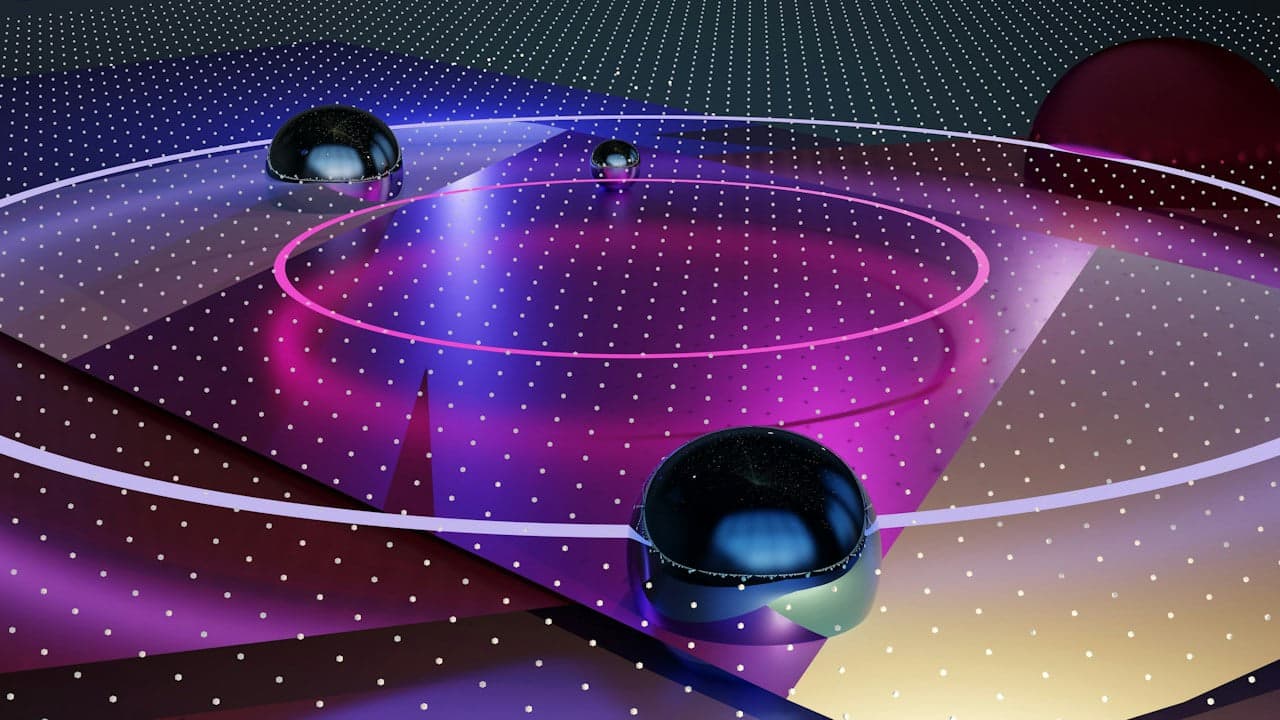
Quantum simulators use fermionic atoms in place of electrons, and an optical lattice made of interfering laser beams in place of a crystal. Such systems are used to study the Hubbard model, a reference for understanding high-temperature superconductors.
Strontium-87 lets the ICFO team go past the two spin states available to an electron and build artificial materials with three or more. That extra freedom matters for exotic quantum magnetism, where spins settle into complex magnetic arrangements. It could also produce spin-liquid behavior, a phase in which the spins do not order and stay suspended in a superposition of many quantum states.
The same atoms interest researchers working on qudits, the generalization of a qubit to more than two values. Neutral alkaline-earth atoms such as strontium are among the candidates for that hardware, and the imaging protocol offers a readout method that the authors say stays compatible with the strict requirements of qudit quantum computing. The paper does not claim a working qudit, only a way to read one out.
What to watch next
The result is an imaging method, not a device on the market. Its value will show in the experiments it makes possible: multi-spin Fermi-Hubbard systems in optical lattices, where three or more spin states can be prepared and then read atom by atom.
The Physical Review X article is dated 2026 and carries DOI 10.1103/v9sh-cq7r. ICFO lists the work under its Ultracold Quantum Gases group, the same laboratory that produced the 2024 strontium-84 images. Nothing in the published account points to a patent application or a commercial partner for the microscope.
AI-assisted article