Ames Laboratory controls magnetic wave handedness for quantum computing
Physicists switch magnon states in ferrimagnetic kagome metals using external magnetic fields and low energy
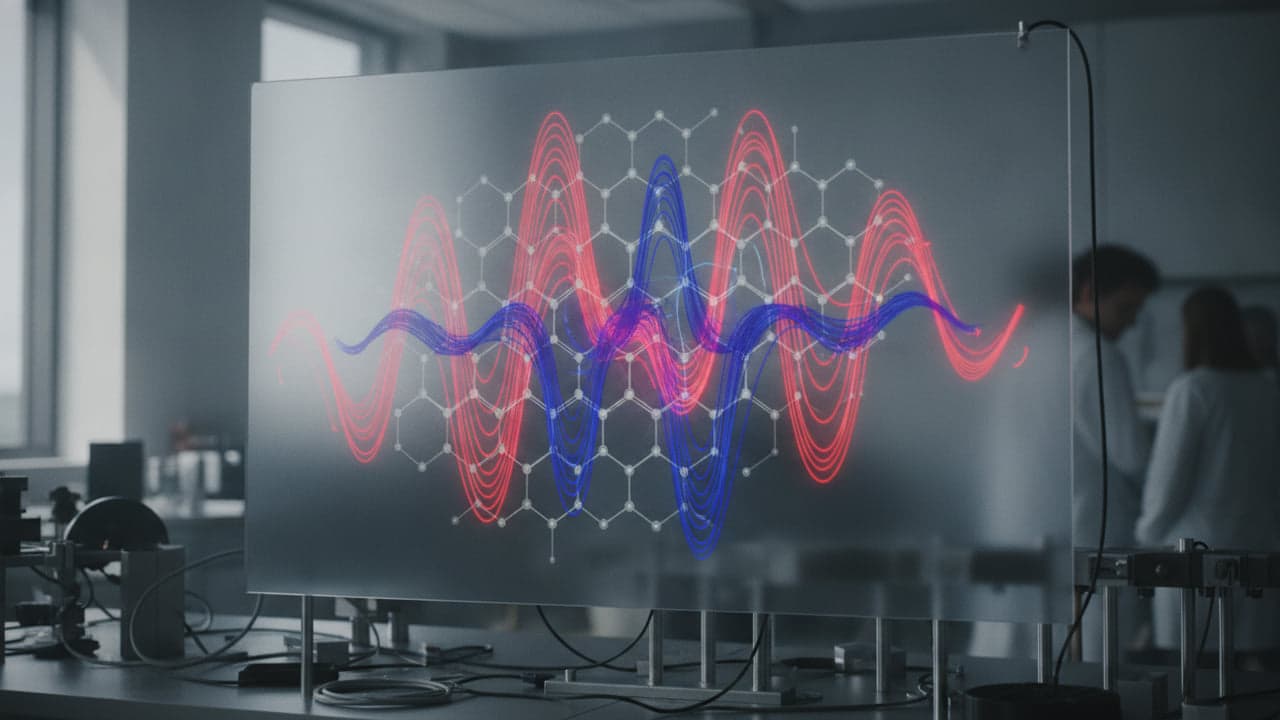
Physicists at the Ames National Laboratory have found a way to switch the handedness of magnons, magnetic waves that travel through solid materials without moving an electrical charge. The discovery, reported on November 10, 2026, provides a new mechanism to encode and process data for future quantum computing hardware. By applying an external magnetic field to specific kagome metals, the research team caused opposing wave states to mix.
Chiral mixing inside kagome metals
Magnons are quasiparticles representing collective waves of magnetic excitation. Like spinning tops, they move with either a right-handed or left-handed orientation. In a study published in Physical Review Letters, a research group led by physicist Rob McQueeney at the Ames National Laboratory showed that these distinct states can interact and switch direction under controlled conditions, as reported by Phys.org. While conventional electronics rely on the physical movement of electrical charges, this innovation allows magnons to transmit information purely through magnetic orientation, avoiding energy loss caused by electrical resistance.
“Magnons have certain advantages for moving information. But manipulating the handedness was not a solved problem. And now it is.”
— Rob McQueeney, Ames National Laboratory
Opposing atomic moments in ErMn6Sn6
The breakthrough occurred while the team investigated kagome metals, a class of quantum materials named for their interlaced atomic lattice. To observe chiral behavior, the scientists examined ferrimagnets, materials composed of two distinct magnetic atoms whose magnetic moments point in opposite directions without canceling each other out entirely. In tests with the compound TbMn6Sn6, right-handed and left-handed magnons crossed paths without interaction. However, when experimenting with ErMn6Sn6, an alloy containing erbium, manganese and tin, the researchers observed that the two wave types collided, avoided crossing and mixed together, as detailed by Phys.org.
Low-energy switching for data storage
Under ordinary conditions, exciting right-handed and left-handed magnons requires completely different energy thresholds. The experimental setup demonstrated that breaking material symmetry lets the two states mix freely. This reaction allows an external magnetic field to toggle the wave handedness using very little power. Controlling chiral states solves a longstanding barrier in spin-based physics. Although no commercial device or patent application has been registered yet, this laboratory invention provides the physical foundation for future intellectual property and spintronic devices, opening practical pathways for high-efficiency magnetic logic in quantum computing.
Read also on The Patent: Physicists Map Particle Motion in Primordial Quark-Gluon Plasma · DeepMind AI Exposes Legacy RSA Weaknesses 1,600 Times Faster