Dinosaur Blood Molecules Identified in 115-Million-Year-Old Fossil
Geochemists detect preserved heme and collagen amino acids inside vascular canals of a Brazilian theropod.
Geochemists at Curtin University have detected chemically confirmed traces of blood inside the 115-million-year-old limb bones of a theropod dinosaur found in northeastern Brazil. Published in the Proceedings of the National Academy of Sciences, the research confirms the survival of hemoglobin-derived heme molecules and collagen amino acids sealed within fossilized vascular canals. The finding provides direct chemical evidence that delicate biological structures can withstand tens of millions of years under specific geological conditions.
Chemical traces inside bone vascular canals
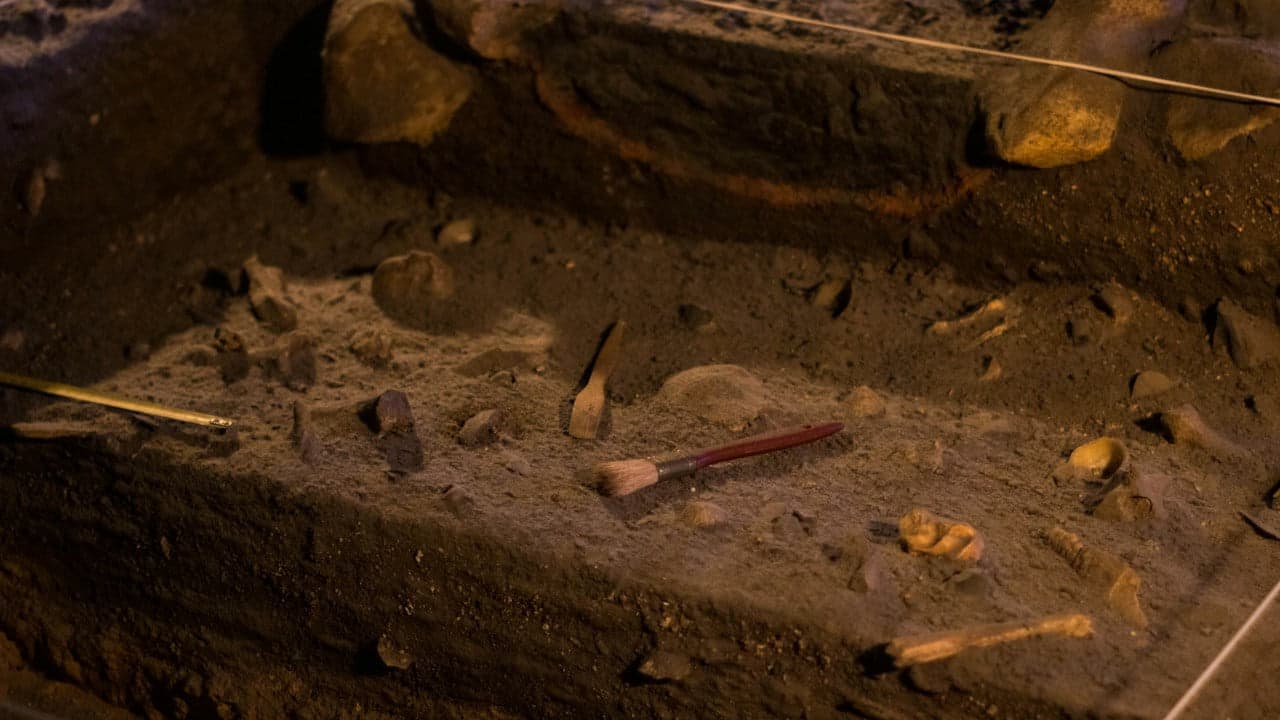
An international research team examined the fossilized limb bones of Aratasaurus museunacionali, a carnivorous theropod unearthed in northeastern Brazil, as reported by ScienceDaily. Inside the microscopic vascular canals that once carried blood vessels, the researchers detected mineralized red blood cells. Chemical tests confirmed the presence of heme molecules, the iron-bearing compounds of hemoglobin that transport oxygen in living animals. The study marks the first definitive chemical confirmation of hemoglobin-derived components inside fossilized red blood cells, rather than visual shapes that merely resemble cellular structures.
“To detect intact heme-derived molecules in 115-million-year-old red blood cells is astonishing: this really is a landmark discovery”
— Professor Kliti Grice, Curtin University
Mineral encasement by hausmannite
The survival of the fragile biomolecules across 115 million years depended on unusual fossilization conditions documented by ScienceDaily. A manganese oxide mineral known as hausmannite coated the structures, creating an inorganic shield that stabilized the red blood cells and collagen amino acids. According to the research group, the animal was buried quickly in low-oxygen sediment with elevated microbial activity, which arrested normal organic decay and prevented the complete breakdown of cellular proteins.
International collaboration and molecular paleontology
The investigation was led by Professor Kliti Grice, founding director of the WA-Organic and Isotope Geochemistry Centre at Curtin University, alongside researchers from the Japan Agency for Marine-Earth Science and Technology, the Brazilian National Museum, the Regional University of Cariri, and Johns Hopkins University. This collaborative method represents an innovation in molecular paleontology, opening new ways to analyze prehistoric metabolic rates and soft-tissue physiology directly from chemical residues rather than skeletal geometry alone, as detailed by ScienceDaily.
Applications for searches in planetary space
The discovery also provides reference data for researchers studying organic preservation in outer space and planetary science. As noted by Curtin University researcher Professor Martin Van Kranendonk via ScienceDaily, knowing that mineral matrixes like hausmannite can protect biological traces for over 100 million years gives astrobiologists concrete chemical targets when looking for biosignatures in extreme extraterrestrial environments. As highlighted by the patent magazine, deciphering these ancient protective shields could eventually inspire novel patent designs for stabilizing delicate biological samples.
Read also on The Patent: AT&T and AST SpaceMobile complete first cellular to satellite network handoff · NASA Map Identifies 13 Possible Martian Origins for Teghaza 001 Meteorite