Italian dinosaur Tethyshadros had a birdlike beak, not spikes, X-ray scans show
Micro-CT imaging of three Italian specimens shows the "spikes" were internal bone supporting a large keratinous beak, and confirms adults reached 5.2 to 5.9 metres
By Letizia Giugliano
4 min read
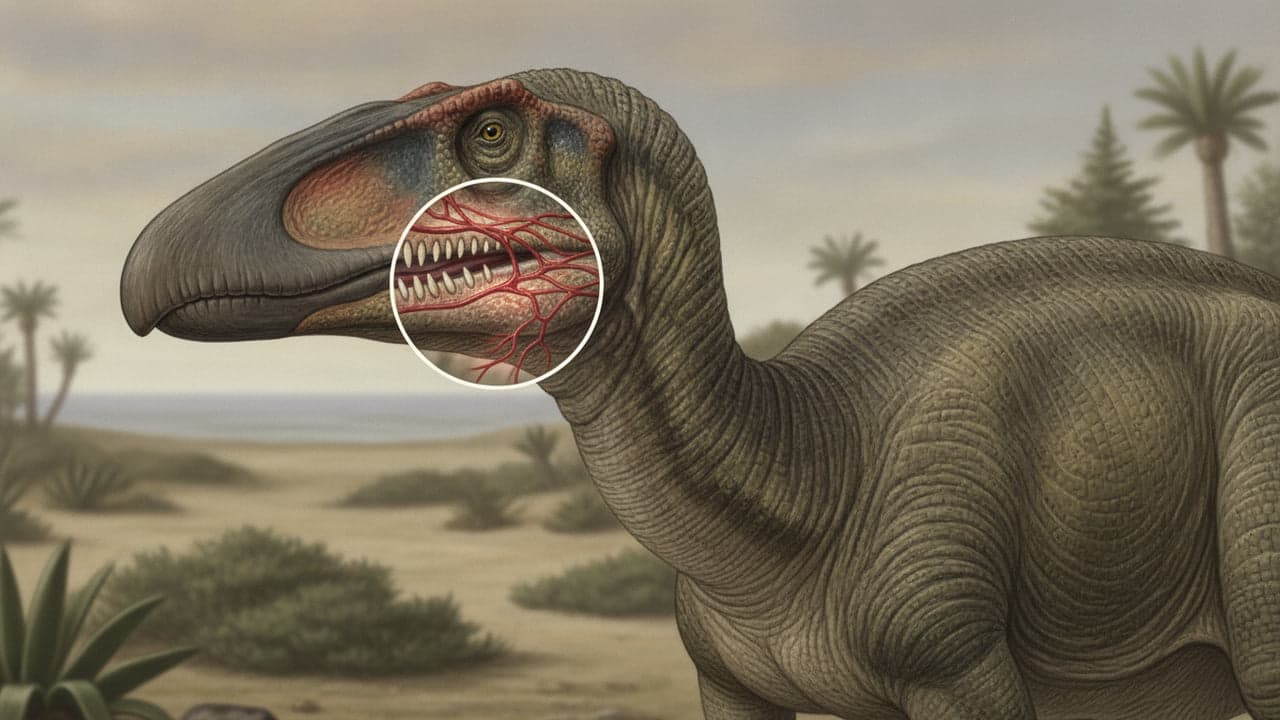
Three specimens of the Italian duck-billed dinosaur Tethyshadros insularis have been re-scanned at the TomoLab facility of Elettra Sincrotrone Trieste, and the bony projections that palaeontologists read for more than 15 years as exposed spikes turn out to be the scaffold of a large, birdlike keratinous beak. The study, published in Royal Society Open Science, also recalculates the animal's adult length at 5.2 to 5.9 metres. The finding matters because the fossils from Villaggio del Pescatore, near Trieste, are among the most complete dinosaurs found in Europe, and the new imaging shows they still hold anatomy that the outside of the bone cannot reveal.
A mouth rebuilt after fifteen years of spikes
For more than 15 years, the reconstruction of Tethyshadros insularis gave the dinosaur one of the strangest mouths among hadrosauroids, the group of duck-billed dinosaurs. Each side of the upper jaw ended in three forward-pointing bony projections, read as exposed spikes or toothlike ornaments.
A team from the University of Bologna, Elettra Sincrotrone Trieste, University College London and Freie Universität Berlin has now overturned that reading in a paper in Royal Society Open Science. The projections were never visible on the outside of the living animal. They formed the internal bony framework that carried a much larger and deeper keratinous sheath, the rhamphotheca, the same kind of horny covering that sheathes a modern bird's bill. The study was reported by Phys.org on 19 November 2026.
“Micro-CT allowed us to explore these exceptionally delicate fossils without damaging them”
— Diego Dreossi, Elettra Sincrotrone Trieste
“What looked like a bizarre toothed or spiked beak may actually be the bony footprint of a much more complex living organ”
— Marco Muscioni, University of Bologna
What the micro-CT saw inside the bone
The researchers used high-resolution X-ray micro-computed tomography, a scanning method that builds a three-dimensional image of density inside a solid object, at the TomoLab facility of Elettra Sincrotrone Trieste. They imaged three Tethyshadros specimens from the Villaggio del Pescatore fossil site near Trieste, including the holotype nicknamed "Antonio".
Read also on The Patent: Italy Probes AI Music Startup Suno Over Unfair Terms · Dignity, remembrance and responsibility: the WMF 2026 Opening Ceremony kicks off the biggest edition ever
The scans resolved canals a fraction of a millimetre across, invisible from the surface of the bone, and the digital 3D reconstructions showed a neurovascular system: a network of blood vessels and nerves that fed a fast-growing keratinous sheath and supported tactile organs similar to those of living birds.
"Micro-CT allowed us to explore these exceptionally delicate fossils without damaging them," said Diego Dreossi of Elettra Sincrotrone Trieste in the release. The technique leaves the specimen intact, which matters for bones this fragile.
A beak that fed, felt and cooled the animal
The new reconstruction gives the beak several jobs at once. It absorbed the heavy mechanical wear of cropping abrasive, grit-laden vegetation. It worked as a tactile sensory organ while the animal foraged. And through its dense blood supply it acted as a thermal radiator, sending heat out and returning cooled blood to the braincase, the part of the skull that houses the brain.
Marco Muscioni of the University of Bologna, lead author of the paper, put the change of view this way: "What looked like a bizarre toothed or spiked beak may actually be the bony footprint of a much more complex living organ." Alfio Alessandro Chiarenza of University College London said the combination of feeding structure, sensitive organ and heat exchanger may have grown more important as duck-billed dinosaurs evolved much larger bodies.
Secundus, and adults of 5.2 to 5.9 metres
The paper also revisits specimen SC 57026, known as "Secundus". On the new assessment, fully grown Tethyshadros individuals reached 5.2 to 5.9 metres in length, or 17.1 to 19.4 feet.
The specimens come from a site that has produced one of the richest dinosaur assemblages in Europe, and the study's senior author, Federico Fanti of the University of Bologna, said the Villaggio del Pescatore fossils are among the most complete dinosaurs ever found in Europe. His point is about method: specimens studied for years can still yield unexpected anatomy once the imaging changes.
No patent application appears in the paper, and none is expected for a palaeontological description. The intellectual work here is interpretive: a published re-reading of type material held in public collections, with the digital scans as the evidence behind it. Filippo Maria Rotatori of Freie Universität Berlin and the Museu da Lourinhã, a co-author, said the neurovascular system turned out to have an important physiological function and serves as a key to understanding the evolutionary success of these dinosaurs.
What comes next for the Villaggio del Pescatore bones
The study is a marker of how much innovation in palaeontology now comes from imaging rather than excavation. Every claim in the paper rests on scans of specimens that stay in the collection, which means other teams can re-examine the same digital data.
The paper, "The bird-like complexity of hadrosauroid beaks", is published in Royal Society Open Science with DOI 10.1098/rsos.260392, and the site near Trieste remains open to further sampling and study.
AI-assisted article