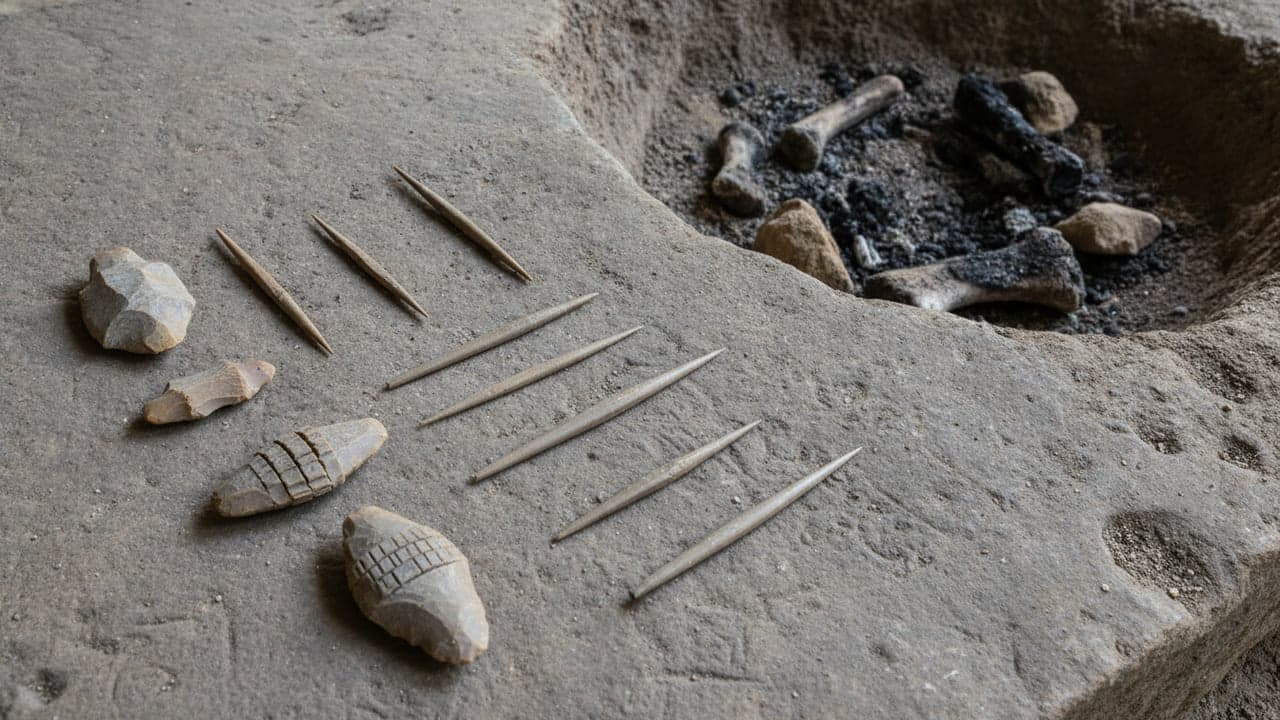
Early Humans Collected Keepsakes 500,000 Years Ago
Archaeologists and neuroscientists link ancient flint souvenirs to the evolution of autobiographical memory.

Early humans began collecting objects with no practical function roughly 500,000 years ago, turning them into personal souvenirs. Researchers at Tel Aviv University argue that these ancient keepsakes acted as external memory aids, driving the biological development of human autobiographical memory.
Curated stones from ancient sites
At prehistoric excavations across Israel, archaeologists have repeatedly uncovered stones and tools that defy utilitarian explanations, a phenomenon explored by the patent magazine. In Qesem Cave, excavators recovered small, colorful pebbles transported from outside the immediate territory, despite showing no signs of being used as tools, according to research reported by Phys.org. In the Sakhnin Valley, Paleolithic foragers shaped flint handaxes around embedded fossils and distinct mineral formations. These fossilized centers were preserved so that a user could feel and see them directly.
Excavations at Revadim, Jaljulia and Qesem Cave revealed flint implements that had been collected long after their creation. Weathering had altered their outer patina before a later human picked them up, as detailed by Phys.org. While some of these tools received minor resharpening, each ancient inventor deliberately kept the worn, aged surfaces intact. The visual history of the object was preserved rather than erased, making the stone an early cultural invention of recorded time.
“The disappearance of large animals, particularly elephants, required early humans to develop new hunting methods and become familiar with hunting grounds inhabited by animals such as fallow deer and wild cattle. Objects taken from these places may have helped them maintain a personal connection with the places that would henceforth provide their livelihood.”
— Prof. Ran Barkai, Department of Archaeology, Tel Aviv University
How objects anchored personal identity
The interdisciplinary study was led by Dr. Yoav Ram, Prof. Ran Barkai, Dr. Ella Assaf, and Prof. Liad Mudrik from Tel Aviv University, alongside Dr. Bar Efrati of Oxford University. Published in Evolutionary Anthropology: Issues, News, and Reviews, their analysis merges field archaeology with cognitive neuroscience. The team posits that carrying a tactile object from a distant landscape created an innovation in human cognition: an external trigger that verified firsthand experience.
Personal keepsakes could be carried, held, and shown to other members of a band, according to Phys.org. That physical presence helped a person distinguish between actual events they lived through and tales told by others. In early human groups, establishing reliable recollections of alliances, territory, and shared obligations proved fundamental to cooperation and social survival.
Ecological shifts and brain evolution
The timing of this behavior coincides with drastic changes in Paleolithic fauna. According to Prof. Ran Barkai, the disappearance of massive prey, notably elephants, forced human hunters to seek smaller, swifter targets such as wild cattle and fallow deer. Surviving required exploring unfamiliar terrains, and keepsakes gathered from distant hunting grounds helped groups maintain connections to territories essential for subsistence, as reported by Phys.org.
Over hundreds of millennia, recurring reliance on external items exerted evolutionary pressure on neurobiological mechanisms. As Dr. Yoav Ram explained to Phys.org, these keepsakes operated as physical memory devices that helped shape the human capacity for continuous autobiographical memory and a distinct sense of personal identity.
Read also on The Patent: DNA in Fifth-Century German Boat Burial Uncovers Ancient Mediterranean Leprosy · Giant Virus Yields a Potassium Channel Gene Linked to Complex Protein Origins