Diden Spider Climbs Shipyard Steel Walls to Weld Overhead
South Korean startup Diden Robotics deploys a quad-legged magnetic crawler carrying 30-kilogram welding payloads inside ship hulls.
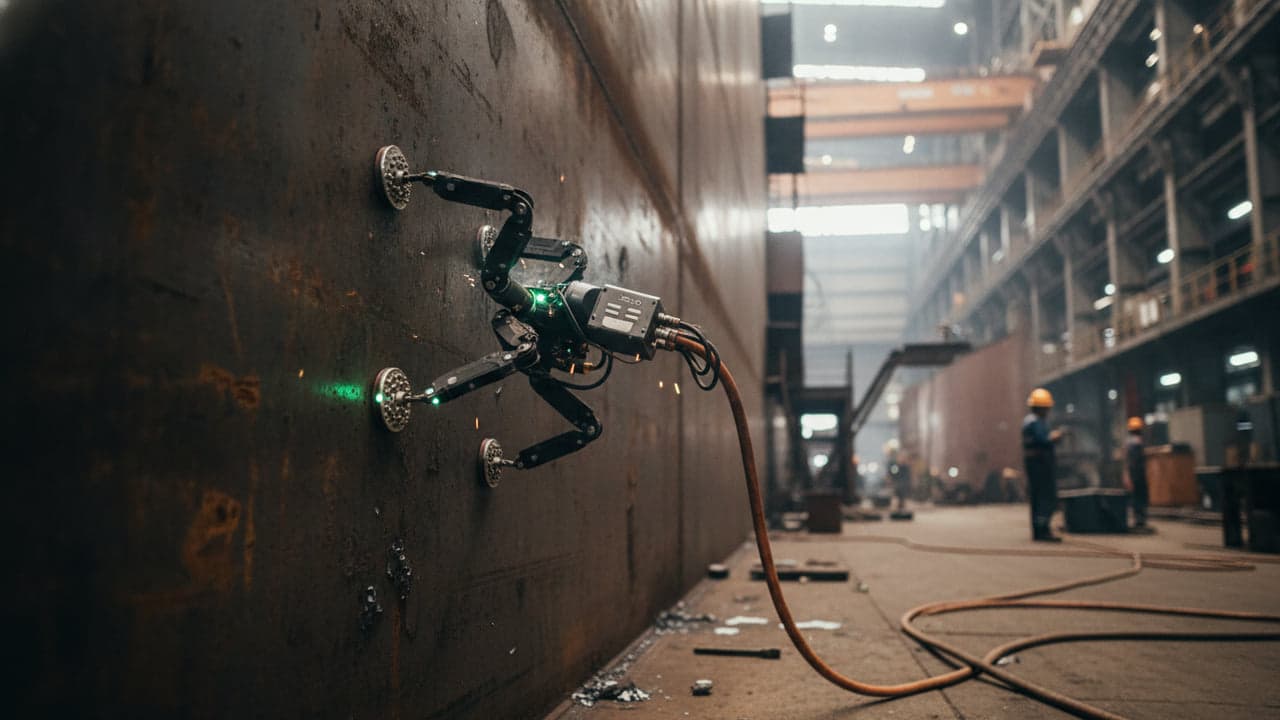
South Korean startup Diden Robotics has built a four-legged climbing machine designed to weld steel bulkheads and ceilings inside commercial vessels. The machine, known as the Diden Spider, uses switchable magnetic feet to scale vertical plates and hold heavy tools in places where human crews would otherwise need staging platforms and rigging. Field units have already entered shipyard production lines in South Korea.
From dog legs to a spider silhouette
Reaching an awkward seam inside a ship hull often demands scaffolding, heavy safety rigging and long setup times before a torch even touches metal. To tackle that problem, startup Diden Robotics developed a quadruped crawler built specifically for vertical steel plate, an innovation reported by Yanko Design.
The machine did not start with its current look. Company co-founder and chief operating officer Youngha Shin explained that early prototypes relied on a dog-like leg structure. That layout faltered when the machine tried to turn sideways on vertical walls. The posture left too few actuators bearing the weight, and feet that failed to seat flat against the steel caused the machine to flip off the surface. By pushing the legs outward into a broad spider stance, engineers kept the chassis closer to the steel and ensured the pads sit flush against the metal.
Magnets that hold without constant power
The physical attachment depends on electropermanent magnets housed inside each foot pad. An electrical pulse flips their magnetic state on or off. Once clamped against a steel plate, the pads maintain their magnetic grip without drawing a continuous supply of electricity, according to Yanko Design. Electricity is reserved for running joints, sensors and onboard computers.
To reassure operators monitoring equipment suspended overhead, the design team fitted visible LEDs to each foot. The lights switch on only when a secure hold is established, giving human crews immediate visual feedback from the deck. In its Spider 30 configuration, the platform supports a payload of 30 kilograms, or about 66 pounds. That capacity enables the crawler to act as an adaptable industrial platform, carrying either automated welding heads or swappable modules such as inspection cameras and robotic arms.
Navigating cluttered hulls with CAD data
Holding onto a bulkhead is only half the problem: the machine must also find its path through structural ribs and stiffeners within a tight space. Diden designed an onboard navigation stack that matches live, three-dimensional sensor readings against the ship's digital CAD model to verify its exact position and orientation. Depth cameras map nearby obstacles in real time so the software can plot collision-free footsteps.
The system has moved beyond laboratory tests into real manufacturing, supported by patent protection for its core mechanisms. South Korean business daily Maeil Business Newspaper reported commercial sales to major Korean shipbuilders in May 2026, and Diden notes that welds completed by Spider 30 units have been incorporated into vessels currently in production. Long-term adoption will depend on routine maintenance overhead and repeatable seam quality across varied welding positions, but the invention demonstrates how specialized robotics can relieve workers from hazardous overhead welding tasks.
Read also on The Patent: FlexiQuad: the collision-resistant ring drone from ETH Zurich · Engineers Solve Key Physical Hurdle in Exhaled Breath Diagnostics