Colorado State University builds a bendable, connecting robot
The 59-centimetre TeCoBot has no elbows: three cables bend its elastic body, and several units can dock into a ring or a walker.
By Letizia Giugliano
2 min read
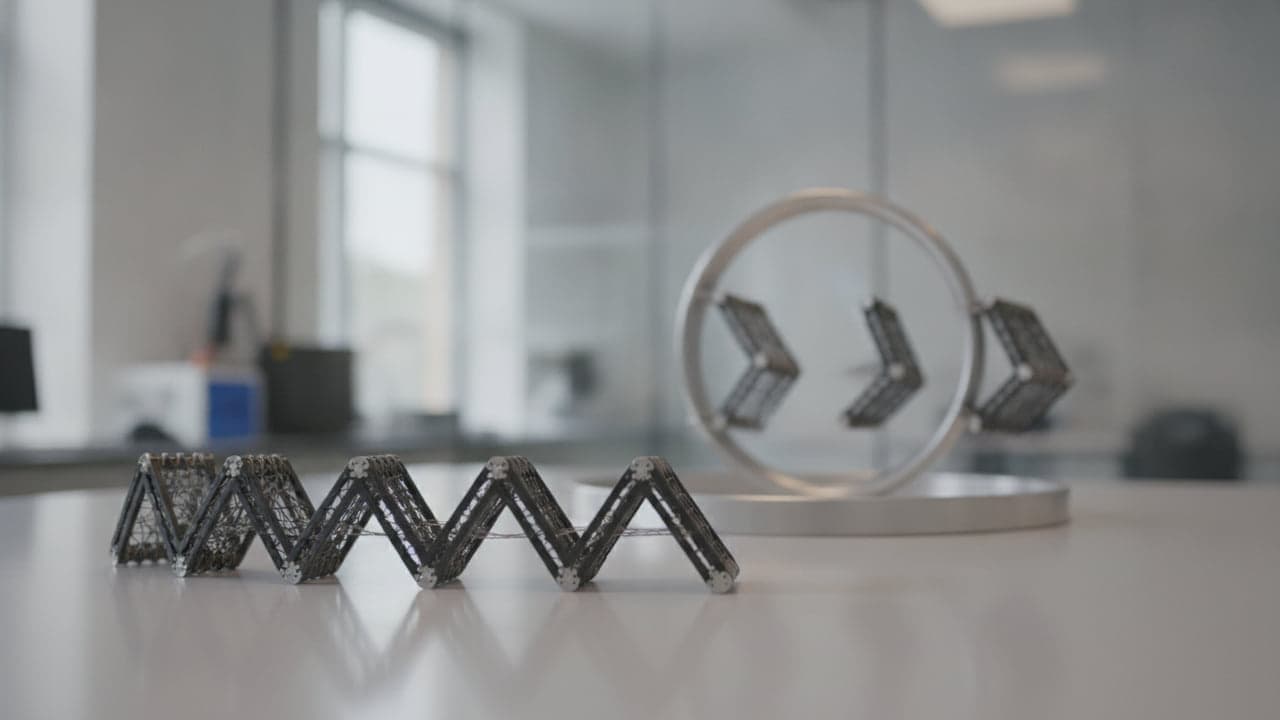
Researchers at Colorado State University’s Adaptive Robotics Lab have built TeCoBot, a 59-centimetre robot that changes shape by pulling three cables inside an elastic lattice. The machine can bend, grip, crawl, roll and climb, and several units can connect to form a ring or a walker. The team calls the approach task-adaptive morphology, and the work is described in Nature Machine Intelligence.
A robot with no elbow joints
TeCoBot is about 23 inches, or 59 centimetres, long and described as lightweight. Unlike conventional robots, it has no rigid arm with elbows and joints. Its body is a flexible structure that can shorten, lengthen and bend in different directions. Each unit can also grip objects at either end. The robots demonstrated crawling, rolling and climbing, and they can connect to other TeCoBots.
Three cables replace hinges
The design rests on tensegrity, short for tensional integrity, a structural principle in which tension and compression elements hold a shape together. In each TeCoBot, carbon-fiber rods sit inside an elastic lattice, with three motor-driven cables running lengthwise through the body. Pull all three equally and the robot compresses along its length, like a concertina. Pull one cable harder and that side shortens more, so the body bends toward it. Because the body is compliant, it can absorb impacts and handle uneven surfaces without a control adjustment at every contact.
Docking turns modules into a ring or a walker
The researchers describe task-adaptive morphology: changing a machine’s physical arrangement to suit a task. A single robot can pick up an object. Connect three or four units and they can form a ring, a walker or a longer manipulator. The team demonstrated autonomous docking, but most movements and cooperative tasks still require human control. The ability to assess a situation independently, choose a configuration and complete an unfamiliar task remains to be shown.
Load capacity and endurance remain open
The source lists several limits. Load capacity is unclear because the robots are lightweight, even when combined. Endurance is also unclear, since motion and gripping consume power. Coordination of large numbers of units has not been established, and long-term durability is yet to be tested. The researchers point to search and rescue as a possible use: units could pass through gaps individually and then connect to overcome obstacles or manipulate objects. The next questions are how much weight connected units can handle and how long they can operate before power runs out. Other lightweight designs, such as the FlexiQuad, the Diden Robotics Spider and the Hopcopter, show how varied the search for adaptable locomotion has become. The study appears in Nature Machine Intelligence.
Read also on The Patent: MIT revives a 1985 three-sided zipper patent as a 3D-printed Y-zipper
Human-Edited, AI-Assisted