MIT microrobot flies and lands on a flower using only onboard sensors
The flapping-wing microrobot now carries its own sensors and computer, a 244-milligram package, though it still draws power from a tether
By Giovanni Sapere
4 min read
Researchers at MIT have flown a flapping-wing microrobot that carries its own sensors and computation, and landed it precisely on a sunflower outside the lab's motion-capture room. The demonstration, published in Science Robotics on 18 November 2026, is the first time an aerial robot of this size has navigated without an external tracking system, the team says. Power still comes through an offboard cable.
A landing on a sunflower, with no cameras watching
For about a decade, the aerial microrobots built at MIT have matched bumblebees for speed and agility, but they could not lift the electronics needed to navigate. Every flight happened inside a room fitted with a motion-capture rig that told the robot where it was. The new machine, described in a paper in Science Robotics, follows a complex trajectory and touches down on a sunflower outdoors, away from that rig.
The robot is roughly the size and shape of a microcassette and weighs less than a paperclip. Its four wings are driven by soft actuators, artificial muscles that flap fast enough for detailed manoeuvres. Kevin Chen, an associate professor in MIT's Department of Electrical Engineering and Computer Science and head of the Soft and Micro Robotics Laboratory, calls the result a first: "This is the first demonstration of an aerial microrobot that is sensory and compute autonomous."
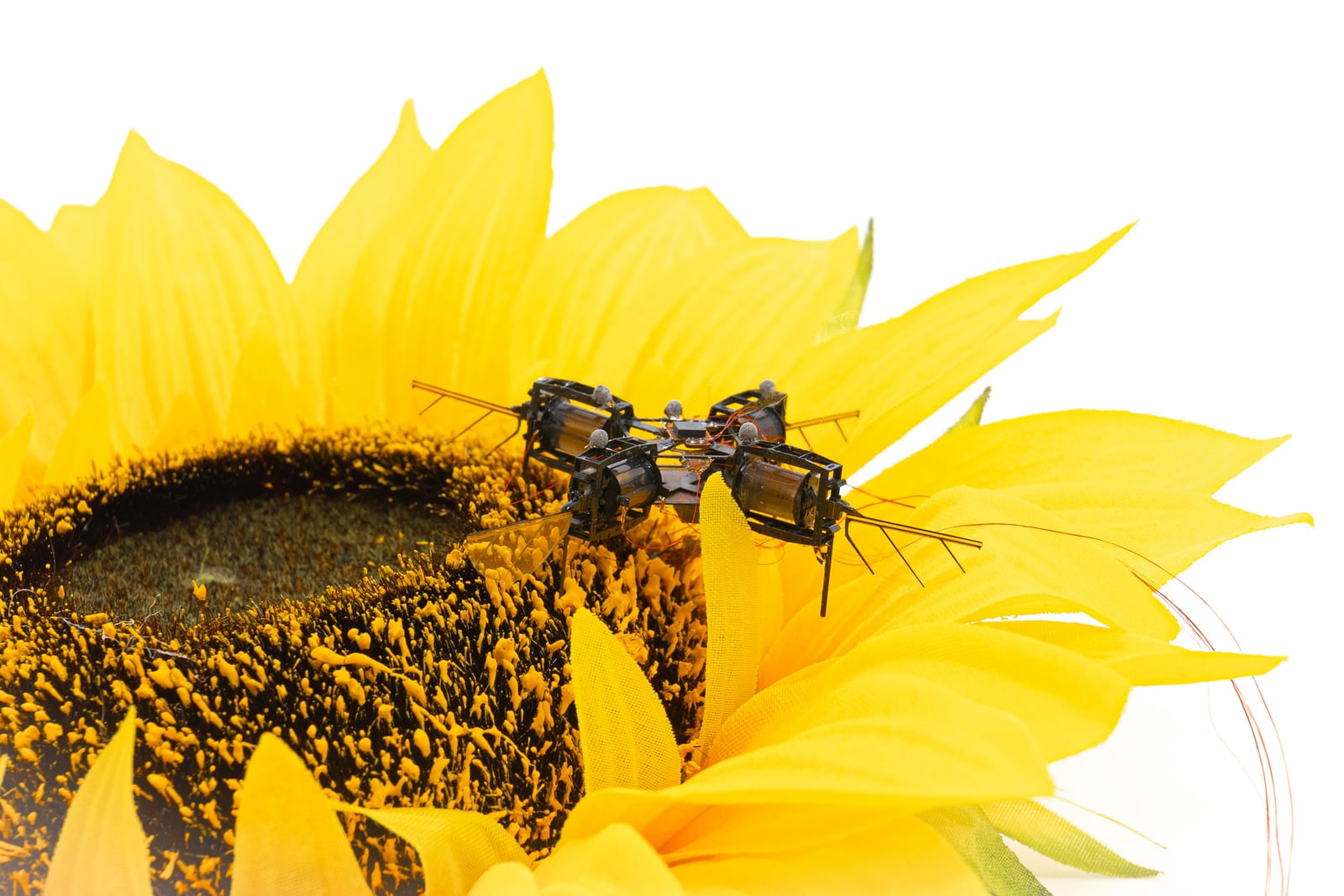 Photo: MIT
Read also on The Patent: None of 99 top US transit systems scores high on all access measures · XRP Ledger plans quantum-resistant accounts without a fee increase
Co-lead authors Yi-Hsuan (Nemo) Hsiao, Quang Phuc Kieu and Zhongtao Guan, all MIT graduate students, worked with co-corresponding authors Jonathan P. How of MIT's Laboratory for Information and Decision Systems and Elizabeth Farrell Helbling of Cornell University.
“This is the first demonstration of an aerial microrobot that is sensory and compute autonomous.”
— Kevin Chen, associate professor, MIT Department of Electrical Engineering and Computer Science
Bigger muscles, 46 percent more lift
The obstacle was weight. Adding a sensor suite and a microcontroller to a vehicle that already struggled to carry anything meant finding lift elsewhere. The team tuned the radius and length of the artificial muscles, making them 50 percent larger and raising the robot's net lift force by 46 percent.
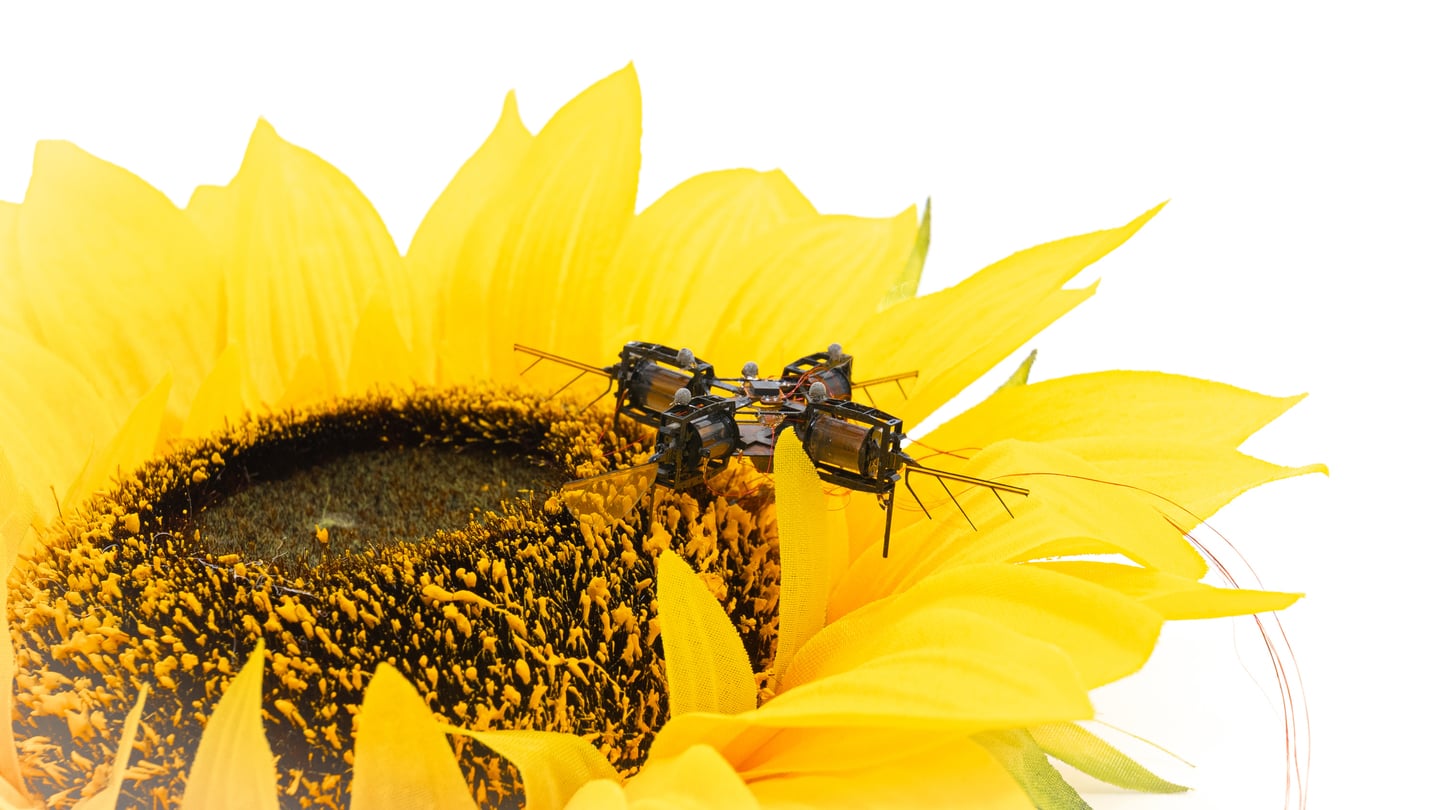 Photo: MIT
That margin was enough. The electronics package, containing the sensors and the microcontroller needed for onboard sensing and computation, weighs 244 milligrams, and the robot reaches a lift-to-weight ratio of 1.9, comfortably above the 1 needed to fly. A separate sensor suite estimates the robot's position and orientation in flight without any help from an external camera system.
Scaling up soft actuators is not automatic. Chen's group notes that enlarging them usually drags down the output power of the system, and with it the lift.
The cable that is still there
The robot is not wireless. It remains connected to an offboard power source, a limit the researchers state plainly in the paper. Autonomy, in this demonstration, covers sensing and computation, not energy.
The applications the MIT team sketches depend on getting free of that cable. Microrobots of this size could weave through a field of almond trees or blueberry bushes to pollinate blossoms in regions where habitat loss has cut natural pollinator populations, or hover close to plants without damaging them to monitor crop health and spot pests early. Industrial surveillance is the other case Chen names, where the space is too small for a larger machine.
The source of the funding and any commercial partner are not described in the paper announced by MIT.
An invention with no patent named in the paper
The Science Robotics paper sets out a device and a method: expanded artificial muscles that carry more payload, a sensor suite that fixes position without external tracking, and a miniature mount that holds the electronics on the moving vehicle. Those are the elements a patent application would have to claim, and the publication is the kind of disclosure that shapes what prior art exists from here.
MIT's announcement names no patent, no application and no licensing arrangement for this robot. The intellectual property position is therefore unknown from the sources: whether the university has filed, whether a spin-off is planned, and under what terms the technology could be transferred to industry.
What is documented is the invention and its authors, in a peer-reviewed journal, on 18 November 2026. Chen's own assessment of the work's future is conditional: "if this thread of technology becomes successful in the future, it could be very promising." The next step, by his account and the paper's, is proving the robot useful away from the lab bench, in a field or a factory, where the power cable becomes the remaining problem to solve.
AI-assisted article