Magnetic microbots tumble through blood vessels to dissolve clots faster
ETH Zurich files a patent application for microscopic rollers that clear arterial blockages in animal tests
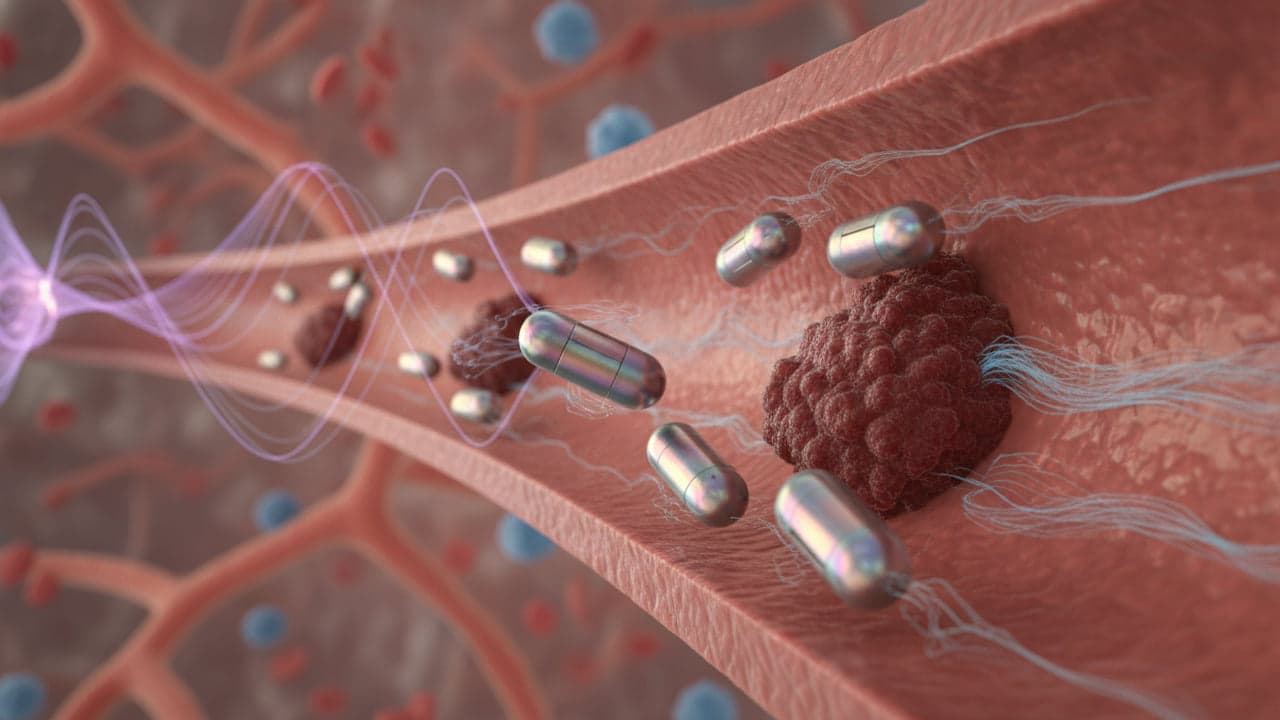
Engineers at ETH Zurich have developed magnetically driven microbots that roll along blood vessel walls to help clot-dissolving drugs reach arterial blockages. The university filed a patent application for the technology after laboratory and animal trials demonstrated that artificial flow speeds up clot breakdown.
Somersaulting through the vascular system
When a blood clot obstructs a vessel, blood flow stops. Because blood flow ceases, medications delivered through standard catheters cannot easily flush against the blockage. The drugs must rely on passive diffusion, a slow physical process that risks irreversible tissue damage in strokes, heart attacks or pulmonary embolisms. To overcome this transport barrier, a team led by Simone Schürle, professor of medical microsystems at ETH Zurich, built microscopic robots designed to create localized fluid currents, as reported by MedicalXpress.
Measuring around 8 micrometers long, each microbot matches the approximate dimensions of a human red blood cell. Shaped like an oblong cocoon, the devices consist of a biocompatible sugar polymer gel embedded with magnetic iron oxide nanoparticles. Rather than distributing these particles evenly, the team produced the bots inside a rotating magnetic field. This technique aligns the iron oxide particles along the longitudinal axis, creating an internal magnetic backbone that aligns like a compass needle.
“To our knowledge, we are the first to show in a clinically relevant large-animal model that the use of microrobots in this way does indeed enhance thrombolysis, i.e., the process of dissolving blood clots”
— Simone Schürle, professor of medical microsystems at ETH Zurich
Artificial currents double vessel clearance in live trials
To move the machines inside the body, physicians would inject the microbots alongside standard thrombolytic drugs using a catheter. An external magnetic control system applies a rotating field that forces the microbots into continuous forward rolls along the inner vessel wall. The movement resembles a gymnast performing handsprings. As the machines somersault forward, their motion churns the surrounding liquid and generates miniature currents that actively push medication straight into the thrombus.
Initial bench testing took place in a synthetic silicon vascular network using blood clots formed from pig blood. In those tests, medication delivered with the tumbling microbots cleared obstructions six times faster than medication acting on its own. Working alongside medical specialists at Charité University Hospital in Berlin, the ETH Zurich team evaluated the system in live pigs with blocked arteries. After 30 minutes of treatment, the cross-sectional area of the vessel restored to blood flow was twice as large in animals treated with the microbots compared to those treated with pharmaceuticals alone.
Patent filing and the path to clinical trials
ETH Zurich has submitted a patent application covering the robotic system and nominated the invention for its annual Spark Award, an internal prize honoring the university's most promising intellectual property filings. The underlying scientific paper is undergoing peer review.
Human clinical trials remain several steps away. The research team must first assess how the biocompatible gel and iron oxide particles behave over extended periods inside living tissue. Future work will also test the microbots in specialized disease models, including heart attack scenarios, before regulators can review the platform for use in emergency operating rooms.
Read also on The Patent: UT Southwestern designs versatile 3D microscope for live cell imaging · A 3D-printed robot moth grows UV sensors using its own artificial blood