BepiColombo X-ray telescope MIXS sees the Crab Nebula, sharper than in 2015
MIXS detected the Crab Nebula slightly more sharply than during ground tests, days before the ESA and JAXA spacecraft enters orbit around Mercury.
By Letizia Giugliano
3 min read
The X-ray telescope aboard BepiColombo has taken its first look at the sky, eight years and 10 billion kilometres after leaving Earth. The instrument, led from the University of Leicester, detected X-rays from the Crab Nebula with a resolution slightly better than in its laboratory tests in 2015. The observation came as the European Space Agency and Japan Aerospace Exploration Agency mission prepared to enter orbit around Mercury on November 21.
A view that opened only in September
The instrument is the Mercury Imaging X-ray Spectrometer, or MIXS, part of the payload of BepiColombo. For most of the cruise it had no clear line of sight to open space. That changed in September, when the Mercury Transfer Module separated from the two science orbiters, the Mercury Planetary Orbiter and the Mercury Magnetosphere Orbiter, also called Mio.
For its first target the team chose the Crab Nebula, a supernova remnant about 6,500 light-years from Earth whose X-ray output is strong and predictable. Between 11 and 12 September the spacecraft carried out 55 controlled changes of orientation over 39 hours to collect the data.
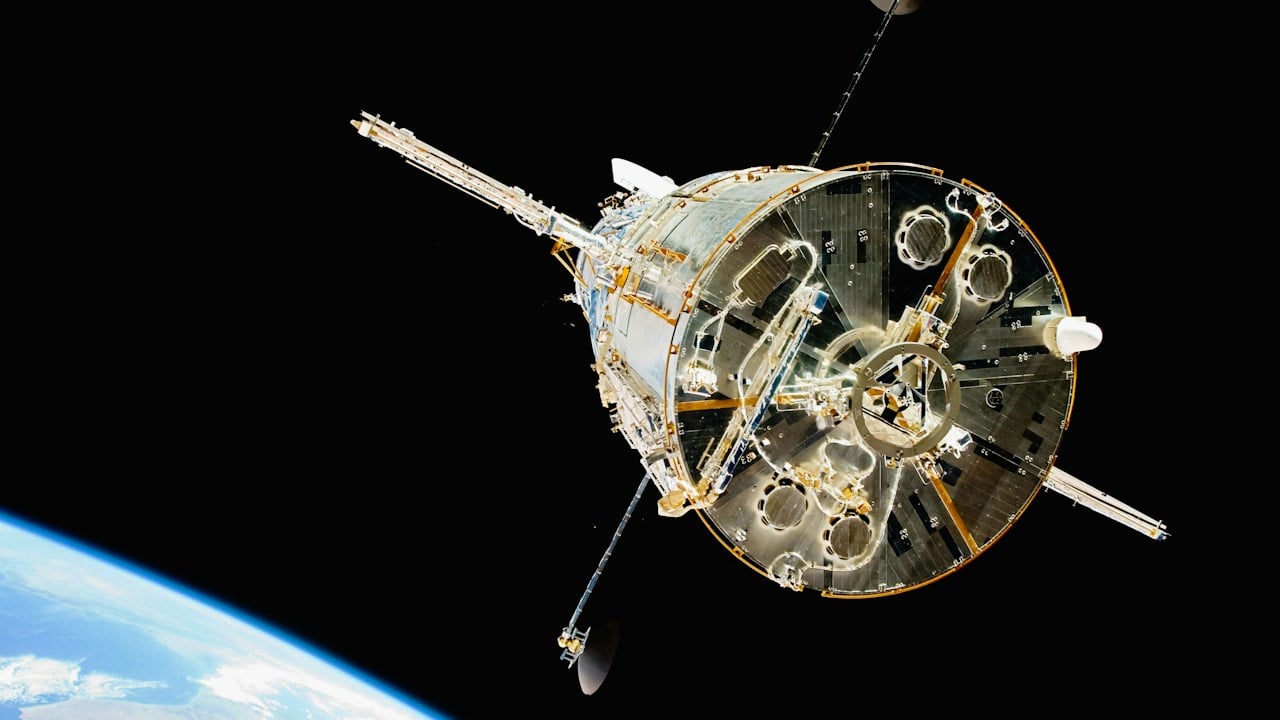 Photo: NASA Hubble Space Telescope / Unsplash
“80% of the technology on MIXS is new!”
— Emma Bunce, principal investigator for MIXS, University of Leicester
“Traveling a light-day is a singular feat for a spacecraft, but Voyager is so much more than a distant traveler.”
— Joe Westlake, director of the Heliophysics Division, NASA Headquarters
Sharper than the 2015 laboratory benchmark
Angular resolution measures how finely an instrument can separate detail. The Leicester team estimated it from the spread of the nebula's signal across the detector. MIXS came out slightly sharper than in its last laboratory calibration, carried out in 2015.
Read also on The Patent: Hera sends back its first close-up of the asteroid DART hit · A saloon-style desk turns an armchair into a workstation
Engineers also looked for the usual signs of wear. They found no stray light in the images, meaning no unwanted visible photons reached the detector. Galactic cosmic rays still appear, as they did during cruise, but the team says the signal is understood and can be removed in processing. Sunlight on the optic produces a small amount of self-fluorescence inside the instrument, which the team expects not to affect dayside observations of Mercury. The detector has suffered no radiation damage in eight years.
What MIXS will do at Mercury
At Mercury, MIXS will read the X-rays that the surface emits when particles and sunlight strike it, a technique that reveals which elements are present. Mercury is the smallest rocky planet in the solar system and one of the least explored. Mapping its chemistry is meant to help explain how it formed.
A largely new instrument, with no patent named
Emma Bunce, principal investigator for MIXS and director of the Institute for Space at the University of Leicester, said the instrument is largely new. "80% of the technology on MIXS is new!" she said, crediting the engineering team and international partners who built it over many years.
The releases describing the observation name no patent, patent application or licence covering MIXS. What they document is a novel instrument that has now passed a space qualification test: its optics survived launch and eight years of cruise, and its detector came through without radiation damage. Some effects are still under study, and the team plans optimisation during the Mercury commissioning phase.
Voyager 1 puts the distance in perspective
On 18 November 2026 at 2:16 a.m. PST, NASA's Voyager 1 became the first spacecraft to reach a distance of one light-day from Earth, about 16.1 billion miles (25.9 billion kilometres). A signal now takes 24 hours to arrive, so a command and its reply span two days.
The probe has not returned science or engineering data since 14 November, though it still transmits a carrier signal. Engineers at the Jet Propulsion Laboratory in Southern California used that signal and the spacecraft's trajectory to confirm the milestone. Voyager 1 and Voyager 2 were launched in 1977; both are now in interstellar space.
AI-assisted article