Hera sends back its first close-up of the asteroid DART hit
ESA's spacecraft, 196.8 million km from Earth, photographed Didymos from a side never seen in detail and will now look for debris thrown across the 1 km gap from Dimorphos
By Letizia Giugliano
3 min read
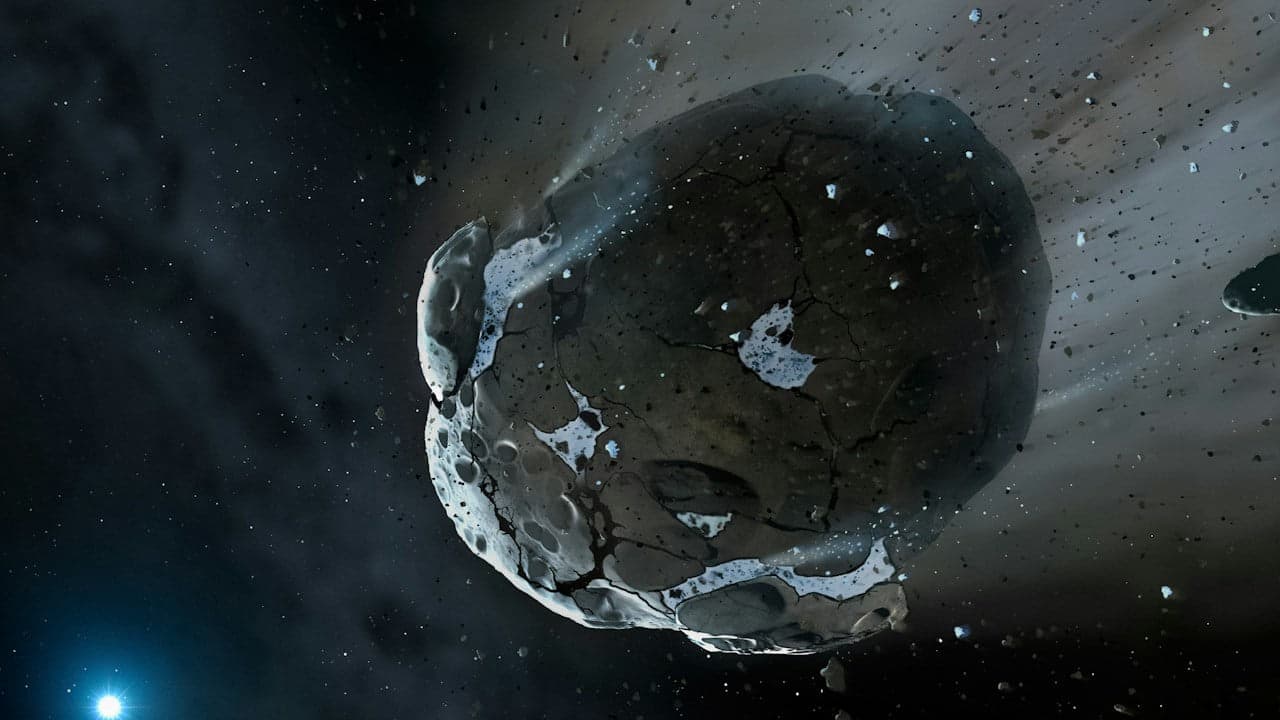
The European Space Agency's Hera spacecraft has returned its first close-up image of the Didymos binary asteroid system, the site of NASA's 2022 asteroid deflection test. The picture shows the larger asteroid, Didymos, from a side that DART's camera never saw before it struck the smaller Dimorphos. Hera's job now is to work out what the collision did, so that hitting an asteroid can become a technique planners can rely on.
A ridge, boulders and grooves on the side DART never photographed
Hera took the image with its monochrome Asteroid Framing Camera, which records in black and white, according to the European Space Agency's release via ScienceDaily. The larger body, Didymos, is 780 m across and fills the frame; the smaller Dimorphos, 151 m across, sits mostly in shadow. The camera's caption puts the shooting distance at 600 km, while the article text gives 60 km.
What scientists saw was unfamiliar ground. "This is the other side of Didymos from the one that DART's camera showed us shortly before impact, so this feels like looking at a whole new world," said Patrick Michel, Hera's principal investigator and a director of research at CNRS / Observatoire de la Côte d'Azur. The equatorial ridge seen in earlier images is still there, he said, but the rest of the surface carries boulders, craters and what look like grooves or ridges.
Read also on The Patent: Hubble Detects 93-Billion-Mile Cat's Tail From Colliding Worlds · Cornell chip cools trapped ions to quantum ground state in 150 microseconds
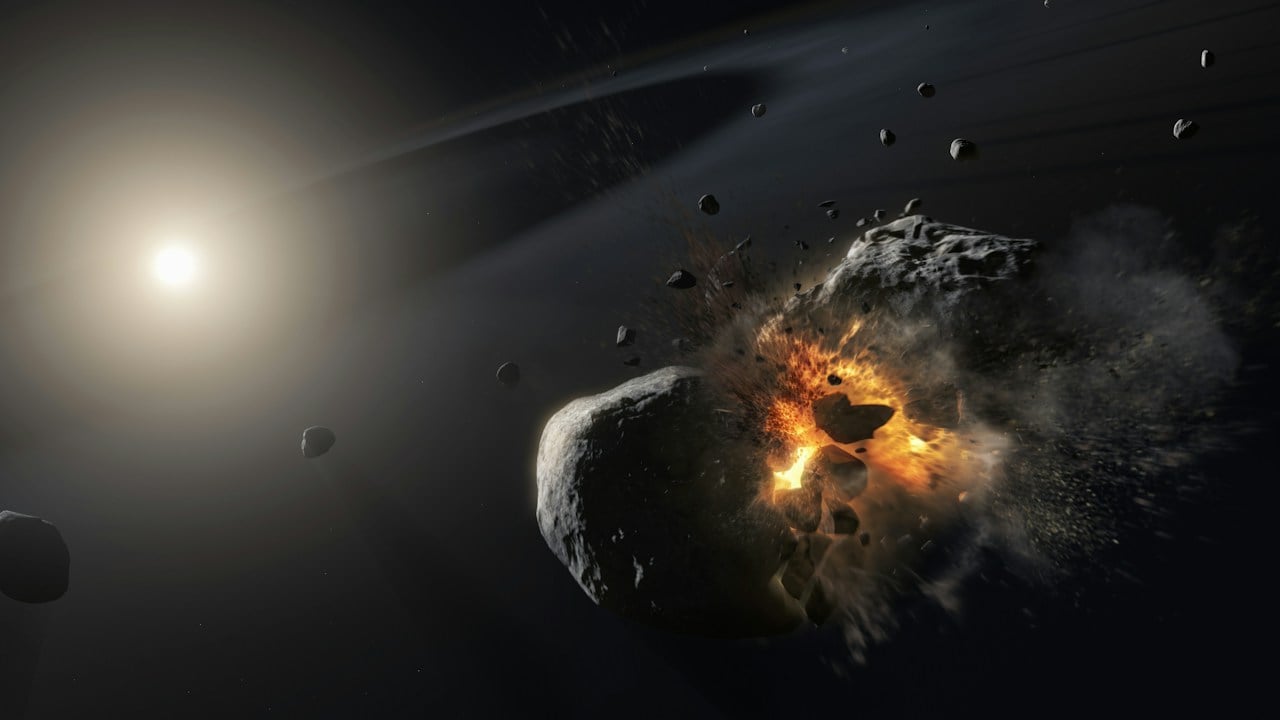 Photo: NASA Hubble Space Telescope / Unsplash
“The first thing we said was wow!”
— Patrick Michel, Hera principal investigator, CNRS / Observatoire de la Côte d'Azur
“It may be that some of these characteristics originate from this transport of material, and we have exciting work ahead of us to sort it out.”
— Michael Kueppers, ESA Hera mission scientist
DART shortened an orbit by about 33 minutes
On 26 September 2022, NASA flew its 580 kg DART spacecraft into Dimorphos at roughly 6.1 km/s. The hit cut the time Dimorphos needs to circle Didymos by about 33 minutes, give or take a minute, a change larger than the mission team had expected, the ESA release reports. Dimorphos became the first object in the Solar System whose orbit humans measurably changed.
That result is the whole point of the experiment: a spacecraft is heavy enough, and fast enough, to nudge a body off a threatening path. The approach has a name, kinetic impact deflection, and the DART shot remains its only full-scale demonstration.
Did the debris cross the one kilometre of space?
Between the two asteroids there is roughly 1 km of vacuum. When DART hit, it threw material outward, and some of it may have landed on Didymos. "It may be that some of these characteristics originate from this transport of material, and we have exciting work ahead of us to sort it out," said Michael Kueppers, ESA's Hera mission scientist, in the same release.
Hera's task is a crash-site investigation: map both bodies, compare the new surfaces with the pre-impact record, and establish which features were already there. Without that baseline, a deflection campaign in a real emergency would be a single data point rather than a method.
No patent in sight, but a technique that has to be repeatable
Neither agency's material mentions a patent or a patent application covering the deflection method, and none should be assumed: DART and Hera are publicly funded missions whose results are published. The intellectual property here sits less in a device than in the trajectory models, targeting software and impact physics that make a second attempt predictable.
Hera is the mission that tests whether the first shot was luck or engineering. Its measurements of mass, shape and surface properties feed the models that a future deflection decision would rest on. For the planetary defence community, that is the transferable asset, and it is being built in the open.
Both asteroids in detail on 25 November
Hera reached the Didymos system after a two-year journey, ESA says. "It has taken years of hard work and dedication to reach this point, but we're motivated to know that the adventure is only beginning," said Hera mission manager Ian Carnelli.
The next public milestone is 25 November, when the mission plans to release detailed images of Didymos and Dimorphos together, the first close look at the crater DART left behind.
AI-assisted article