Hubble Detects 93-Billion-Mile Cat's Tail From Colliding Worlds
Visible-light images from NASA's space telescope reveal porous carbon dust produced by planetary collisions in Beta Pictoris.
By Letizia Giugliano
3 min readWritten with AI support · Reviewed and approved by: Giovanni Sapere
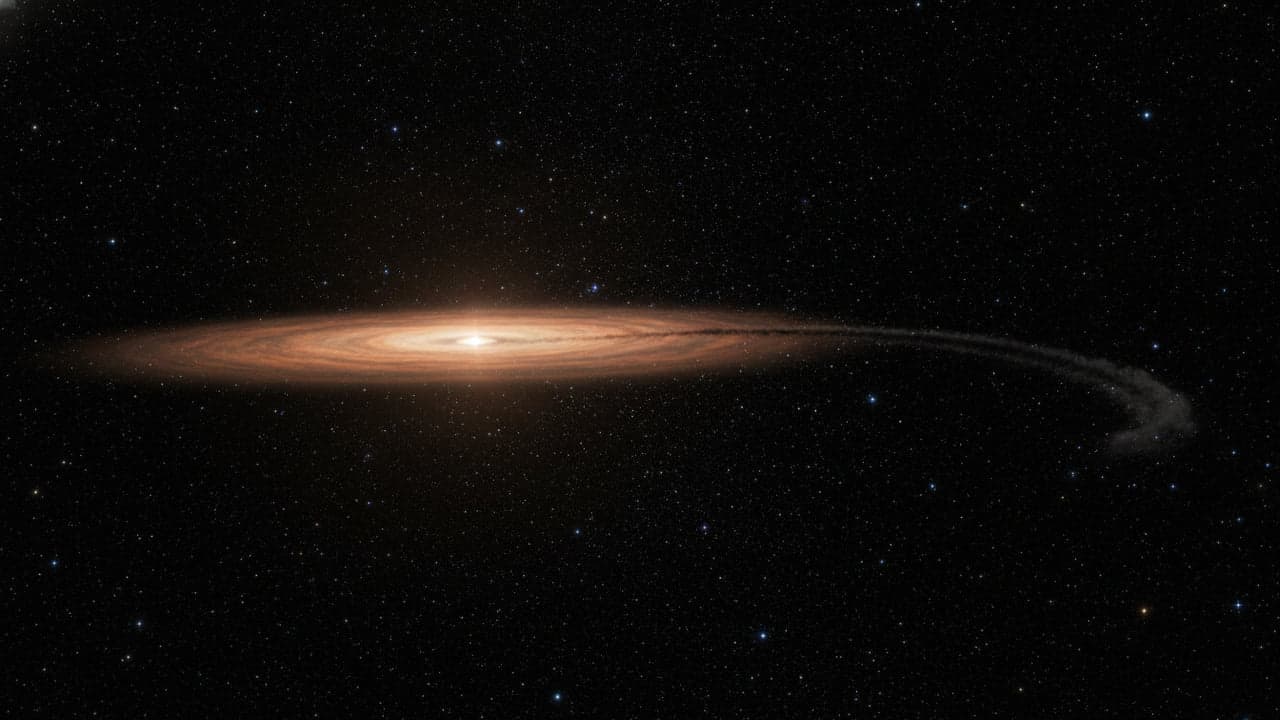
Astronomers led by Arin Avsar at the University of Arizona have captured visible light from the Cat's Tail, an enormous debris cloud stretching 93 billion miles across space in the young star system Beta Pictoris. Combining fresh observations from NASA's Hubble Space Telescope with 14 years of archival data, the team determined that the structure likely formed when two Pluto-sized worlds smashed into each other. The discovery, published in The Astrophysical Journal Letters, provides rare physical evidence of how planets take shape through violent impacts.
Tracking dark debris 63 light-years away
The Beta Pictoris system, located 63 light-years from Earth in the constellation Pictor, offers researchers a window into the messy early stages of planet formation. Our own solar system experienced similar turmoil 4.6 billion years ago before rocky debris settled into planets and asteroid belts. Beta Pictoris remains surrounded by a massive disk of gas and dust that indicates planet-building collisions are still actively taking place.
Two years ago, observations from the James Webb Space Telescope first revealed a curved trail extending out from the primary disk, prompting astronomers to name it the Cat's Tail. That infrared instrument easily detected heat from the cloud, but the structure remained completely invisible at shorter visible wavelengths. The discrepancy puzzled researchers until visible-light analysis from Hubble cleared up the mystery, as detailed in the University of Arizona study reported by ScienceDaily.
“The Cat's Tail is thought to be the aftermath of a collision between large bodies - think something like Pluto”
— Arin Avsar, planetary scientist at the University of Arizona
Fluffy particles from Pluto-sized collisions
By analyzing 14 years of Hubble data, doctoral student Arin Avsar and astronomers Daniel Apai and Kevin Wagner determined why the formation avoided optical detection for so long. The Cat's Tail consists almost entirely of dark organic refractory material, made of long carbon chains that absorb visible light rather than reflecting it back toward observers.
The physical characteristics of the dust proved equally surprising. Individual grains measure about one micron across, roughly one-millionth of a meter, yet they are extremely porous and fluffy instead of dense and solid. Across its entire length, the structure spans roughly 1,000 astronomical units, or 93 billion miles, an expanse equivalent to lining up 200 trillion house cats.
Co-author Kevin Wagner, a NASA Sagan Postdoctoral Fellow at the University of Arizona, noted that the impact velocities were likely high enough to vaporize solid carbon into gas. As that vapor cooled, it recondensed into delicate, highly porous flakes.
Planetary discoveries and patent protection
Hardware developed to survey deep space often relies on patented technology, from high-precision optical sensors to specialized satellite instrumentation protected by an individual patent or commercial filing. By contrast, the astronomical findings derived from these tools remain in the public domain as scientific discoveries. Celestial structures and the physical laws governing them cannot be claimed through a patent application or private intellectual property filing.
The observations confirm that young planetary systems generate large amounts of carbon-rich debris through cataclysmic impacts. Astronomers will continue to monitor the Beta Pictoris disk to observe how stellar radiation pushes these tiny dust grains away from the parent star over time.
Read also on The Patent: Dinosaur Blood Molecules Identified in 115-Million-Year-Old Fossil · Federal Circuit overturns 9.1 million dollar fee award against ChromaDex
An article by the newsroom of The Patent ®, written with the support of artificial intelligence from sources chosen by the newsroom. Review, corrections and approval for publication: Giovanni Sapere. Publisher responsible: WitUp Ltd.