Rotterdam's outdoor gym is 3D-printed from 480 kg of recycled plastic
The New Raw built Gym Elements, a set of yellow public fitness objects for the City of Rotterdam, along a five-kilometre walking and running route called Yellow Carpet.
By Letizia Giugliano
3 min read
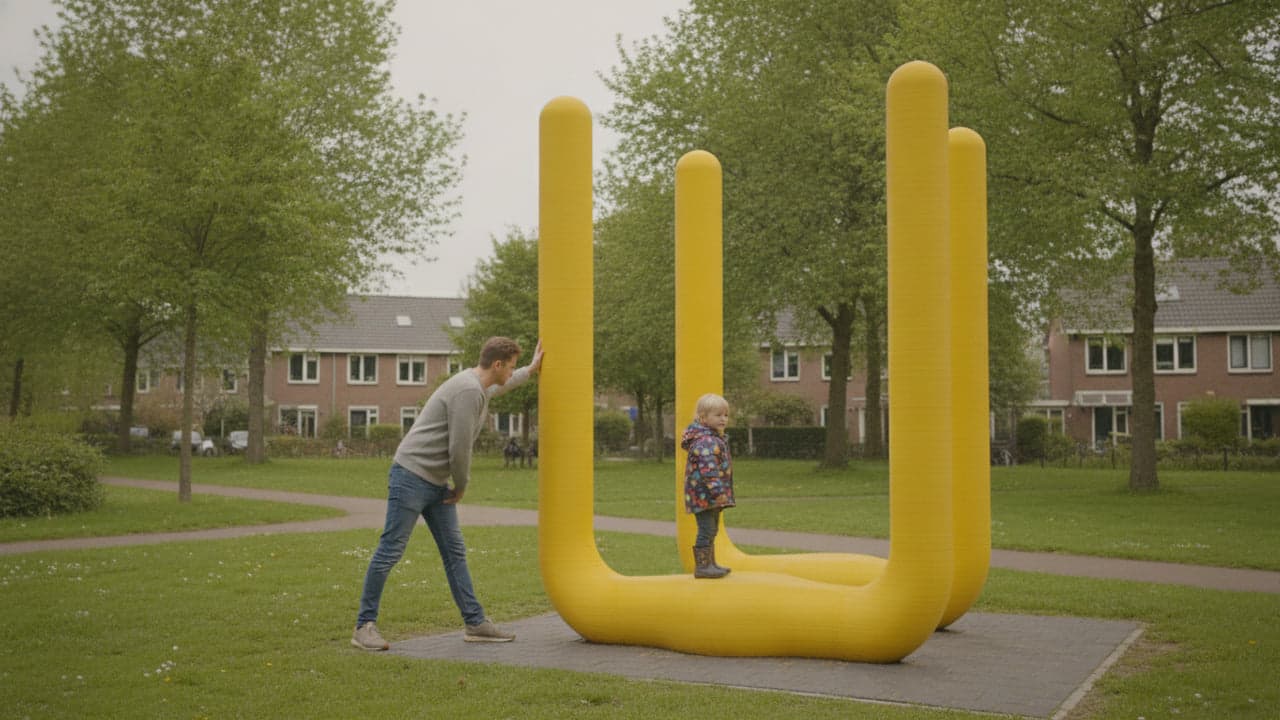
An outdoor gym now stands in Rotterdam with none of the usual chrome and rubber. The New Raw, a design studio based in the city, made the pieces from recycled polypropylene, using 480 kilograms of recycled material for the project. The invention was commissioned by the City of Rotterdam and developed with Urban Ideals and Humankind, and the objects are meant to stay in public space permanently.
Yellow curves instead of chrome handles
The collection is called Gym Elements, and it treats fitness equipment as street furniture. Broad yellow surfaces fold into upright supports and stepped platforms, with generous curves that wrap around the corners. Lines from the printing process stay visible on the surfaces, and larger ribs give the pieces what the studio's own presentation describes as an almost upholstered look.
The shapes are meant to lower the barrier for people who find a gym intimidating. The project photographs show one person stretching with both palms against an upright element and a child standing on a raised platform: deliberate exercise and play on the same vocabulary.
Read also on The Patent: China's J-35 engineers 3D-print a 16.4-foot fuselage structure · São Paulo's streams lose 190 food-web links, down to three
The New Raw's published material describes no patent application or registered design for Gym Elements. What the studio does set out is a production method: single-material construction, no adhesives and no coatings, so the pieces can be repaired and reprocessed. That method, rather than a filing, is the protectable asset the studio presents.
480 kilograms of recycled polypropylene
The material is the second half of the story. The studio reports 480 kilograms (about 1,058 pounds) of recycled polypropylene in the project, and it does not disguise it as timber or polish it into anonymity. The texture is left as it comes out of the printer.
The New Raw also says it reuses misprints and production leftovers, which matters for the sustainability claim: a recycled object only closes a loop if there is a route back for the material when the object's working life ends. The studio's own approach is to keep the plastic in a single material stream so it can be reprocessed rather than landfilled.
Five kilometres of stations, not one gym entrance
Location carries part of the design. Gym Elements was developed for Yellow Carpet, an initiative that links existing and new outdoor fitness facilities along a walking and running route of five kilometres, roughly 3.1 miles. Instead of gathering every machine behind one entrance, the stations sit along a neighbourhood loop, so someone can stretch for a few minutes in the middle of a walk or while spending time in a park.
The pieces are installed objects, intended as permanent additions to public space rather than a temporary exhibition. The studio says it hopes the approach can be adapted to other public spaces.
Dust in the printed layers and colours that fade
Public infrastructure carries duties that photographs do not show. The studio's maintenance guidance acknowledges that layered printed surfaces can collect dust and particles, and that outdoor colours may fade over time even with UV stabilizers in the material. Regular cleaning stays part of the arrangement.
The recycling case has a similar practical edge. Recycled content, or a recyclable design, does not by itself return anything to a processor: someone has to collect and handle the object at the end of its life. The studio's single-material choice makes that step easier, but the collection route is not part of the published project.
What to watch
Gym Elements is in place in Rotterdam as a commissioned installation, and the next question is whether the format travels. The studio frames the collection as a template for other public spaces, with the same printed surfaces and the same single-material logic. For anyone watching the intellectual-property side, that is the point to follow: whether a studio that presents an open production method files on the shapes, on the printing process, or on neither.
AI-assisted article