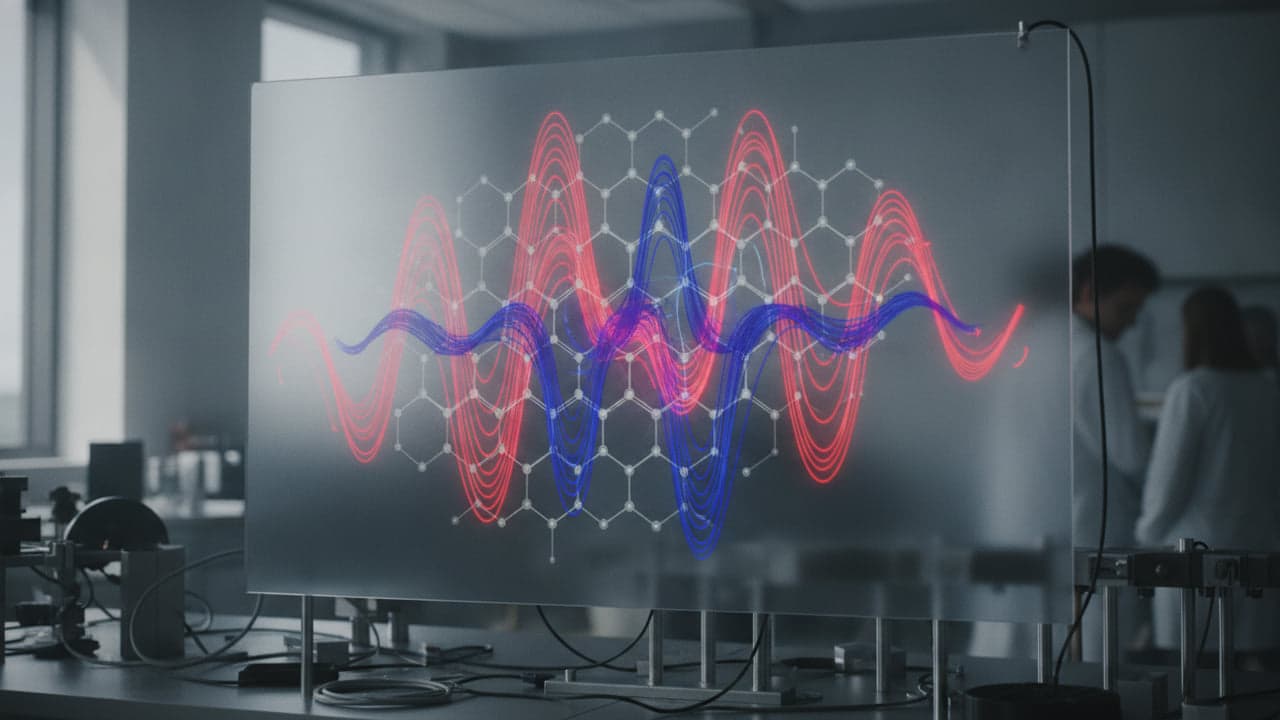
A TU Wien switch with four states instead of two
Researchers in Vienna used gadolinium manganese oxide to build a switch with four polarization states and several routes between them, then found a small electric pulse can steer the material at a halfway point.
By Giovanni Sapere
3 min read
Physicists at TU Wien have built a tiny switch that holds four electrical states rather than the usual two, and they can move it from one state to another through an unstable intermediate point. The material is a gadolinium manganese oxide in which electrical and magnetic effects are coupled, the university reports. The work is published in Communications Materials, and the group says it is already testing the device for processing several bits at once.
Four states, and more than one way to reach them
Most switches in electronics do one thing: they conduct or they block, they hold a zero or a one. The device at the Institute of Solid State Physics at TU Wien does not work that way. It is made from a material of gadolinium, manganese and oxygen, written GdMn2O5, that can take on four distinct polarization states, according to the university's release on Phys.org.
Polarization here means the way electric charges inside the material line up. Apply a voltage and the charges point one way or another, as Andrei Pimenov of the institute puts it: "Many materials change their electrical polarization when you apply a voltage." What is unusual in this compound is that certain symmetries normally respected in other materials are broken, which leaves room for four arrangements instead of two. The paper, credited to M. Ryzhkov and colleagues, appears in Communications Materials under the title "Highly controllable switching pathways in multiferroic GdMn2O5".
Read also on The Patent: Cornell chip cools trapped ions to quantum ground state in 150 microseconds · Ames Laboratory controls magnetic wave handedness for quantum computing
 Photo: Lucas Dalamarta / Unsplash
“We discovered that as the material's electrical state changes, it reaches a particularly interesting point halfway to another state”
— Andrei Pimenov, Institute of Solid State Physics, TU Wien
“We're already working on using it to process several bits”
— Andrei Pimenov, TU Wien
A crossroads halfway between two states
Control was the hard part. For a long time the four states looked reachable only in a fixed sequence, the way a four-stroke engine repeats the same four strokes and no other order. The Vienna team found a way around that. As the material moves from one state toward another, it passes through an unstable intermediate point that behaves like a junction in the energy landscape.
"We discovered that as the material's electrical state changes, it reaches a particularly interesting point halfway to another state," Pimenov says. From that point a small nudge, delivered as an electric pulse, is enough to send the material into whichever state the operator wants. The intermediate point is not stable, so the choice has to be made while the material is there, but the energy needed is small.
Why magnetism and electricity in one material matter
Magnetic moments are the usual carrier of stored data, while processing relies on electric charge, and in most devices the two live in separate components. In this oxide they are coupled, and that coupling is what gives the researchers a handle on four states rather than two. Pimenov's group has spent years studying how magnetic and electrical effects interact in solids.
"We usually think about magnetic and electrical phenomena separately," he says. "In this material, the two are coupled." The practical consequence is a single small element that could both hold and manipulate information, which is where the innovation claim of the paper sits: not a faster version of an existing transistor, but a different set of physical states to encode data in.
Several bits, and no patent application in sight
The next target is density. "We're already working on using it to process several bits," Pimenov says, which would mean one switch carrying more information than a binary device of the same size. The work was published on 16 November 2026 in Communications Materials, DOI 10.1038/s43246-026-01166-1, and the release was distributed by Vienna University of Technology.
Nothing in that release describes a patent application, a granted right or a licensing deal around the four-state switch. The invention is documented so far as a peer-reviewed result in a materials physics journal: a laboratory device, measured and modelled, with the multi-bit version still under development. Readers watching the intellectual property side will have to wait for a filing to appear before any claim scope can be read.
AI-assisted article