A dental retainer that turns tongue taps into computer commands
TeethMark, built at Aarhus University, combines capacitive sensing with electrical pulses the tongue can feel, and it is still an experimental prototype
By Letizia Giugliano
3 min read
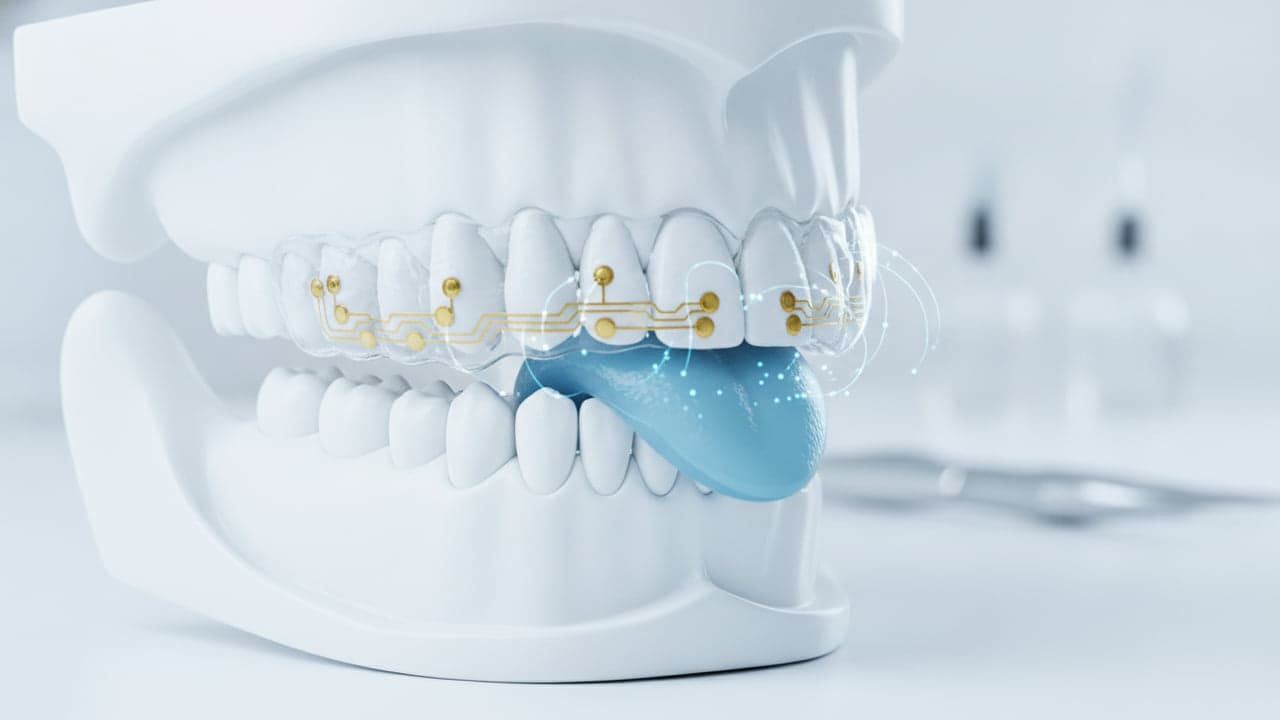
Researchers at Aarhus University have built TeethMark, a transparent dental retainer with electrodes that reads tongue movements and uses them to control electronic devices. The brace recognises taps on single teeth, slides across several teeth and simultaneous contacts, and it can send small electrical pulses back to the tongue. The work, reported by Hackster.io, is a laboratory prototype: the source names no patent application, no commercial partner and no product launch.
A four-layer circuit hidden in a dental brace
The device looks like a clear orthodontic retainer. Inside the custom-made brace sits a flexible printed circuit board carrying electrodes that register tongue position through capacitive sensing, the same principle used in phone touchscreens, where a finger changes an electric field Hackster.io.
An ESP32 microcontroller handles the sensing and drives the stimulation circuitry. A MOSFET driver produces the stimulation signals, and a relay switches the board between sensing and feedback so the two jobs do not interfere. The four-layer flexible board also carries shielding to keep the readings reliable.
Read also on The Patent: Columbia Chemists Upgrade stroboSCAT Microscope to Track Single Quantum Particles · Electric comb delivers genetic molecules to reverse hair loss in mice
Fitting different mouths was part of the engineering. The team wrote a design tool that places electrodes using a 3D model of the user's teeth, and the resulting circuit is bonded to a brace made from biocompatible dental resin, with only gold-plated electrodes left exposed.
Three gestures, and a pulse the tongue can feel
TeethMark separates three kinds of input: tapping an individual tooth, sliding the tongue across several teeth, and touching several teeth at once. The tongue is well suited to the task because it moves fast, lands precisely on individual teeth and does not need visual guidance to find them, the researchers note Hackster.io.
Feedback runs the other way too. Electrodes on the inner surfaces of the teeth deliver small electrical pulses that the tongue feels, a technique called electrotactile feedback. A second set of electrodes on the outer surfaces stimulates the inside of the lips, so a notification can arrive without the user moving the tongue at all.
What 12 participants achieved after a short training session
The team tested the system with 12 volunteers, each given a brief training session first. Recognition reached 82.92% for tapping a single tooth, 92.78% for touching several teeth together and 94.92% for sliding. Participants identified the direction of the electrotactile feedback correctly 99.17% of the time Hackster.io.
The gap between tapping and sliding is the number to watch: single-tooth contact was the least reliable gesture in the trial, while the moving gesture and the feedback channel came close to error-free.
Pronunciation practice, virtual reality and a hands-free UV lamp
Beyond cursor control, the researchers demonstrated several uses. TeethMark can track where the tongue sits during speech, which could give language learners feedback on pronunciation. It can add unusual tactile sensations in virtual reality. It can support tongue rehabilitation exercises, where the device would sit close to a clinical setting.
One demonstration wired tongue gestures to a UV curing light, so a technician can keep both hands on the work while switching the lamp on and off Hackster.io.
Telling a deliberate tap from a swallow
The obstacle is context. TeethMark has no reliable way yet to separate an intended gesture from ordinary tongue activity during speaking or swallowing, which the team lists as work still to be done before everyday use makes sense. The version tested is an experimental prototype, not a finished product.
Nothing in the report points to a filed patent or a granted right covering the design. What exists is a working bench system, a set of measured accuracies and a list of applications. The next step the source describes is further development, with no date attached.
AI-assisted article