São Paulo's streams lose 190 food-web links, down to three
Researchers found the collapse already under way in micro-watersheds with only 12.5% urban cover, and traced it to the reservoirs that supply more than 22 million people
By Letizia Giugliano
4 min read
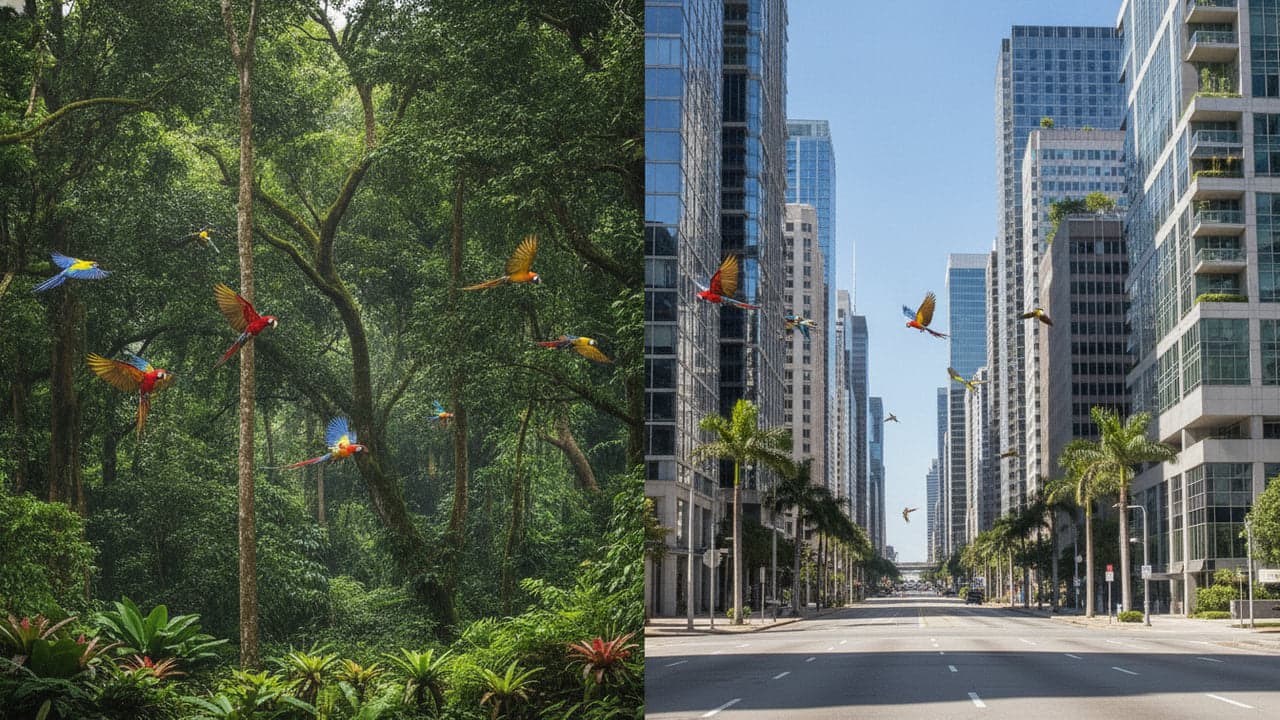
Urbanization is dismantling the food webs of the streams that feed São Paulo's reservoirs. In the most built-up micro-watersheds of the Upper Tietê region, a study counted three feeding links where fully forested streams have 190, and energy flow fell by a factor of 1,446. The work, led by researchers at UFSCar and USP, appeared in Nature Cities and was reported by Phys.org on 14 November 2026.
Thirty micro-watersheds, from Atlantic Forest to concrete
The comparison rests on field sampling in headwater streams, the small waterways that feed larger rivers, across 30 micro-watersheds in the Upper Tietê region. The sites were chosen to represent every stage of urbanization, from areas entirely covered by Atlantic Forest to fully built-up land (Phys.org).
Victor Saito, a professor in the Department of Environmental Sciences at the Federal University of São Carlos (UFSCar), and Luis Schiesari, a professor of environmental management at the University of São Paulo (USP), led the team. Both are affiliated with the Center for Research on Biodiversity Dynamics and Climate Change (CBioClima), a Research, Innovation and Dissemination Center. The findings were distributed by FAPESP and published by Phys.org on 14 November 2026 (Phys.org).
Read also on The Patent: Sticky marine snow carries six times more carbon to the ocean floor · UNSW researchers track persistent chemicals in farmland sewage fertilizer
The researchers collected fish and invertebrates, rebuilt the food web at each site from the animals' body sizes and feeding preferences, and estimated the energy passing from prey to predator. What the paper reports is a peer-reviewed method and its results in Nature Cities, not a patented device, a startup spin-off or an invention protected by a patent: the new element is the combination of size data, food-web reconstruction and energy-flow estimates applied to 30 real watersheds.
“The complexity of the food webs plummeted from 190 estimated interactions in fully forested microbasins to just three in fully urbanized areas.”
— Luis Schiesari, professor of environmental management, University of São Paulo
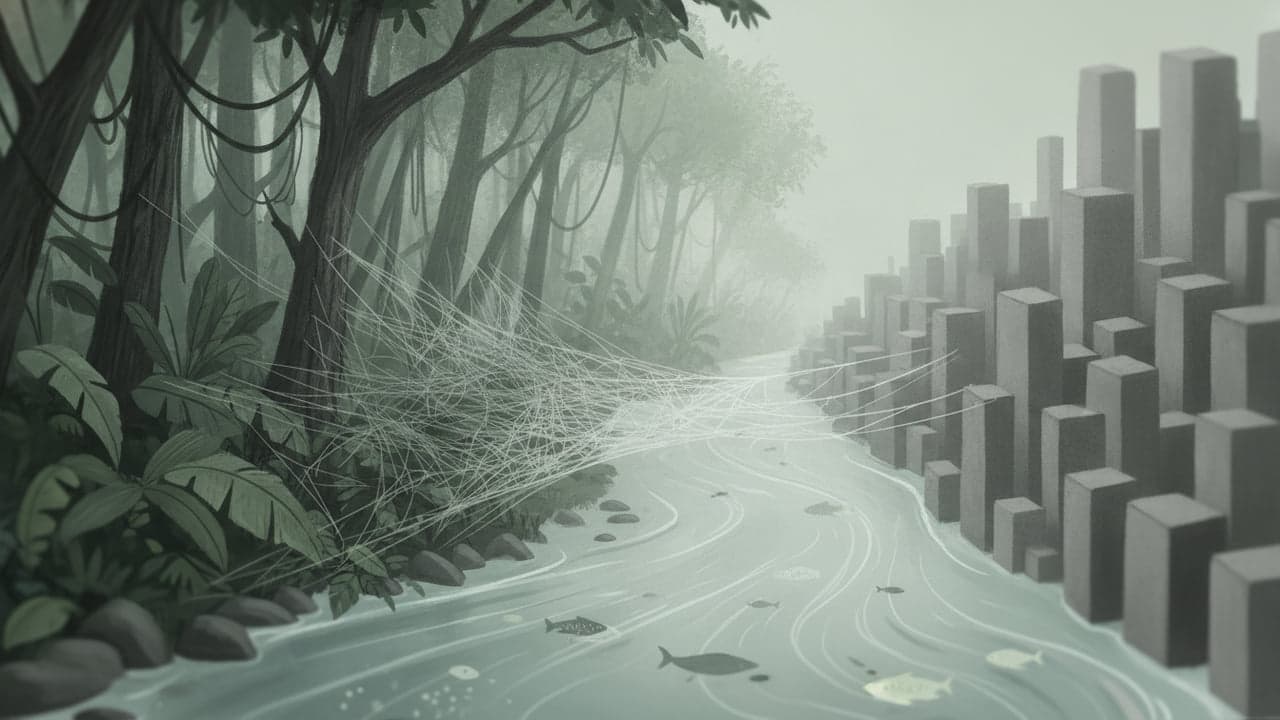
“We can imagine a food web as a mesh: the more threads and connections it has, the more complex the possibilities of energy transfer.”
— Victor Saito, professor of environmental sciences, Federal University of São Carlos
Who survives the city depends on body size
Species loss in these streams is not random. Urban sites kept the small organisms and lost the very small, the medium-sized and the large ones (Phys.org). Because body size sets what an animal eats and what eats it, removing whole size classes cuts the number of possible feeding links faster than a simple count of species would suggest.
Schiesari gave the figures: the complexity of the food webs fell from 190 estimated interactions in fully forested micro-watersheds to three in fully urbanized ones (Phys.org). The damage also arrives early. The collapse was already visible in micro-watersheds with only 12.5% urban coverage and substantial forest cover, so degradation tracks the first stages of human occupation rather than the finished city.
A thinner web carries pollutants toward the tap
Food webs are the routes along which energy and carbon move through a stream. With fewer connections, matter travels faster and is deposited, partly unprocessed, at the lowest points of the terrain (Phys.org). Those low points are where the region's supply reservoirs sit, including the Billings Reservoir, which receives water from several of the sampled micro-watersheds.
The team estimated a 1,446-fold reduction in energy flow in the most affected streams compared with forested ones; the release describes the flow of energy in these ecosystems as reduced by more than a thousandfold (Phys.org). The stake is water for more than 22 million residents of the São Paulo Metropolitan Area. That ties biodiversity loss to the sustainability of the public supply, since a stream that stops breaking down organic matter and toxic pollutants passes them on to larger systems.
"When a stream stops processing organic matter and pollutants, those substances flow freely into larger systems," Saito said (Phys.org).
Streams as ecosystems, not drainage channels
The authors argue that the result goes beyond species counts. Their case is that measuring biodiversity, body size, food-web structure and energy and carbon flux together shows a stream changing at several levels of ecological organization at once (Phys.org). They ask that streams be treated as complete ecosystems rather than as waterways embedded in the urban grid, and that keeping them in good environmental condition be a priority.
Saito's image for the process is a mesh: "the more threads and connections it has, the more complex the possibilities of energy transfer," he told the UFSCar news portal. Fewer threads, less transfer. The study appeared in Nature Cities in August; the Phys.org article is dated 14 November 2026 (Phys.org). For patent news and intellectual property coverage, The Patent® magazine follows such research, even when no patent or startup spin-off results.
AI-assisted article