Quantum skyrmions on a chip survive after photon entanglement breaks down
Researchers at the University of Pennsylvania show that topological patterns in light persist across quantum networks despite environmental noise.
By Letizia Giugliano
2 min readHuman-Edited, AI-Assisted

Physicists at the University of Pennsylvania have demonstrated that topological patterns encoded in light can persist even after the quantum entanglement linking two photons breaks apart. The finding addresses one of the fundamental vulnerabilities of optical quantum networks, where environmental noise routinely destroys sensitive quantum links. By using an integrated silicon nitride circuit, the team showed that mathematical topology offers a resilient way to protect quantum states.
A photonic chip builds light with a twist
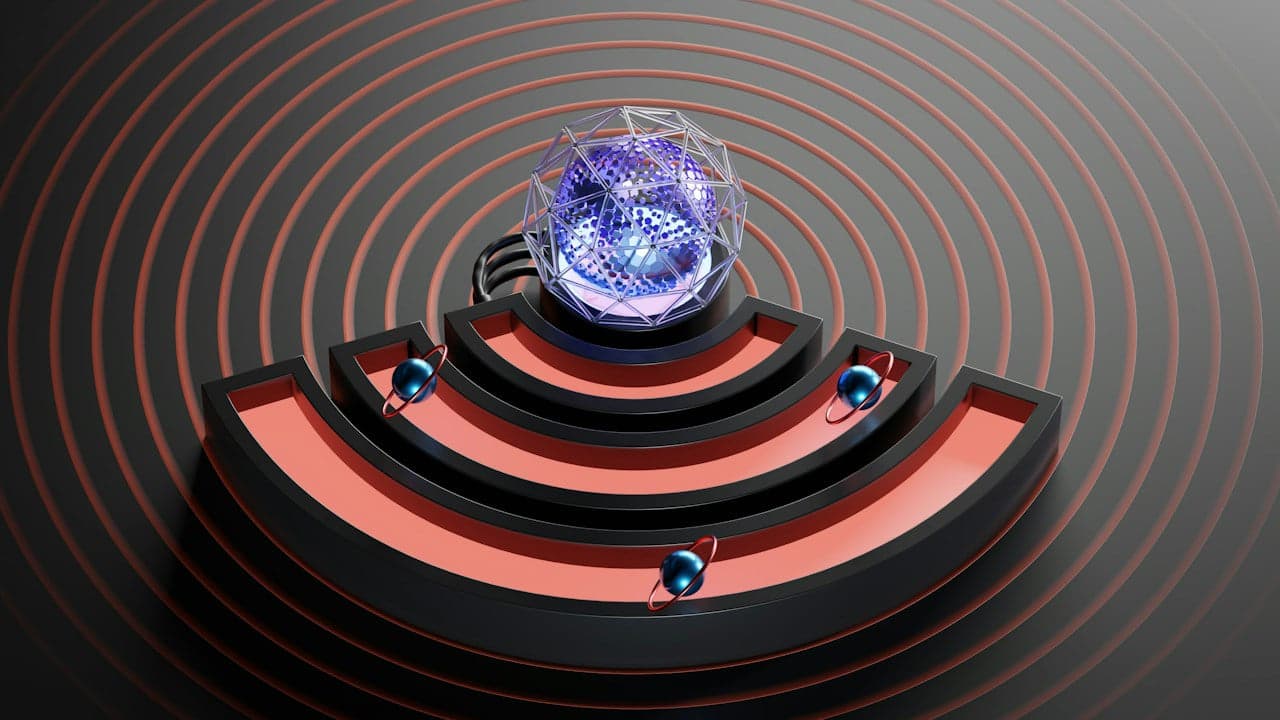
Connecting quantum hardware across long distances requires sending photons through fiber or open air, but stray thermal noise or scattering typically collapses quantum bonds. To test a sturdier mechanism, researchers spent nearly five years engineering a photonic device at the Singh Center for Nanotechnology at the University of Pennsylvania, as reported by Interesting Engineering. This microscopic silicon nitride chip functions as a complete optical circuit designed to generate, steer and manipulate quantum light in a single platform, representing a technical innovation in integrated optics.
“It’s as if one dancer’s unique movement suddenly became part of a duet, and persisted even when the dancers were separated,”
— Liang Feng, professor in materials science and engineering at the University of Pennsylvania
Encoding mathematical topology onto paired photons
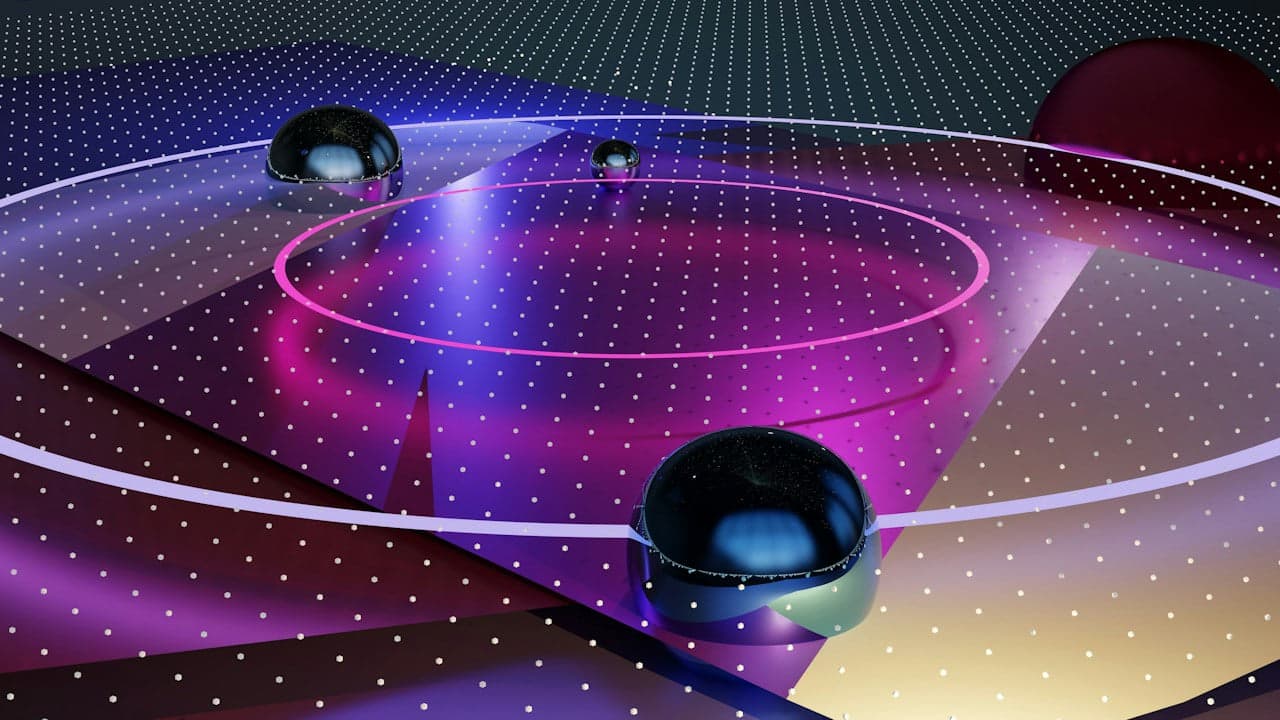
The experiment begins by directing a femtosecond laser pulse into two spiral waveguides on the chip. Through a nonlinear optical mechanism called spontaneous four-wave mixing, the pulse generates pairs of entangled photons whose quantum states become linked, as detailed by Interesting Engineering. Miniature interferometers route the particles across the chip, sending one photon into specially textured microring resonators. These structures shape the photon's polarization and orbital angular momentum to form a quantum skyrmion: a vortex-like topological pattern in light that covers every polarization state a specific number of times.
Measurements confirm the pattern outlasts quantum entanglement
Using a Bell-state measurement, the researchers transferred this topological structure to the two-photon state, achieving an average quantum-state fidelity of 89 percent. Tomography revealed an initial single-photon topological number of 1.981, matching closely the theoretical target of 2. When the team deliberately injected background noise, the quantum entanglement deteriorated and eventually ceased, yet the skyrmion configuration persisted. According to the study published in Nature Physics and covered by Interesting Engineering, the surviving correlations registered as quantum discord, a metric that tracks non-classical links beyond standard entanglement.
Limits and future steps for quantum communication
While earlier physics models assumed skyrmion structures relied entirely on entanglement, the experiment shows topology behaves independently under moderate noise. Stronger interference does eventually destroy the pattern, and the research team notes the current prototype circuit does not yet constitute an operational communication channel without active entanglement. Future research will explore whether these topological states can be harnessed to shield data transfer inside experimental networks and future quantum computing hardware.
Read also on The Patent: Ultrathin Iridium Manganese Boosts Spintronic Signals in Kyushu Lab Test · OpenAI Reports Breakthroughs in Mathematics, Computer Science and Physics