Silicon Superinductors Built on Standard Foundry Lines
Researchers produce high-inductance superconducting elements in commercial silicon chips using titanium nitride.

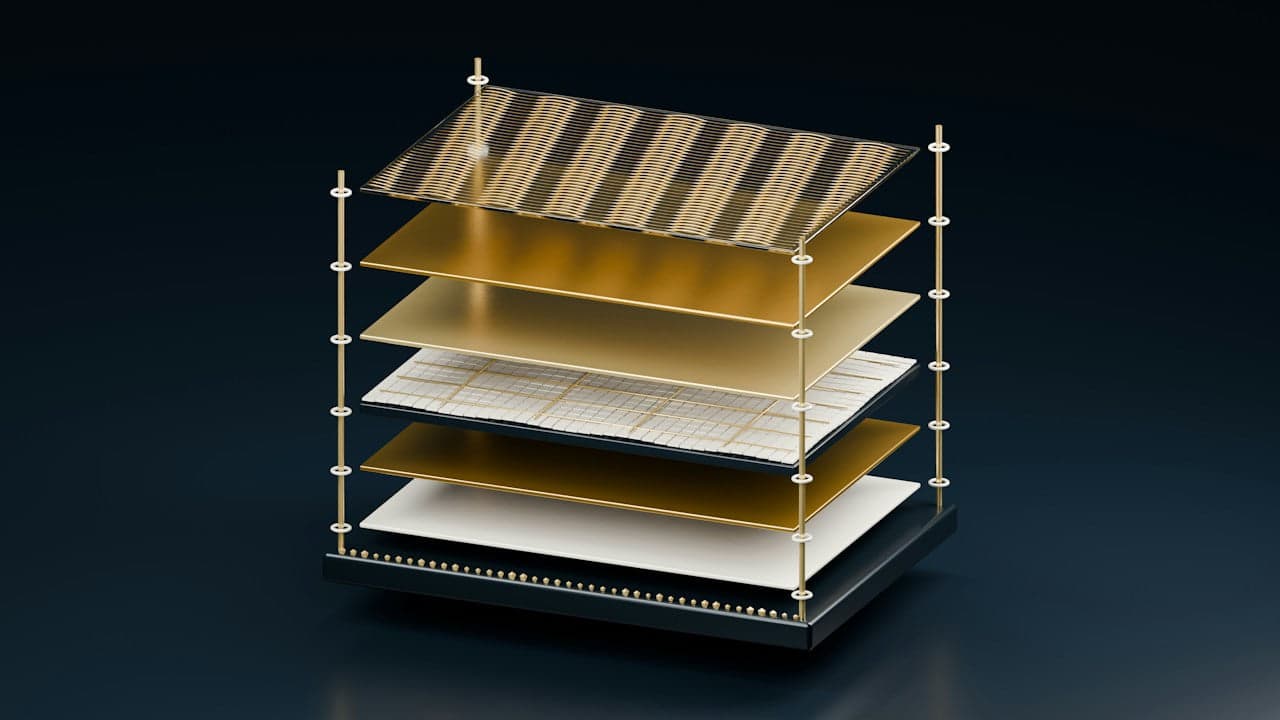
Engineers have built a nonlinear superinductor directly inside a silicon integrated circuit using a standard manufacturing setup. The hardware innovation combines commercial silicon processing with superconducting materials to create high-impedance circuits for quantum hardware.
Standard silicon chips gain superconducting properties
Superinductors are specialized electrical components built to generate extreme levels of inductance well above the limits of traditional wire coils. In a study published in Nature Electronics, a team led by Thomas H. Swift demonstrated an important technological innovation: these devices can be manufactured directly on silicon wafers, as reported by Phys.org.
The collaboration included scientists from the Quantum Hardware research group at nanoGUNE, startup company Quantum Motion, the London Center for Nanotechnology, Imperial College London and the University of Cambridge. Instead of relying on custom laboratory fabrication lines, the group produced the components through a commercial complementary metal-oxide-semiconductor process.
Titanium nitride provides high kinetic inductance
To build an inductor with high impedance and low inductive energy scales inside a compact footprint, the researchers used titanium nitride. The compound possesses strong kinetic inductance, a property that allows a conductor to store energy in the motion of charge carriers rather than purely in a magnetic field.
According to Phys.org, this physical trait allows the team to reduce the physical dimensions of the components while preserving their superconducting behavior. The resulting nonlinear circuit element can operate as a compact radiofrequency single-electron transistor, a sensor architecture commonly used to measure semiconductor spin qubits in quantum computing systems.
Cryoelectronics and spin readout below microsecond speeds
Integrating superinductors directly into commercial silicon chips simplifies the wiring and physical interfaces usually required between room-temperature control hardware and cold quantum processors. The researchers plan to pair the resonator with multi-gate transistors to test spin readout at speeds well below the microsecond timescale, as reported by Phys.org.
Beyond qubit measurement, the invention could supply components for low-power cryoelectronics, quantum simulation hardware and instruments used in space research and radio astronomy.
Read also on The Patent: ULASSON, the UV “everything-cleaner” · Reducing CO2 by working on cement production