Gas Plumes over Alba Mons Suggest Martian Volcanism May Still Be Alive
Planetary scientists detect localized hydrogen chloride emissions emerging from fresh surface fractures on Mars.
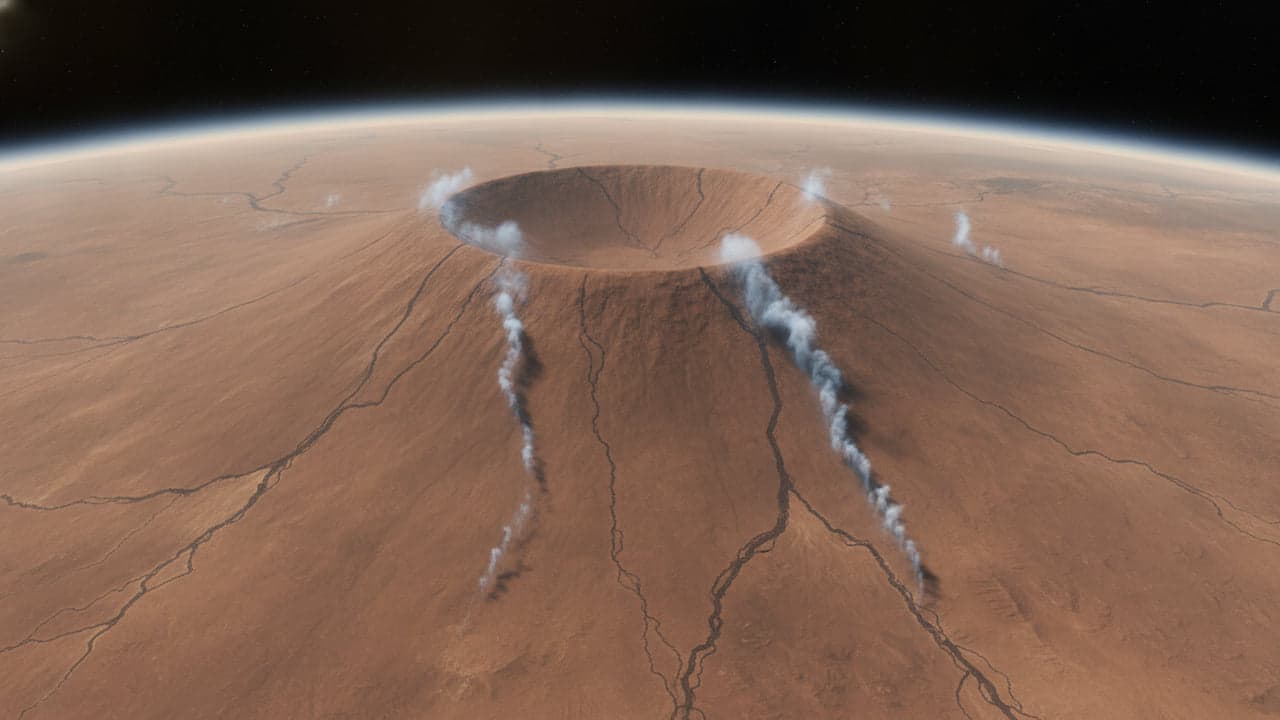
Instruments aboard the ExoMars Trace Gas Orbiter have detected localized leaks of hydrogen chloride gas rising from fissures in the Martian crust, pointing to possible active magma reservoirs beneath the surface. An international research team observed the emissions over the northern slopes of the Alba Mons volcano during early summer, challenging assumptions that geological activity on the planet has ended.
Unusual hydrogen chloride spikes in early summer
The European Space Agency reported observations showing unexpected concentrations of hydrogen chloride gas hovering directly above geological fractures on Alba Mons, the volcano with the largest surface area on Mars. Planetary scientists led by Alexander Trokhimovskiy noticed the anomaly during early summer in the Martian northern hemisphere, according to findings published in Science Advances and reported by ScienceDaily. The timing directly contradicts the broader atmospheric cycle of the gas, which typically peaks during northern winter before dropping to trace levels in the summer months.
Researchers tracking atmospheric data from the ExoMars mission found that the chemical anomaly repeated in the same localized coordinates. While atmospheric dust and water cycles explain the broader seasonal fluctuations of hydrogen chloride first recorded by the orbiter in 2021, they do not account for isolated plumes rising from volcanic terrain. The targeted detection marks a notable technical innovation for orbital sensors monitoring deep space environments.
“Our findings suggest that Mars has retained enough internal heat to support volcanic activity until recently, and possibly still does.”
— Daniel Mège, Professor at the Space Research Centre of the Polish Academy of Sciences
Fissures and seasonal ice seals
To identify where the gas originates, researchers combined atmospheric spectroscopy from the orbiter's Atmospheric Chemistry Suite with high-resolution surface imagery from the CaSSIS camera. The photographs showed narrow, fresh fractures running for hundreds of meters across the slopes of Alba Mons, flanked by visible discolorations in the surrounding terrain, as documented by the European Space Agency.
The research team proposed that subterranean gas accumulates behind surface ice during the freezing Martian winter, when temperatures drop to -120°C. As summer approaches, the rising temperatures cause the ice to sublimate into vapor, opening conduits that let trapped subterranean vapors vent into the thin atmosphere. On Earth, similar vents are known as fumaroles, which leave mineral coatings identical to the discoloration observed along the Martian rifts.
Testing the hypothesis of underground magma
Surface seismometers have previously detected marsquakes, and past orbital surveys confirmed lava flows dating back only a few million years. However, scientists have never observed an active volcanic eruption or liquid lava on the surface, leaving open questions about how much internal heat Mars preserves.
Evaluating whether the gas is volcanic required the team to test alternative chemical mechanisms that might produce hydrogen chloride without subsurface heat. As co-lead author Daniel Mège, a professor at the Space Research Centre of the Polish Academy of Sciences, explained, ruling out non-volcanic chemical pathways remains essential before confirming a permanent magma reservoir. Further orbital monitoring will determine whether these gas vents remain active over subsequent Martian seasons, providing critical data for planetary exploration and advanced robotics.
Read also on The Patent: NASA Map Identifies 13 Possible Martian Origins for Teghaza 001 Meteorite · JAXA Launches MMX Mission to Retrieve Martian Moon Samples by 2031