How much does a patent cost? The bill year by year, country by country
The calculator adds up official fees, attorney fees and translations year by year, and marks every figure that is an estimate
A patent has no single price. It depends on where you file, how complex the invention is, how many years you keep it and who files. The Patent AI calculator puts those choices side by side and shows what each one changes.
Short answer. The cost of a patent depends on the countries you choose, the complexity of the invention, the number of years you keep it and who files. The Patent AI cost calculator adds official fees, attorney fees and translations year by year and lists each patent office on its own line. The official fees of the European Patent Office, the PCT, the Unitary Patent and the USPTO come from the official tables. Every other figure is an indicative estimate, and the tool marks it as one.
How much does a patent cost?
There is no single figure, because a patent is not one payment. There are official fees when you file, when the application is searched and examined, and when the patent is granted. After that come renewal fees, year after year. Attorney fees arrive at several steps. Translations come in when a country asks for another language.
Each country and each office has its own schedule, and a family of patents in several countries adds them together. That is the sum the calculator shows: an order of magnitude with the reasons behind it, and no quote.
What does the calculator ask?
The calculator opens from the "Costs and timing" card on the first screen of The Patent AI, or from an answer about costs, where it is filled in from the words you wrote. It runs on the page and does not count as a question. It asks seven things:
- Where you want to protect the invention: Europe with the Unitary Patent; Europe, single countries (the European Patent Office, France, Germany, Italy, Spain and the United Kingdom); worldwide, meaning Europe, the United States, China, Japan and Korea; or an extended list that adds Australia, Brazil, Canada, India, Israel, Mexico, the Netherlands, Sweden and Switzerland.
- Where you file first: let the calculator decide, straight at the European Patent Office, straight with an international (PCT) application, or in your own country.
- How complex the invention is: a simple case (8 claims, 20 pages), a medium case (15 claims, 35 pages) or a complex one (25 claims, 60 pages).
- For how many years: 10, 12, 15 or 20.
- Who files: a large company, a small company, or a micro filer, meaning an individual, a university or a micro-company.
- Whether attorney fees are included, and at which level: essential, medium or high.
- Whether translations are included, and in which currency to show the result.
Change one choice and the total updates.
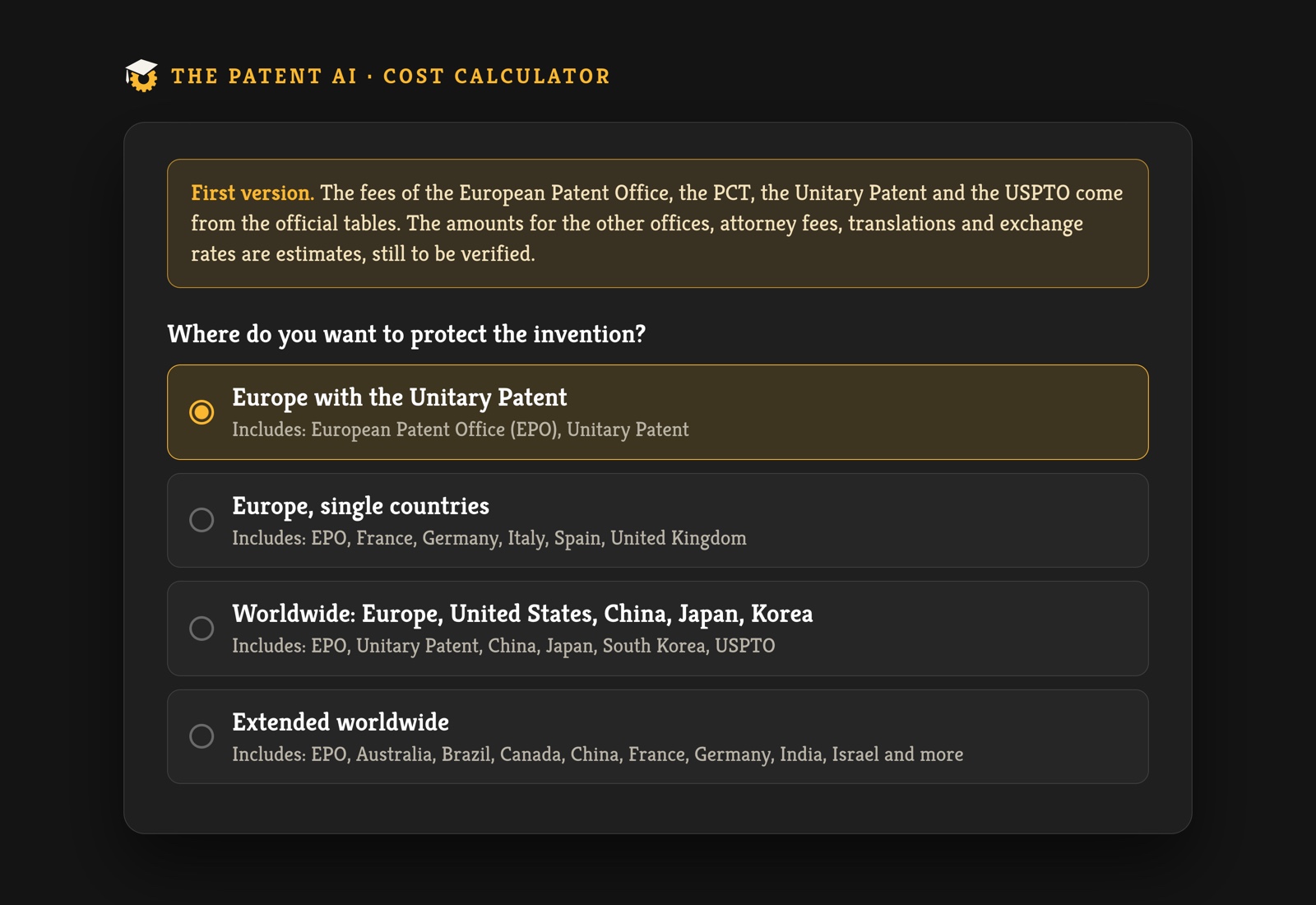 The form opens with a notice: the fees of four offices come from official tables, the rest are estimates.
What does the result show?
The result starts with three numbers: the cost up to grant, the total over the years you chose, and the average per year. A line under them says what share of the total comes from estimates still to be verified.
Below, a chart splits each year into official fees, attorney fees and translations, so you can see which years weigh most. A table lists every office with its official fees, attorney fees, translations and total, and a badge says whether the office figure is "official" or "estimate". A last block, "Other routes compared", shows what the total would be with a different choice: the Unitary Patent against single-country validations, with or without the United States, without attorney fees, or over 20 years.
A second view, "Line by line", lists every cost with its official source and the day it was read. At the foot, the calculator prints the date the official tables were read and the date of the exchange rates.
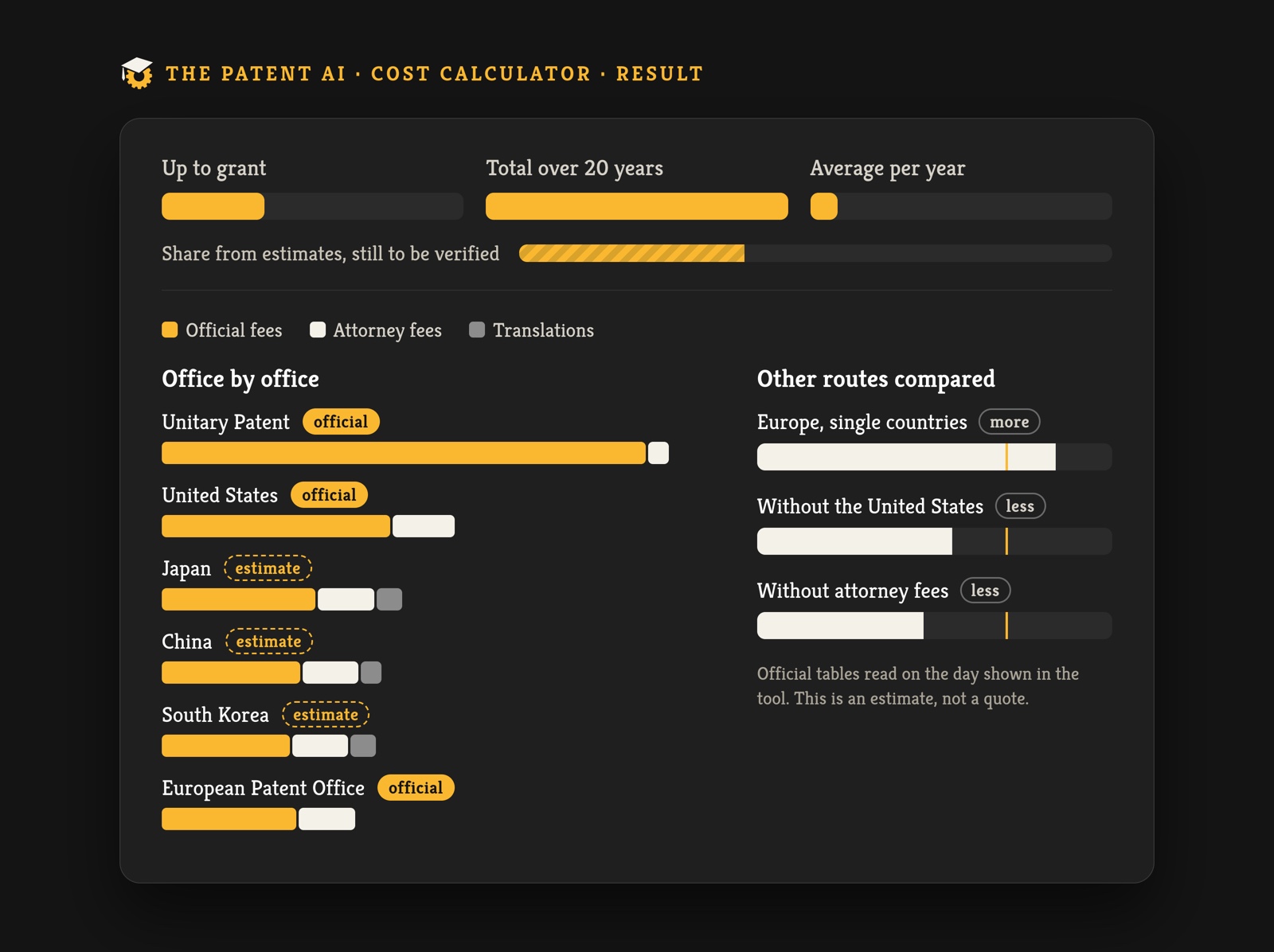 In this example the Unitary Patent, the United States and the European Patent Office are marked official, while Japan, China and South Korea are marked estimate.
Which figures are official and which are estimates?
The first version says it plainly in its opening notice. The fees of the European Patent Office, the PCT, the Unitary Patent and the USPTO come from the official tables, each with its source and the date it was read. The amounts for the other offices, the attorney fees, the translations and the exchange rates are indicative estimates, still to be verified.
That includes Japan, China and South Korea. The official fees of the Japanese office are not loaded in the tool yet, so Japan appears with the "estimate" badge. The same rule applies to every national office outside the four above.
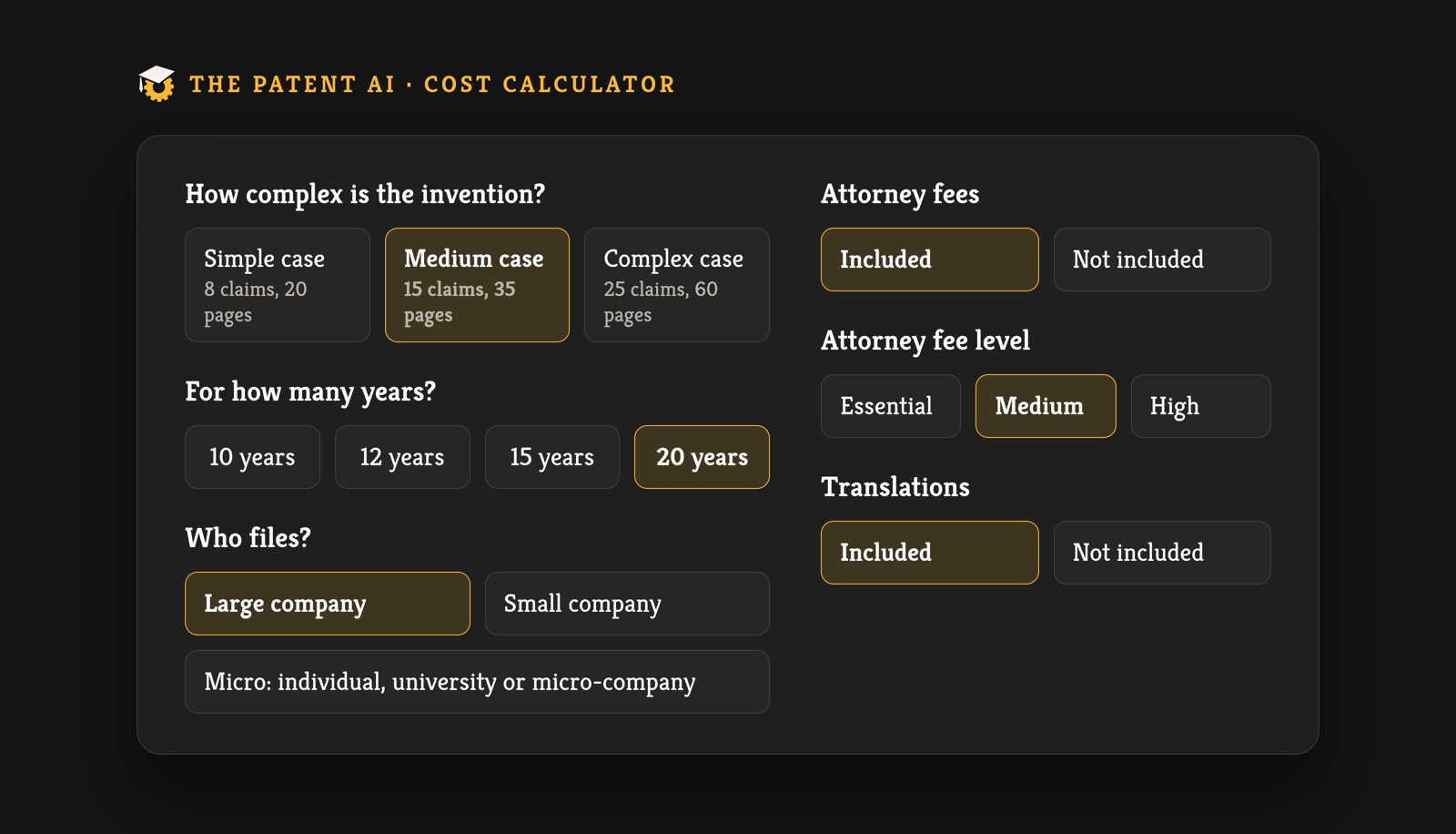 The same form further down: complexity, years, who files, attorney fees and translations.
How long does it take?
The result shows the year by which the last grant is expected, in the line "Up to grant". When you ask about timing in the chat, the answer can also quote the three time limits of the PCT from the pages of the World Intellectual Property Organization, each with its source: a PCT application or a foreign filing within 12 months of the first filing, publication shortly after 18 months from the priority date, and the national phase usually at 30 months from the priority date.
Does the calculator replace a patent attorney?
No. The Patent AI is not legal advice, the figures are not a quote, and filing a patent application requires a patent attorney. Use the calculator to arrive at that conversation with numbers to discuss, and ask the attorney what is missing from them. If you are still deciding whether the idea is new, the next step is the idea card and the novelty check. The presentation page explains the whole tool.
How to estimate the cost of a patent in The Patent AI
- Open The Patent AI. The first five questions need no registration.
- Choose "Costs and timing" on the first screen: the calculator opens at once. Or ask how much it costs to patent an invention, and read the answer with its numbered sources.
- If you asked, the calculator is drawn under the answer, filled in from your words. Open it in full to change the choices.
- Set where to protect, where to file first, the complexity, the years and who files. Decide whether to include attorney fees and translations.
- Read the result, and look at the badges: "official" or "estimate".
- Compare the other routes, then take the table and the source dates to a patent attorney.
Questions and answers
How much does it cost to patent an invention? It depends on the countries, the complexity, the number of years and who files. The calculator turns those choices into a total up to grant, a total over the years you pick and a yearly average, and says how much of it is estimated.
Are the figures in the calculator official? Some are. The fees of the European Patent Office, the PCT, the Unitary Patent and the USPTO come from official tables with source and date. National offices, attorney fees, translations and exchange rates are indicative estimates still to be verified.
Does it include attorney fees and translations? You choose. Both can be included or left out, and attorney fees come in three levels: essential, medium and high. Neither is in an official fee schedule, so both are estimates.
Does it cover trade marks or designs? No. The calculator covers patents only.
Is the calculator free? It runs on the page and does not use up a question. The first five questions of The Patent AI need no registration, and after that a free account is enough.
Related reading on The Patent ®: Advantages of selecting the European Patent Office for PCT applications · China update: the European Patent Office as International Searching Authority · When is paying patent excess claims fees excessive in Australia and New Zealand?
AI-assisted article