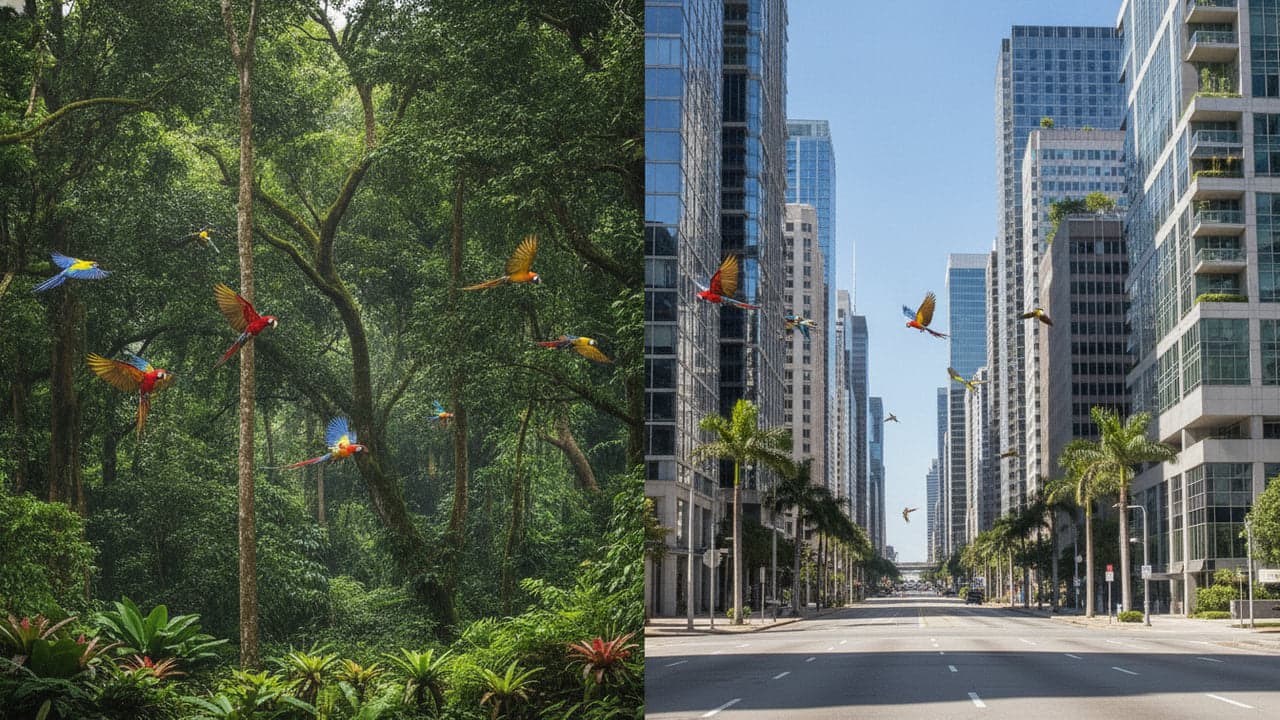
Birds and bats nearly double cacao yields in diverse Peruvian landscapes
Field tests across 28 organic farms reveal that mixed tree cover generates 1,640 dollars in added value per hectare.
By Letizia Giugliano
2 min readWritten with AI support · Reviewed and approved by: Letizia Giugliano
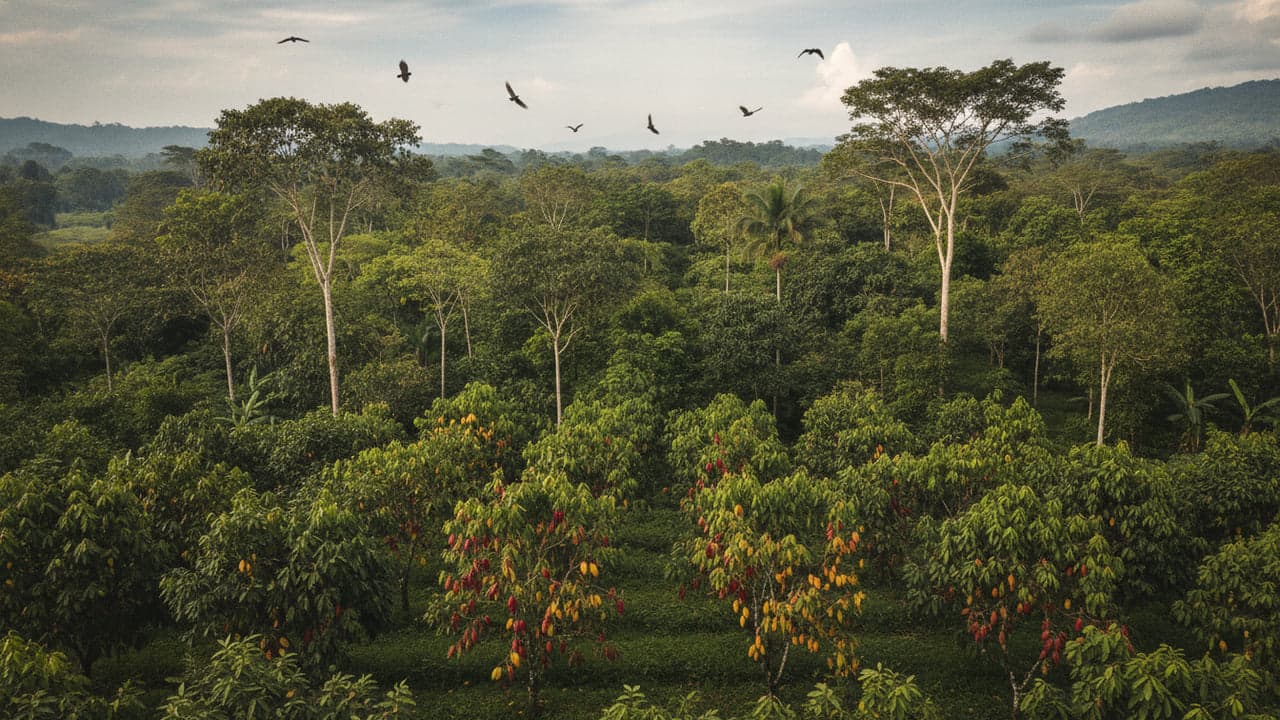
Ecologists at the University of Vienna found that wild birds and bats nearly double cacao harvest weights when farms sit in tree-dense surroundings. Published on November 9, 2026, the investigation covered 28 organic cacao agroforests in the northern Peruvian Amazon. This agricultural innovation demonstrates that balancing open spaces with varied shade canopies protects wildlife while advancing economic sustainability.
Canopy architecture and the limits of shade
Farmers often face an apparent conflict between maximizing harvest volumes and preserving native wildlife, driving the search for agricultural innovation. Lead author Pablo Aycart-Lazo and his colleagues examined how different farm designs affect this balance, publishing their findings in Phys.org. The researchers deployed drones and remote-sensing tools alongside ground surveys to record bird, bat, and arthropod numbers across the northern Peruvian Amazon.
More shade did not guarantee better farming outcomes. Dense overhead canopies protected soil moisture and moderated extreme heat, but they blocked sunlight and sharply reduced cacao bean formation. Aycart-Lazo observed that farms with varied tree heights avoided this penalty. "Our data show that cacao farms do not need uniform shade to support biodiversity. A mosaic of tall and short trees, tree clusters and open patches can create habitat for wildlife while maintaining production," explained Aycart-Lazo.
“Birds and bats can be powerful allies for cacao farmers, but only if the surrounding landscape provides enough habitat. If these landscapes become large monocultures, much of this natural pest-control benefit is lost”
— Bea Maas, senior author at the University of Vienna
Natural pest control adds 1,640 dollars per hectare
The surrounding geography proved decisive for farm output. In fully deforested zones, annual cacao production stalled at 265 kg per hectare (236 pounds per acre). In contrast, yields rose to roughly 1,000 kg per hectare (892 pounds per acre) in areas surrounded by moderate forest cover and complementary tree crops.
Experimental netting confirmed that flying animals drove this increase. Birds and bats consumed arthropods that typically feed on delicate cacao flowers and developing pods. In diverse forest areas, their foraging nearly doubled harvested crop weights. The team calculated that this natural pest control contributed an estimated 1,640 dollars per hectare each year in added production value. Senior author Bea Maas pointed out that this benefit disappears if surrounding lands turn into bare monocultures.
Balancing forest cover and open farmland
The research team proposed specific landscape targets to guide regional farming policies. They recommend keeping 30% to 35% natural forest cover, 40% to 45% tree-based habitats such as agroforests or orchards, and 20% to 30% open ground for annual crops. Unlike proprietary chemical treatments protected by commercial patent rights and intellectual property restrictions, this open agroecological method relies on natural predation.
Local conditions will determine how communities apply the findings. Co-senior author Carolina Ocampo-Ariza of the Technische Universität Darmstadt and the University of Göttingen stressed that the recommendations serve as flexible guidance rather than a rigid formula. Regional planners and farming cooperatives must adapt tree targets to local land tenure and work alongside local communities to maintain both yields and forest corridors, fostering long-term sustainability.
Read also on The Patent: Fruit and vegetable scraps pack more fiber than flesh, King's study shows
An article by the newsroom of The Patent ®, written with the support of artificial intelligence from sources chosen by the newsroom. Review, corrections and approval for publication: Letizia Giugliano. Publisher responsible: WitUp Ltd.