Tropical cities lose three times more bird species than northern hubs
Analysis of 10,000 avian species reveals how urban spread flattens the equatorial diversity gradient
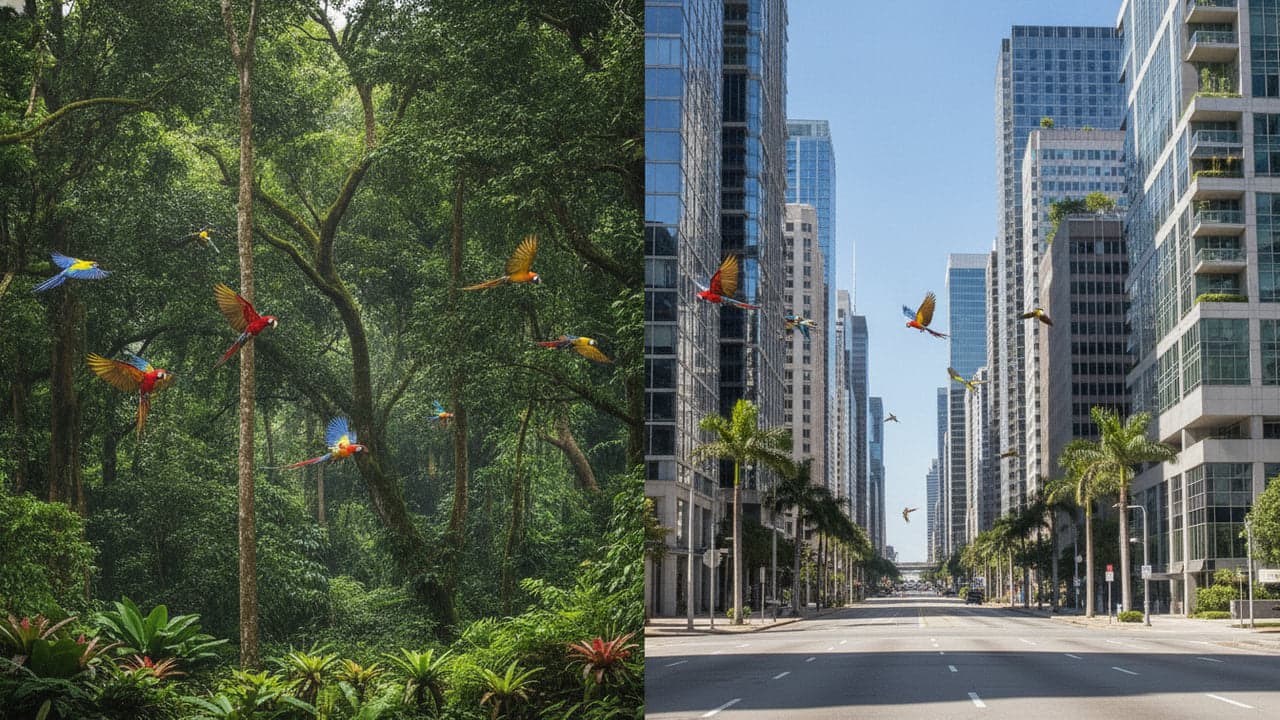
Ecologists analyzing more than 10,000 bird species found that urban expansion weakens Earth's latitudinal diversity gradient by a factor of three. The team, led by researcher Jory Griffith, reported that cities near the equator lose far more native bird varieties than northern settlements, highlighting where conservation innovation is needed most.
Specialist birds vanish from asphalt and concrete
Cities disrupt the ancient ecological rule that multiplies plant and animal diversity toward the equator, according to a study published in the Proceedings of the National Academy of Sciences. Metropolitan areas hold one third fewer bird species than surrounding wilderness, but the damage concentrates heavily in the tropics, underscoring the urgent need for sustainable urban innovation. A 1-by-1-kilometre urban grid cell near the equator, such as in Singapore or Quito, averages 42% fewer bird species than an equivalent natural parcel. By contrast, a plot at 65 degrees latitude, including Reykjavík or Fairbanks, experiences only a 12% drop.
Crowded canopies versus adaptable generalists
Evolutionary specialization explains the difference. Natural tropical forests shelter species that depend on dense multi-story foliage, specific fruits, or constant humidity. Urban development replaces diverse plant cover with uniform lawns, concrete, and drained wetlands. While generalist species like crows and Canada geese thrive in artificial environments, tropical specialists disappear rapidly when canopy cover drops. The findings show that urbanization acts as a global ecological filter that selectively eliminates equatorial wildlife.
Mapping global wildlife through open data
To evaluate these shifts, researchers divided the terrestrial surface into 1-by-1-kilometre grid cells categorized as urban, suburban, or natural using human population density and land-use records. The study relied on the digital eBird platform, an open-access community science system where millions of volunteers log sightings with precise coordinates and timestamps. Filtering these observations allowed the team to track species presence across distinct zones without geographical sampling bias.
Designing urban green space for future sustainability
Smarter planning and architectural innovation can blunt these losses, the authors noted. Across all latitudes, cities that preserved parks and connected tree networks retained significantly higher species richness than heavily paved centres. As national delegations discussed habitat targets at the COP17 global biodiversity summit in Yerevan, Armenia, researchers stressed that dense green infrastructure is key for urban sustainability. The team is now investigating how the loss of tropical urban birds alters natural pollination and seed dispersal across remaining city forests.
Read also on The Patent: Wooden wind turbines, the evolution of renewable energy · Bacteria Produce Hormones to Save Corals from Extreme Heat