A forgotten heavy neutrino may solve why matter survived the Big Bang
Calculations reveal that a slow-decaying particle altered early cosmic expansion and left traces in gravitational waves
By Giovanni Sapere
2 min readHuman-Edited, AI-Assisted
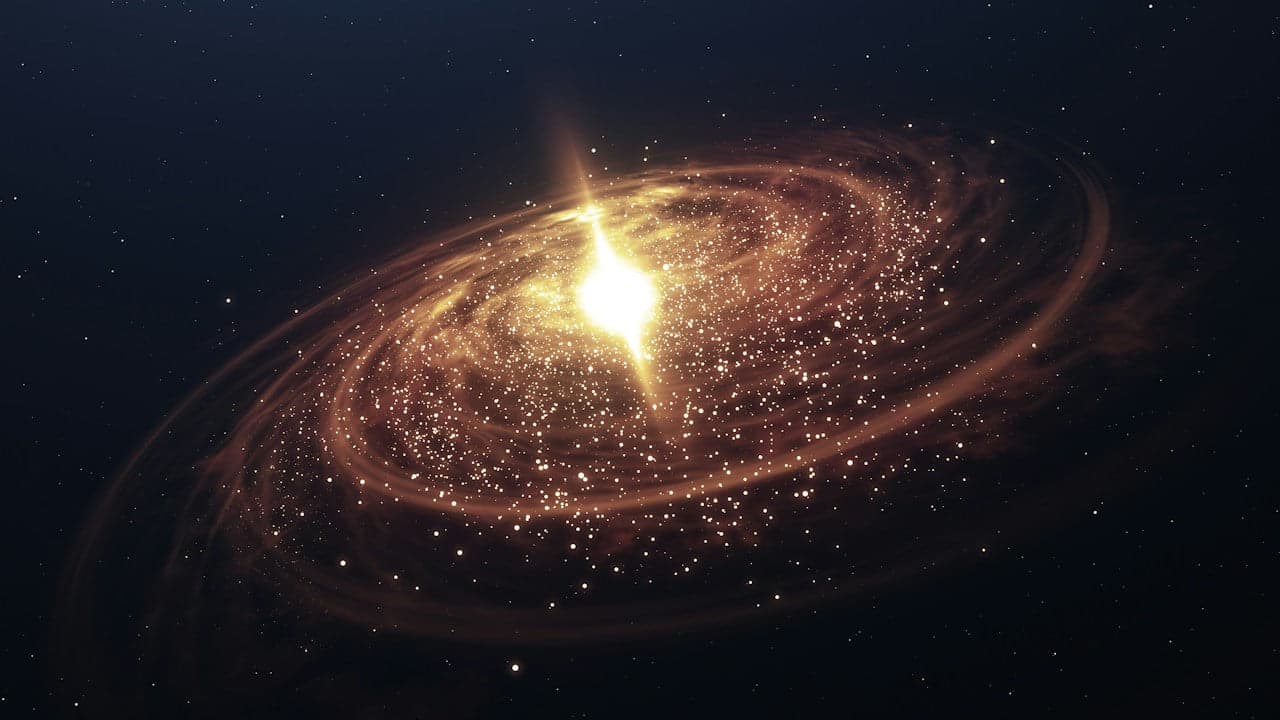
Physicists from the University of Southampton and the Indian Institute of Technology Kanpur have found that a neglected particle may explain why matter exists today instead of empty space. Their analysis shows that a decoupled heavy neutrino briefly dominated the cosmos after the Big Bang, tipping the balance against antimatter.
A slow-decaying particle takes control of energy density
Equal quantities of matter and antimatter formed during the Big Bang, a condition that normally results in mutual destruction upon contact. If that balance had stayed exact, the cosmos would have emptied out completely, leaving no material for stars or planets in space. In research published in Physical Review Letters, theorists investigated the role of a hypothetical heavier relative of the neutrino, as reported by ScienceDaily.
Physicists had long set this decoupled heavy neutrino aside because it interacts weakly with surrounding matter. Yet its unusually slow decay rate changes its cosmic influence. As the young cosmos expanded and cooled, the particle survived long enough to dictate the overall energy balance.
Dr. Rishav Roshan of the University of Southampton described the particle's changing role: "This decoupled heavy neutrino has long been dismissed as an irrelevant background detail in particle physics. However, it decays incredibly slowly." Roshan noted that as temperatures dropped, the particle lasted long enough to trigger a temporary matter-dominated epoch.
“This decoupled heavy neutrino has long been dismissed as an irrelevant background detail in particle physics. However, it decays incredibly slowly.”
— Dr. Rishav Roshan, University of Southampton
“The dramatic shift in the early expansion of the cosmos leaves distinct but detectable imprints of changes, for example on primordial gravitational waves.”
— Dr. Sudipta Show, Indian Institute of Technology Kanpur
Setting the temperature switch for the Higgs boson
The brief period of dominance altered the physical environment that produced the matter-antimatter asymmetry. For reasons physicists have debated for decades, matter emerged with a slight numerical surplus over antimatter, allowing basic elements to endure after mutual annihilation.
The research links this shift directly to the Higgs boson, the elementary particle tied to mass generation. The heavy neutrino modified the temperature at which particles such as electrons and other leptons interacted with antiparticles through the Higgs mechanism. This thermal shift acted like an operational switch, setting the exact parameters that allowed matter to prevail.
Signatures written into primordial gravitational waves
The temporary dominance of this particle reshaped how the cosmos expanded during its earliest stages. This structural shift provides a way to verify the model through observational astronomy.
Dr. Sudipta Show of the Indian Institute of Technology Kanpur noted that the altered expansion history leaves concrete evidence in spacetime. The physical upheaval created specific signatures within primordial gravitational waves, the faint ripples produced during the first moments of the universe. Tracking these wave signals gives researchers a direct tool to test the theory against upcoming observational data, marking a major theoretical innovation in cosmological science.
Read also on The Patent: Ultrathin Iridium Manganese Boosts Spintronic Signals in Kyushu Lab Test · OpenAI Reports Breakthroughs in Mathematics, Computer Science and Physics