Caltech finds a mass gap in black holes born without a supernova
An analysis of 257 gravitational-wave mergers shows a shortage of black holes between 12 and 16 solar masses, a pattern that fits stars collapsing straight into black holes.
By Letizia Giugliano
4 min read
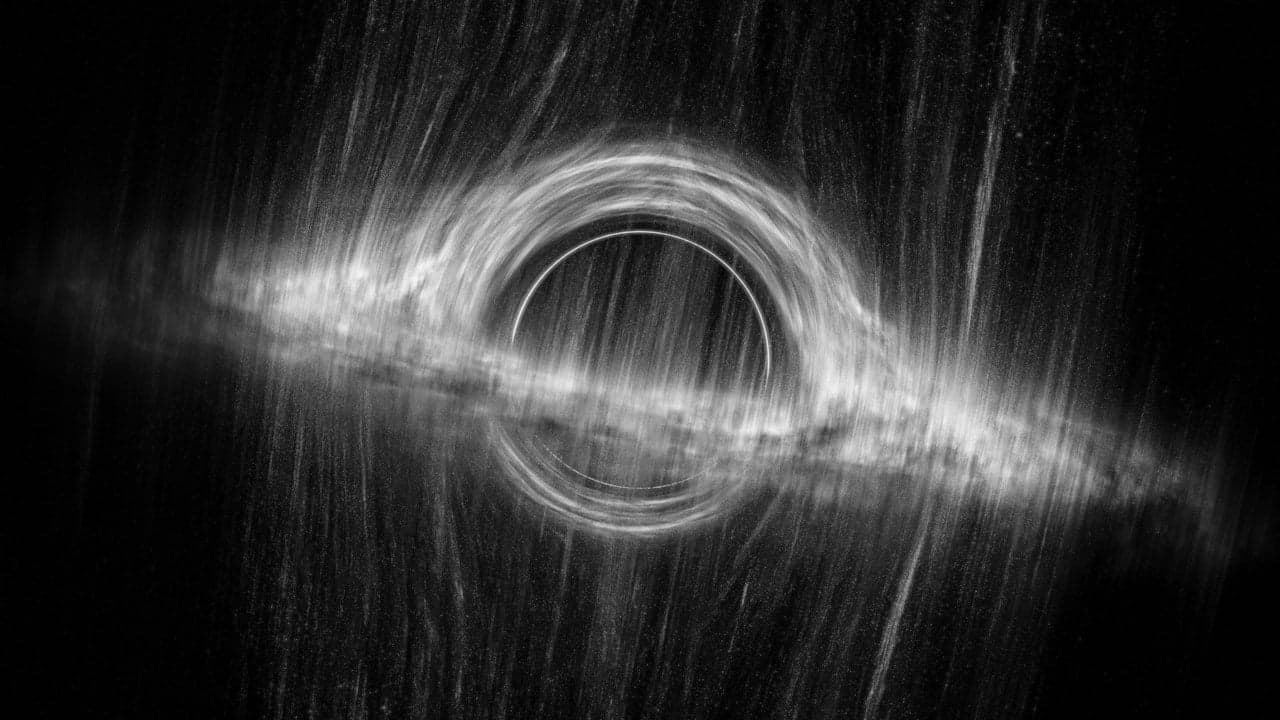
Black holes about 10 times the mass of the Sun appear in roughly three-quarters of the mergers detected so far, and a Caltech-led team has found a matching hole in the distribution between 12 and 16 solar masses. The pattern, drawn from 257 collisions, fits an idea astronomers have never confirmed: some massive stars collapse into black holes without exploding first. The work was published in Physical Review D.
257 mergers, and a gap nobody had seen before
The team examined the masses of the black holes involved in 257 mergers recorded over the past decade by the detector network that combines LIGO in the United States, Virgo in Italy and KAGRA in Japan. That network has logged more than 300 black hole collisions since LIGO made the first direct detection of gravitational waves in 2015.
Black holes around 10 solar masses turned out to be exceptionally common, appearing in about three-quarters of the sample. Between 12 and 16 solar masses, the numbers dropped. According to the study, this is the first time such a distinct gap has been found in the mass distribution.
Read also on The Patent: Two youtubers managed to film the speed of light · Patents violated: $837 million fine for Apple
Isaac Legred, who completed the work at Caltech and is now a postdoctoral researcher at the University of Illinois Urbana-Champaign, put the puzzle plainly in the announcement: "We see 10 solar-mass black holes merging all the time." He then asked why objects at 14 solar masses should be so rare.
“The gap we see in the distribution of masses indicates there may be a special cocktail of internal physics that goes into forming the abundance of 10 solar-mass black holes.”
: Isaac Legred, lead author, University of Illinois Urbana-Champaign
“Our data are showing that this group of black holes may have a common origin, they may be a distinct subpopulation that failed to go supernova.”
: Katerina Chatziioannou, Caltech physics professor and LIGO team member
A star that disappears instead of exploding
The biggest stars usually end in a supernova, throwing material into space while the core collapses into a neutron star or a black hole. Theorists have long suspected a quieter ending for some of them, a direct collapse into a black hole with no explosion at all.
Observations have not caught one. Ordinary supernovae produce flashes visible across enormous distances, while a failed supernova leaves little that telescopes can see. The Caltech group did not set out to photograph one. It tested whether the black holes already detected by gravitational waves carry the signature that theory predicts for this silent route.
Katerina Chatziioannou, a Caltech physics professor and LIGO team member who led the study, said the data point to a shared history for the commonest objects: they "may be a distinct subpopulation that failed to go supernova." Jacob Golomb, a former member of her research group, also contributed to the work.
Spin rates as a fingerprint of formation
Mass alone is not the whole argument. The researchers also looked at how fast the black holes rotate, because spin can preserve traces of the conditions in which an object formed.
Black holes near 10 solar masses showed spin rates clustered in a narrower range than the wider black hole population. Combine that with the excess at 10 solar masses and the scarcity between 12 and 16, and the simplest reading is a group of black holes with a common origin.
The paper is explicit about the limit: the findings do not directly confirm failed supernovae. What they do is match theoretical predictions about how black holes made that way should be distributed, which is a weaker but measurable claim.
What a confirmed failed supernova would need
A direct detection of a star vanishing without a bang still eludes astronomers, and that remains the test the model has to pass. Until then, the evidence is statistical: a shape in the mass distribution and a pattern in the spins, both extracted from mergers rather than from the death of a single star.
The patent question does not arise here. The study reanalyses detector data that the LIGO, Virgo and KAGRA collaborations had already released, and it appears in a peer-reviewed journal, so nothing in the result is filed or licensed. For anyone tracking patent news in astronomy, the interesting filings sit in the instruments, not in this paper. The same record-based reasoning applies beyond astrophysics: who invented the telephone is settled by patents and documents, just as Jensen Huang patents, the design history of Google Sabrina, or the lineage of a Quadro 3D printer are traced through filings rather than a single headline.
Chatziioannou framed the work as a bridge between two fields. The gravitational-wave data, she said, are showing a connection with "underlying astrophysics we are trying to extract." The next word on failed supernovae will come from more mergers, not from a telescope image.
AI-assisted article