Graphene energy harvester powers wireless sensors from magnetic field leaks
Researchers at the University of Arkansas and the University of Michigan built a battery-free sensor running on electromagnetic radiation from wiring.
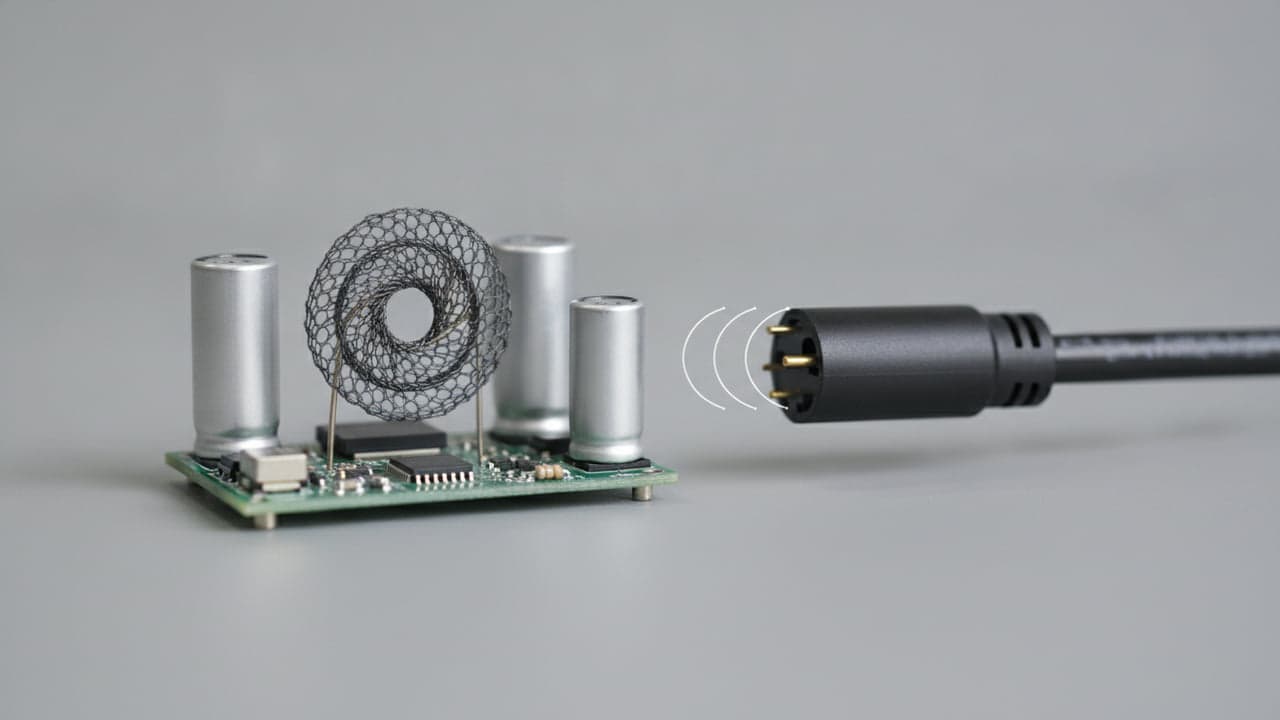
A research team led by physicist Paul Thibado has developed a battery-free temperature sensor that draws its operating electricity from ambient electromagnetic fields around alternating-current wiring. The invention, created by researchers at the University of Arkansas and the University of Michigan, couples a graphene inductor with low-drain electronics to run without wired power connections or chemical batteries. It offers industrial plants a maintenance-free option to monitor machinery without the need to replace exhausted cells.
Capturing power from alternating 60 Hz magnetic fields
Electrical current traveling through standard power lines produces an oscillating magnetic field. In the United States, alternating current oscillates at 60 Hz, generating a changing field that continuously radiates into the surrounding environment. To capture this dispersed energy, the team fabricated an inductor from graphene and inserted a steel core to strengthen magnetic flux capture, as reported by New Atlas. When placed next to an active cable, the component generates an alternating voltage through electromagnetic induction, following the basic operating principle behind traditional electrical transformers.
“The inductor adds charge to these capacitors at a slow rate, but it's faster than the rate the sensor uses up the charges from the capacitors.”
— Prof. Paul Thibado, graphene energy harvester inventor, University of Arkansas
Voltage multiplication and capacitive storage
Because the raw signal produces alternating current at a voltage far too weak for conventional electronics, the researchers designed a conversion circuit based on a Cockcroft-Walton voltage multiplier. The circuit converts the alternating current into direct current and steps up the voltage to operational levels. For energy storage, the system relies on three capacitors rather than a rechargeable battery. Graphene energy harvester inventor Paul Thibado and colleagues designed the custom temperature sensor to run at the nanowatt scale, consuming billionths of a watt, or roughly 30 million times less power than a single wireless earbud, according to New Atlas.
Continuous operation and current constraints
The graphene inductor gathers electricity slowly, yet its intake outpaces the sensor's power drain. Surplus electricity remains in the capacitors, keeping the temperature probe operational for at least 24 hours, and potentially up to a week, if line current stops entirely. The research team, which includes Syed Maksudur Rahman, Tamzeed Bani Amin, Ashaduzzaman, MD Rezaul Kabir and Jim Mangum, demonstrated the setup inside laboratory conditions. However, the system cannot function away from active alternating-current cables, and the prototype required pre-charged capacitors and pre-programmed processing to begin operating, limiting its present use to specialized low-power monitors, as detailed by New Atlas.
Read also on The Patent: Engineers Solve Key Physical Hurdle in Exhaled Breath Diagnostics · Spear Wound in Shanidar Cave Points to Oldest Wooden Weapon Attack