Spanish researchers use electrospray to concentrate milk without heat
A nonthermal technique reduces water content by nearly half and keeps milk proteins intact
Researchers in Barcelona have demonstrated that a high-voltage electrical field can concentrate liquid milk at room temperature, offering a nonthermal alternative to industrial heat drying. The method, currently being patented, cuts water content by nearly half while preserving fragile proteins.
Breaking droplets with high voltage
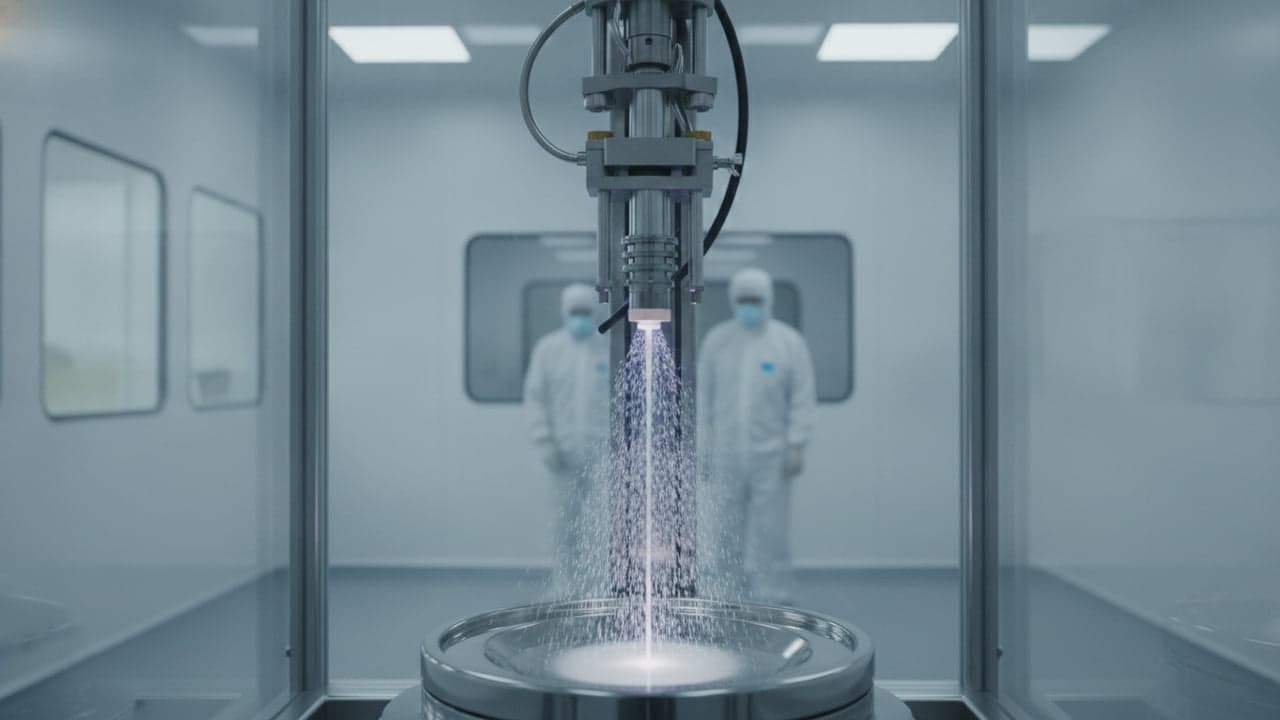
Turning milk into powder usually demands intense heat to evaporate water, a step that can degrade whey proteins, enzymes and vitamins. To prevent heat damage, a team from the Institute of Microelectronics of Barcelona (IMB-CNM-CSIC) and the Autonomous University of Barcelona (CIRTTA-UAB) tested electrospray at 20°C. As reported by Phys.org, the system applies a strong electric field to liquid milk. This force overcomes surface tension and shatters fluid drops into millions of microdroplets, allowing water to evaporate at ambient temperature.
Testing flow rates in the clean room
The experiments took place inside the Micro and Nanofabrication Clean Room at IMB-CNM-CSIC using a Fluidnatek LE-10 electrospray unit. First author Bernat Perez Playà adapted the device to process reconstituted skim milk under an electrical charge of 29 kV across a distance of 10 cm between tip and collector. The flow rate proved decisive: injecting milk at 0.2 mL/min caused almost no change, whereas slowing delivery to 0.01 mL/min raised total solids from 12.3% to 36.8%. At lower speeds, each droplet carries a greater electrical charge relative to its volume, which accelerates breakup and water loss.
Protecting caseins and seeking a patent
Gel electrophoresis showed that the nonthermal invention left key components undamaged. CIRTTA-UAB professor Manuel Castillo noted that the process preserves caseins and whey proteins that normally degrade under industrial thermal processing. The team filed a patent application covering the dehydration method for liquid food products. While the bench tests reduced milk water by almost half, the equipment did not yield completely dry powder.
Scaling up and testing energy consumption
Co-author Llibertat Abad explained that upcoming trials will assess multiple emission nozzles to scale up production volume. Future work will also test microbiological stability, measure net energy consumption and evaluate whether this non-thermal patent pending method can handle other heat-sensitive liquid foods.
Read also on The Patent: UT Southwestern designs versatile 3D microscope for live cell imaging · Federal Circuit overturns 9.1 million dollar fee award against ChromaDex