Astronomers find oldest quasar pair from 900 million years after Big Bang
The two black holes, of 1.5 billion and 400 million solar masses, were already as heavy as present-day giants when the Universe was a thirteenth of its age, and no theory explains how.
By Mattia Sapere
4 min read

An international team led by Silvia Onorato, a postdoctoral researcher at NSF NOIRLab, has found the most distant compact pair of quasars ever seen, two feeding black holes shining 900 million years after the Big Bang. The objects are separated by about 18,100 light-years, roughly a fifth of the width of the Milky Way, and weigh 1.5 billion and 400 million times the mass of the Sun. The pair, designated J1602+4228AB and nicknamed Nāpōwawāʻenakaulua, is only the third quasar couple known from the period astronomers call cosmic dawn.
Two black holes 18,100 light-years apart, seen at cosmic dawn
The discovery was made with the James Webb Space Telescope and the Gemini North telescope on Maunakea, a dormant volcano in Hawai'i, and is described in a paper in The Astrophysical Journal Letters. The two quasars sit about 18,100 light-years apart, a separation the team describes as unusually close for objects this distant.
Quasars are the bright cores of galaxies where a supermassive black hole is pulling in matter. The infalling gas heats up and can outshine every star in the host galaxy. Here both members of the pair were in that bright phase at the same time, which is what makes them visible as two sources rather than one.
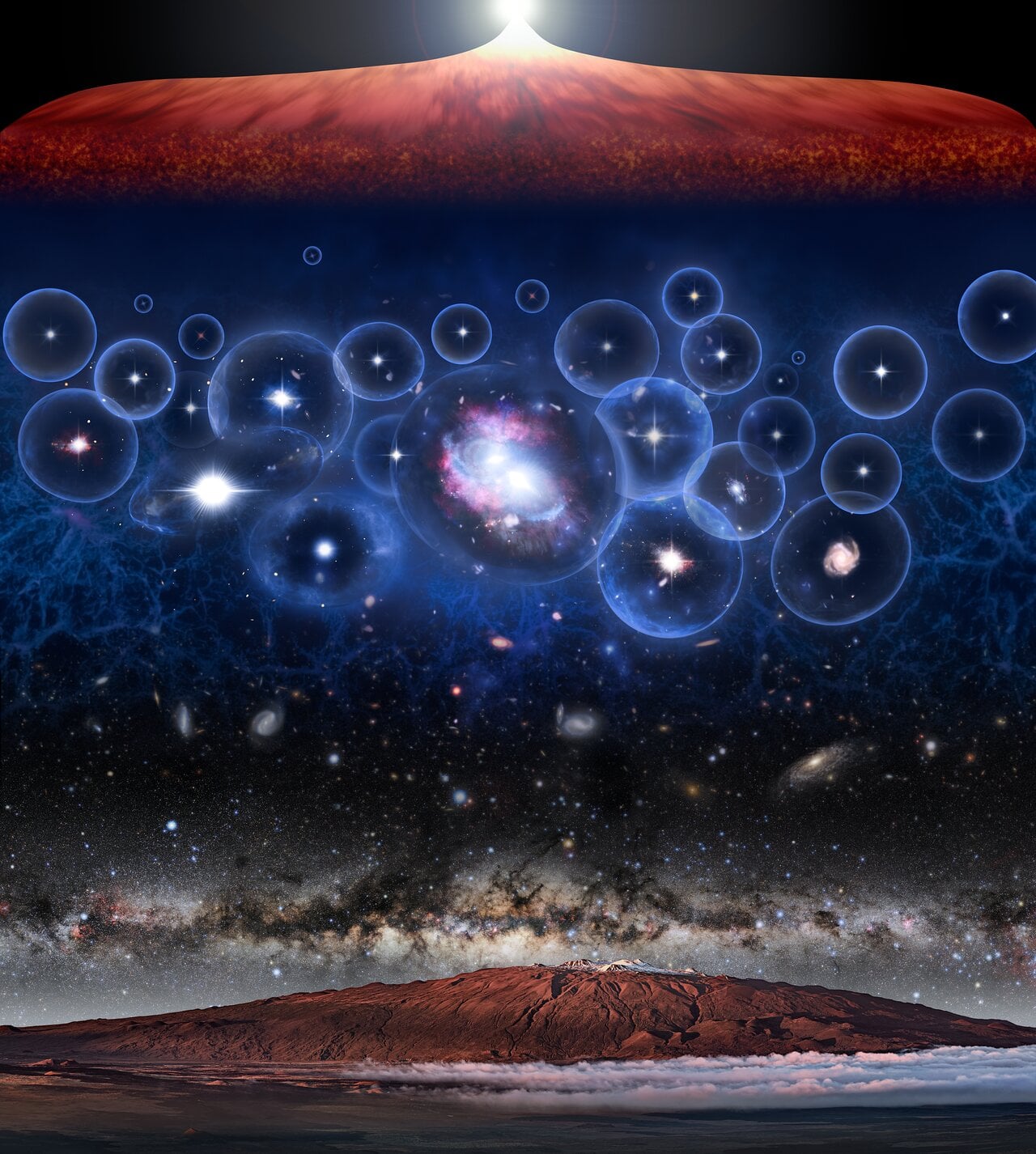 Photo: www.noirlab.edu
Read also on The Patent: Hubble sees 93-billion-mile dust cloud from colliding worlds at Beta Pictoris · NASA Map Identifies 13 Possible Martian Origins for Teghaza 001 Meteorite
Astronomers see the system as it was 900 million years after the Big Bang. The bigger of the two black holes holds 1.5 billion solar masses, the smaller about 400 million.
“We observed Nāpōwawāʻenakaulua at a time when the Universe was only a thirteenth of its age”
: Silvia Onorato, NSF NOIRLab
A name made with Hawaiian language scholars
The pair carries the Hawaiian name Nāpōwawāʻenakaulua, which the team renders as "Two celestial bodies of fathomless powerful darkness in the brilliance of heat reincarnating energy into the Universe." It was developed through the A Hua He Inoa programme, a collaboration between the ʻImiloa Astronomy Center of Hawaiʻi and the University of Hawai'i's Ka Haka ʻUla O Keʻelikōlani, the Hawaiian Language College.
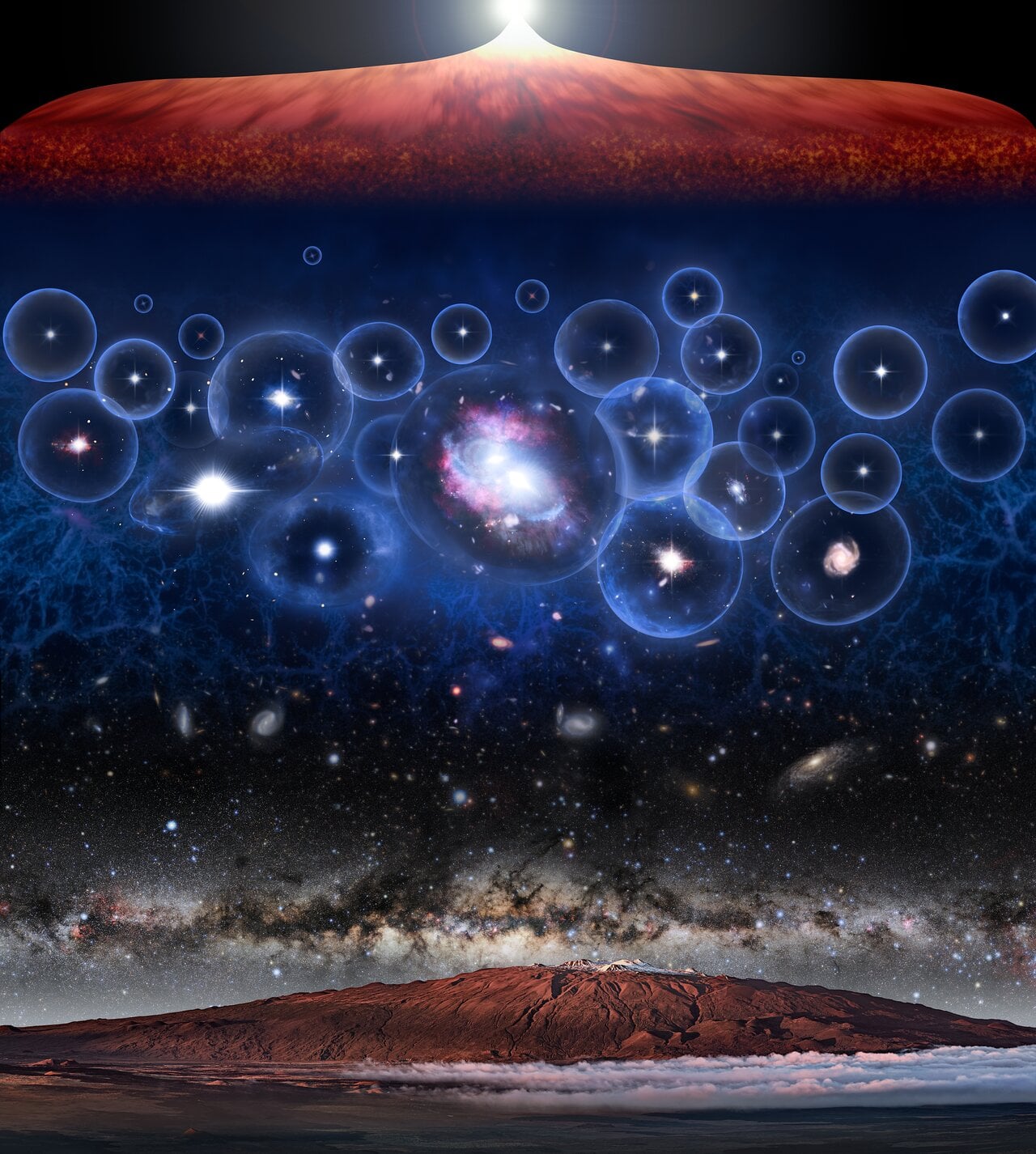 Photo: www.noirlab.edu
The official designation, J1602+4228AB, follows the coordinates-based naming used in catalogues. The A and B suffixes mark the two components of a single system.
Why pairs are predicted but rarely caught
Galaxies collide and merge constantly, so astronomers expect many quasars to come in close pairs. Finding them is another matter. A black hole stays in its bright quasar phase for a relatively short stretch of time, so catching two at once is a matter of luck.
The distances involved add a second obstacle. Light from cosmic dawn has travelled so long that the sources look extremely faint, and even from the ground, two objects sitting close together can blur into one point.
That is why Nāpōwawāʻenakaulua is only the third quasar pair identified from this early epoch, and why it also holds the record for the tightest separation among known early pairs.
The growth problem nobody can yet solve
What troubles theorists is not the pairing but the mass. Black holes of this size exist today, after more than 13 billion years of mergers and accretion. Finding comparable objects at 900 million years means the first giants assembled far faster than models allow.
"There is no definitive theoretical explanation for how a single one of these giant quasars exists so early in the age of our Universe, much less two," Onorato said. In the same statement she noted that the pair was observed when the Universe was only a thirteenth of its current age.
The collaboration behind the observatory is run by NSF NOIRLab for the U.S. National Science Foundation, with Canada, Chile, Brazil, Argentina and the Republic of Korea taking part. The discovery is reported in The Astrophysical Journal Letters, and the claim the paper makes is a record rather than a patent: the oldest compact quasar pair known. It arrives as one more item of astronomy patent news in a field where instrumentation, not discovery, is what usually gets protected by the patent.
What comes next for J1602+4228AB
The pair now becomes a target for follow-up work, since its two components can be studied separately in a way that single early quasars cannot. The open question the team poses is direct: how the first supermassive black holes reached such masses so quickly, and whether pairs like this one are the exception or the rule in the first billion years.
The answer will come from more finds of the same kind. Only three early pairs are known, a sample too small to say whether Nāpōwawāʻenakaulua is an outlier or the first clear view of something common.
Human-Edited, AI-Assisted