Anthropic mathematician says Claude helped prove Riemann Hypothesis
The 250,000 page proof was written in Lean for machine checking, and no one has verified it yet
By Mattia Sapere
3 min read
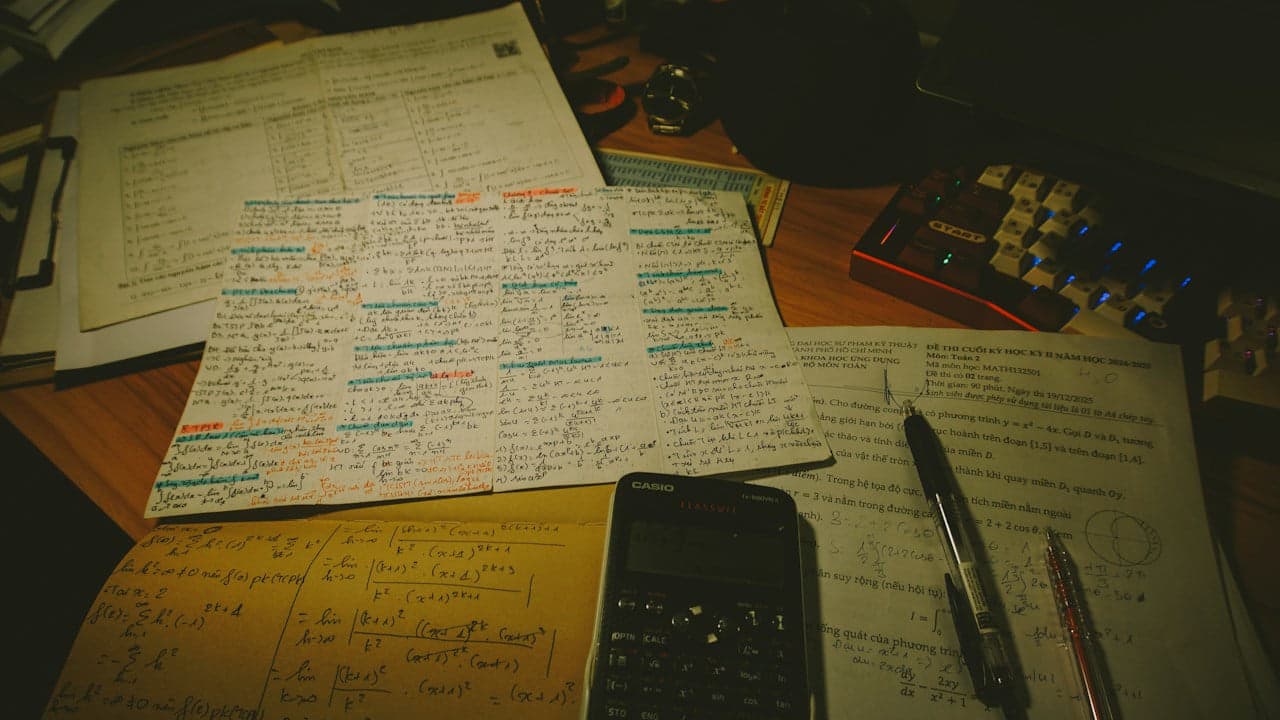
Levent Alpöge, a mathematician employed by Anthropic, says he has found a proof of the Riemann Hypothesis with help from the company's Claude artificial intelligence model. He worked on it for six weeks and wrote the argument in Lean, a programming language designed to write and confirm mathematical proofs. The claim has not been verified.
An announcement on a personal post, with no referee named
Alpöge published the result himself, and Engadget reported the claim on 21 November 2026, citing the BBC. "This problem has been the sacred object in mathematics for me since my childhood," he said in his announcement.
No journal, referee or review date was attached to the work. What exists is a document that other mathematicians can now open and test.
 Photo: Yen Vu - 烟雨 / Unsplash
“This problem has been the sacred object in mathematics for me since my childhood.”
: Levent Alpöge, mathematician at Anthropic, in his announcement
“98 or 99 percent certain”
: James Maynard, University of Oxford, to The New York Times
A question about prime numbers open since 1859
Bernhard Riemann set out the conjecture in 1859. It concerns prime numbers, the whole numbers that divide only by themselves and by one, and it holds that their positions along the number line follow a meaningful order.
Read also on The Patent: Neuroscience 2026: four new biomarker studies for Alzheimer's and depression · PlasmidFactory files at the EPO for plasmid production at 39 °C
The question has stood for 167 years. The Clay Mathematics Institute counts it among its Millennium Prize Problems and promised $1 million to whoever produces the first correct solution.
Why 250,000 pages of Lean is the part that can be checked
Alpöge wrote the proof in Lean, where each step of an argument can be written and confirmed by software. The complete text, he said, runs to more than 250,000 pages.
That size is what makes the claim testable at all. No referee reads a quarter of a million pages by hand; a structure that long is built to be walked through by a machine, line by line, until a step fails.
Claude is a large machine learning model from the artificial intelligence startup Anthropic: it produces candidate reasoning, and the reasoning then has to stand on its own. The reporting describes no patent application over the result and no institution claiming ownership of it. Mathematical theorems fall outside the subject matter that intellectual property and patent systems protect as an invention, so no inventor can claim ownership; the value of this one rests on being checked and cited.
One Oxford mathematician is 98 or 99 percent sure
James Maynard of the University of Oxford told The New York Times he was "98 or 99 percent certain" that the discovery is accurate. A specialist's near-certainty is not a verification, and it leaves room for one step that fails.
Others are working the same ground. In October, OpenAI posted hundreds of solutions to previously unsolved mathematics problems, including progress towards the Riemann Hypothesis, and those also await checking: a marker of the pace of artificial intelligence innovation.
What comes next is the plain task of mathematicians and proof-checking software going through the Lean files. No timetable for that has been given, though the method may travel beyond mathematics to robotics and space software. For readers of the patent magazine, the case is a reminder that not every breakthrough fits an intellectual property claim.
AI-assisted article