A synthetic voice and a year of typing: brain interfaces at Neuroscience 2026
Three research groups presented brain-computer interfaces that restored speech or writing for people with paralysis, at the Society for Neuroscience annual meeting.
By Giovanni Sapere
4 min read
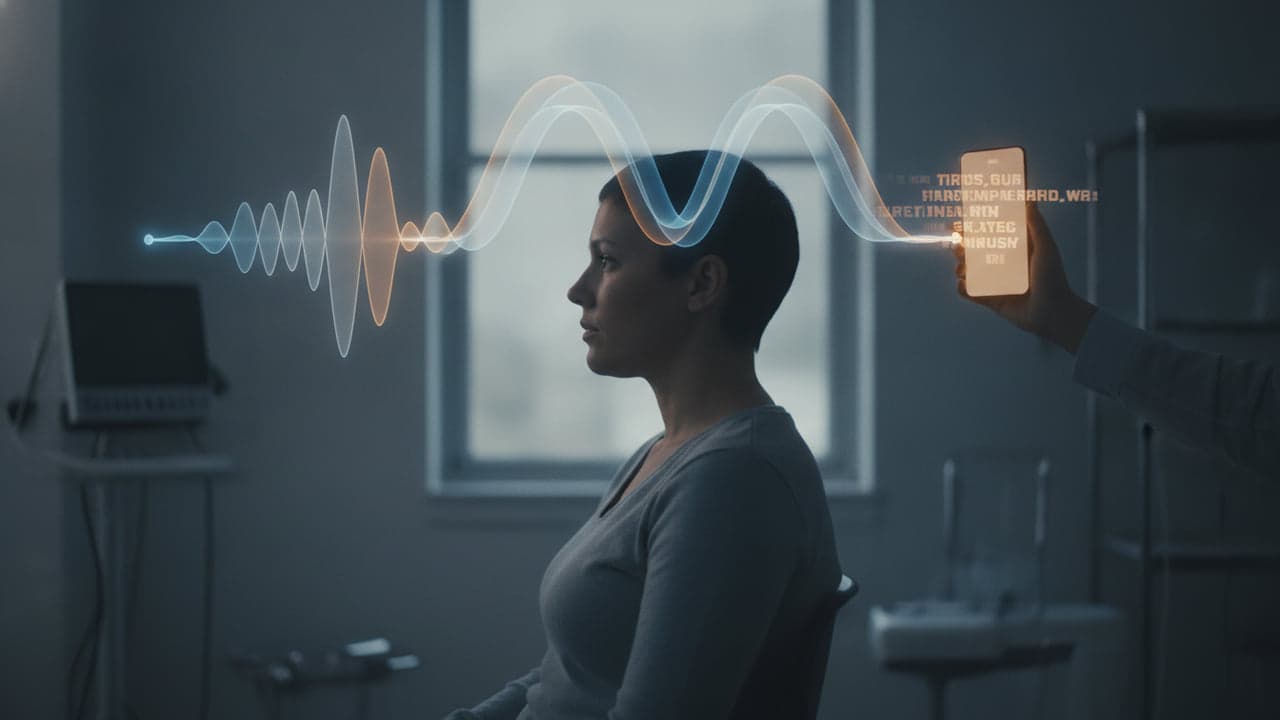
A person in a completely locked-in state held independent conversations for more than a year through a brain-computer interface. Another patient sang, using a synthetic voice that reproduces pitch. The results were presented at Neuroscience 2026, the annual meeting of the Society for Neuroscience, and reported by MedicalXpress on 14 November.
Three clinical trials, one aim: returning speech to paralysed patients
Brain-computer interfaces, or BCIs, record a person's brain signals and turn them into commands for a computer, a prosthetic limb or another device. The technology remains largely experimental, but it is being tested on people who have lost speech or voluntary movement to amyotrophic lateral sclerosis (ALS), stroke and other neurological disorders, according to the Society for Neuroscience.
At the meeting, three teams reported on participants already using such systems. Each device targets a different output: an audible voice, a decoded intention to move, and written text. All three depend on software that reads brain activity and converts it into something the outside world can act on, which is where most of the engineering effort and the intellectual property in this field sits.
“The ability to decode and convert brain activity into spoken or written words has life-changing potential for people with paralysis.”
— Cynthia Chestek, biomedical engineer, University of Michigan
“The work presented today brings brain-to-voice and brain-to-text technologies closer to reaching people outside of clinical trials, which is extremely exciting.”
— Cynthia Chestek, biomedical engineer, University of Michigan
A voice with pitch, and a patient who could sing
Maitreyee Wairagkar, of the University of California, Davis, described a BCI fitted with a synthetic voice that reproduces pitch variation. The added prosody made the output easier for listeners to understand, and it allowed one patient to sing, the meeting report states.
Read also on The Patent: EpiPad Uses Radar to Turn Your Forearm into a Smartwatch Trackpad · Quantum Hardware Advances Target Error Rates, Diamond Nanopillars and Photon Detection
Flat, robotic speech has been a limit of earlier voice-restoration systems. Restoring pitch is a change in the quality of the output and in how much of a conversation a listener can follow without effort.
More than a year of independent communication
At Massachusetts General Hospital, Daniel Rubin worked with a person in a completely locked-in state, meaning no reliable voluntary movement remains, including eye movement. The participant communicated independently for more than a year using a BCI that decodes intended movement from brain activity, according to the same MedicalXpress account.
Duration matters here. A device that works in a single session is a demonstration; one that holds up over twelve months of daily use is closer to a medical device that a patient could rely on at home.
Brain-to-text that runs on an iPhone
A third team, led by Chethan Pandarinath of the Georgia Institute of Technology and Emory University, showed a portable brain-to-text system. The group reported accurate, efficient and reliable decoding of brain activity into written words, running even on an iPhone, per the Society for Neuroscience summary.
Portability is the point of that result. Much BCI work depends on racks of equipment in a laboratory, while a phone-sized decoder moves the system toward use outside a clinic.
A market forecast of $6.2 billion by 2030
The report puts the global BCI market at $1.7 billion in 2022, projected to reach $6.2 billion by 2030. It also notes that the trials are deepening researchers' understanding of how the brain produces speech, a question that outlives any single device.
Cynthia Chestek, a biomedical engineer at the University of Michigan who builds implantable BCIs for prosthetic control, moderated the session. "The ability to decode and convert brain activity into spoken or written words has life-changing potential for people with paralysis," she said, adding that the work brings brain-to-voice and brain-to-text technologies closer to people outside clinical trials.
What the abstracts did not say about patents
The summaries presented at Neuroscience 2026 name no patent, patent application or licensing deal behind any of the three systems. What they document is the science: decoding accuracy, expressive output, length of use.
That leaves the ownership question open in the public record, even though the institutions involved (UC Davis, Massachusetts General Hospital, Georgia Tech and Emory) are the kind of research centres that usually file on decoding methods and electrode designs before commercial partners take a device forward. Any filing in this field would also have to clear prior art stretching back to the first implanted BCIs of the 2000s. Until those documents surface, the invention on show at the meeting is a laboratory and clinical result, not a granted right.
AI-assisted article