Queensland physicists send a message through solid walls with gravity
A team at the University of Queensland moved an elevator counterweight in a timed sequence to spell one word, read by a gravimeter on the other side of a wall.
By Mattia Sapere
4 min read
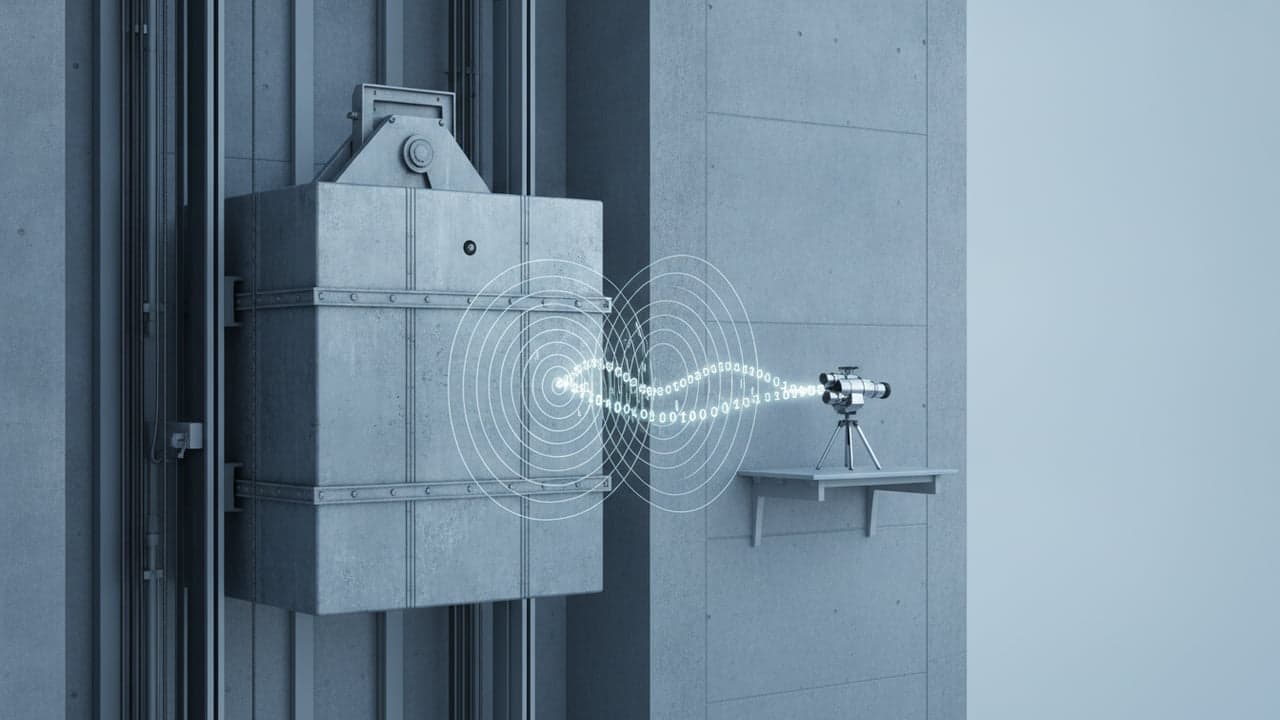
Physicists at the University of Queensland have transmitted a text message using nothing but a moving mass and a gravity sensor. The 49-bit signal spelled the word "Gravity" and took 63 minutes to arrive, with a solid wall between sender and receiver. The experiment, published in Science Advances, is a first demonstration of gravitational communication, a channel that ordinary materials cannot block.
A counterweight in a lift, read from the far side of a wall
The sending apparatus was an elevator. The team moved its counterweight, which weighs nearly 4,000 pounds (1,815 kg), in a carefully timed sequence, and placed a commercial gravity sensor called a gravimeter on the opposite side of a separating wall. Assigning a zero and a one to two positions of the counterweight, the researchers recovered all 49 bits of the message, plus the short sequences that marked its start and its finish. The word they chose was "Gravity".
The work began as something more mundane. The group had been trying to weigh trucks without driving them onto a scale. "Once we had shown that the idea worked, we realized the same physics could be used to encode and transmit information," said physicist and lead author Andrew Groszek. The results appeared in the peer-reviewed journal Science Advances, as reported by New Atlas.
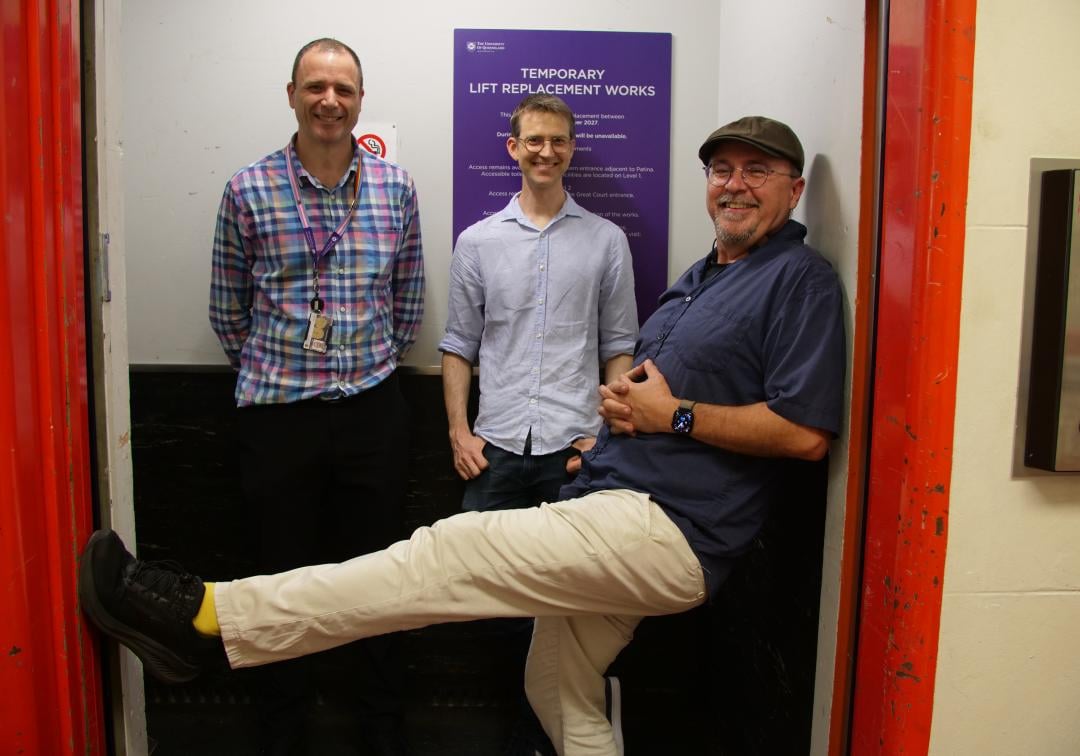 Photo: News
“Unlike the electromagnetic signals used in modern wireless communication, a gravitational signal cannot simply be screened out by placing ordinary material in its path.”
: Charles Woffinden, physicist and co-author, University of Queensland
“Once we had shown that the idea worked, we realized the same physics could be used to encode and transmit information.”
: Andrew Groszek, physicist and lead author, University of Queensland
One bit per minute, measured by a spring
The receiver was not exotic. Inside the gravimeter, a spring-mounted mass registered tiny changes in the vertical pull of gravity as the counterweight moved. Those changes came to about 50 nanometers per second squared, roughly five billionths of the pull we normally feel from Earth.
Read also on The Patent: Barcelona's ICFO microscope reads all 10 spin states of strontium atoms
Each bit was given a full minute: 25 seconds for the counterweight to travel, 10 seconds for the system to settle, and another 25 seconds to average the readings. The researchers then corrected for Earth's tides and for drift in the instrument, and found the whole message intact. The design, in other words, is a moving mass on one side and a sensitive spring on the other, with no cable, antenna or optical link between them.
 Photo: News
Why a wall does not stop this signal
Radio gets through brick, but a metal mesh is enough to disrupt electromagnetic waves. Gravity has no known equivalent of a Faraday cage, the enclosure that shields electronics from electric fields. Put all the iron you like between two objects and they still pull on each other.
"Unlike the electromagnetic signals used in modern wireless communication, a gravitational signal cannot simply be screened out by placing ordinary material in its path," said co-author Charles Woffinden, a physicist on the study.
Measuring the pull of small masses is an old idea. In 1798, the English physicist Henry Cavendish reported how the attraction of large lead spheres twisted a wire holding a pair of smaller ones, enough to calculate Earth's density. Sending data this way is newer. In 2012, a team at Fermilab used a beam of neutrinos to push a signal through about 790 feet (240 metres) of earth at six bits per minute, but that required a particle accelerator and a detector built for fundamental physics. The Queensland setup needed an elevator and a commercial sensor.
500 metres, 15 bits a minute, and a lot of noise
The demonstration is slow and short-range, and the authors say so. With a faster elevator and a more sensitive gravimeter, they estimate the setup could reach about 15 bits per minute. In a separate calculation they put the possible range at roughly 500 metres (1,640 feet), assuming a much more sensitive detector, a well-placed 75-metric-ton mass and a willingness to accept a noisier signal.
Vibrations and the pull of other moving masses could drown the message out, which is why practical use would need far more work. The paper itself keeps a light tone about the use case: a reader trapped in a soundproofed, Faraday-caged elevator with a broken phone would, it notes, have an experimentally verified way to signal for help.
No patent is named in the accounts of the work. The disclosure came instead as a scientific paper, which places the method in the public record and fixes the date on which it was described. Anyone later seeking protection on a gravitational transmitter would have to build on a method that is already published. What comes next is a matter of hardware: a quieter sensor and a quicker mass, the two components the researchers identify for reaching their higher bit rate. The same public-record logic applies more broadly to invention, whether the subject is a quadro 3d printer, a detangle comb, an electric comb hair growth device, or a flexivol and flexivols: disclosure fixes what is already known before the next patent is sought.
AI-assisted article