BYD puts a folding steering wheel in a production car
The Fang Cheng Bao Tai 9 stows its wheel in the dashboard in 10 seconds, possible because China dropped the rule that a steering wheel must be linked by a mechanical shaft.
By Mattia Sapere
3 min read
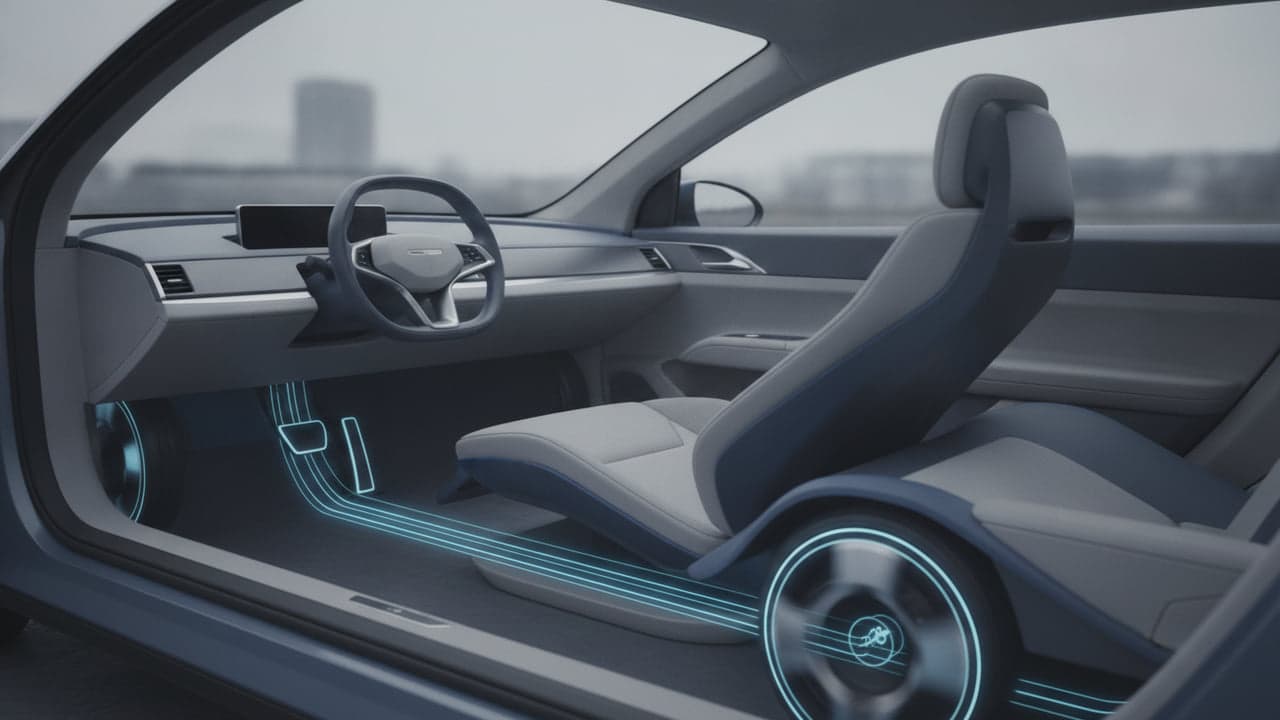
The Fang Cheng Bao Tai 9, a six-seat plug-in hybrid from BYD's off-road brand, is the first production car whose steering wheel folds away into the dashboard. General manager Xiong Tianbo presented it at the launch on 19 November. The wheel takes 10 seconds to disappear and frees about 25 cm of space in front of the driver, turning the front seat into a place to eat or nap while the car charges.
A wheel that drops behind a cover in 10 seconds
A button flips the rim through 180 degrees and lowers it into a compartment in the dashboard, which then closes over it. The move works when the car is parked and, according to Fang Cheng Bao, also while the Tai 9 is parking itself. What is left is an empty space in front of the driver, big enough for a small table holding a lunch and a drink.
A second button raises the base of the driver's seat by 9 cm and reclines the backrest to 165 degrees, in 20 seconds. The wheel itself has a full rim and buttons, not the cut-off yoke that Tesla made familiar. The company says the mechanism is built to fold 80,000 times, which it presents as four times a day for more than fifty years.
Read also on The Patent: Mural 2.0: a pen plotter that draws on walls from a ceiling anchor
The folding wheel comes only on the flagship version, priced at 329,900 yuan (about US$49,000) and for now sold only in China. The car was first shown at the Chengdu Auto Show in August.
No column: sensors read the rim and motors turn the wheels
The reason earlier folding wheels stayed on auto show stands is the steering column, the metal shaft between the wheel and the road wheels. The Tai 9 has none. It steers by wire: sensors read the movement of the rim and send an electrical signal to the motors that turn the wheels.
Steer-by-wire is not new in itself. Tesla's Cybertruck uses it in the United States, and Nio's ET9 was the first Chinese car to do so, in 2025. What is new is combining it with a rim that physically leaves the dashboard, a piece of engineering that depends on the electronics staying reliable when the mechanical link is gone.
A standard change, not a patent, opened the door
The regulatory obstacle fell on 1 July, when a new Chinese national standard dropped the requirement for a mechanical link between wheel and wheels, provided that every key part has a fallback. BYD says the Tai 9 covers five of them.
That rule change, rather than a single patent, is what let the design reach customers. The sources for this article name no patent application, granted patent or inventor behind the folding mechanism, so the intellectual-property position of the system is not documented here. Xiong Tianbo said at the launch that the industry had discussed disappearing steering wheels since 2016, but that none had reached a production car before this one.
Autoliv and Tensor showed one first, but have not shipped it
At CES in January, the safety supplier Autoliv and the California startup Tensor presented what they called the world's first foldable steering wheel, built for Tensor's self-driving Robocar. Tensor has not said when it will deliver the car or what it will cost.
The Tai 9 cannot drive itself yet. Fang Cheng Bao says the cabin is prepared for cars that will, and in the meantime the flat floor in front of the driver is offered as a place to sit while the plug-in hybrid charges.
What to watch: other brands and other markets
Because the Chinese standard now allows steer-by-wire without a mechanical backup, other Chinese carmakers can follow with folding wheels of their own. BYD has given no date for sales outside China, and has not said whether the mechanism will appear on cheaper models in the range. The first thing to watch is whether the 80,000-cycle figure holds up in everyday use, once cars are in customers' hands.
AI-assisted article