Oxford physicists simulate Aharonov-Bohm effect using trapped ions
Researchers used strontium ions to model particle interactions and magnetic flux in a synthetic two-dimensional loop.
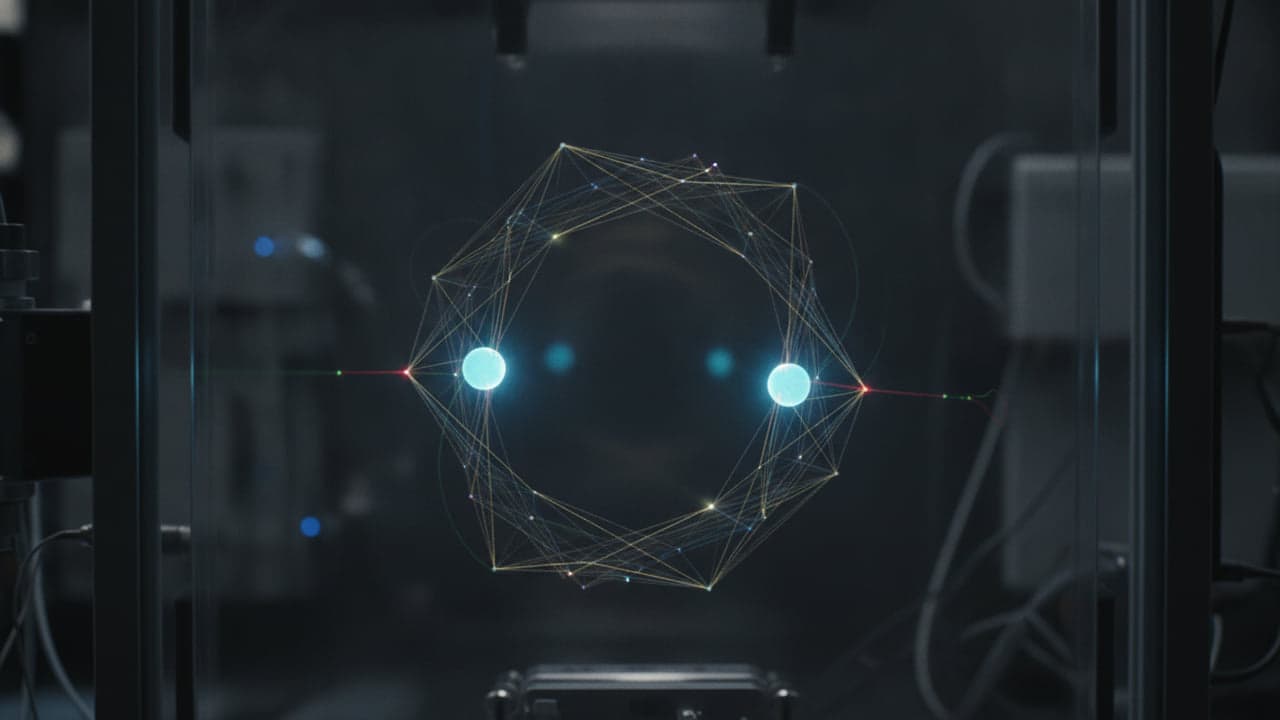
Physicists at the University of Oxford have demonstrated the Aharonov-Bohm effect inside a quantum simulation of a lattice gauge theory using trapped ions. The study, reported by [Phys.org](https://phys.org/news/2026-11-paths-flux-ions-simulate-aharonovbohm.html), models how matter interacts with force-carrying gauge fields in a closed loop. This experimental innovation provides an alternative method for exploring high-energy physics and exotic materials using quantum hardware.
Dual roles for trapped strontium ions
Standard gauge theories explain fundamental forces by tracking how matter fields exchange force-carrying gauge fields. In lattice models, space is treated as a grid where matter occupies vertices and gauge fields sit on the connecting links. Simulating these models on ordinary computers becomes computationally intractable as dimensions grow, which has spurred continuous innovation in specialized quantum computing platforms.
To build their simulator, researchers at the University of Oxford relied on a hybrid architecture. Two electronic energy levels of a strontium ion served as a qubit to represent the gauge field on a link, according to Phys.org. Simultaneously, the ions' vibrational modes acted as harmonic oscillators to store matter fields. In this framework, a single unit of vibrational energy, known as a phonon, represents a matter particle. First author Sebastian Saner noted that "the advantage is that matter fields can be stored much more efficiently in the vibrational modes."
“We first started brainstorming how to use a hybrid trapped-ion quantum system to simulate lattice gauge theories back in 2022.”
— Sebastian Saner, first author and researcher at the University of Oxford
Coupling motion through synthetic dimensions
The geometry of the simulated lattice does not rely on the physical placement of the ions in the trap. Even when aligned in a straight line, the particles can replicate higher-dimensional layouts through laser-engineered couplings known as synthetic dimensions.
To induce particle movement, the researchers directed laser beams to exert two separate forces on different vibrational modes. Each force pushed in a direction determined by the internal state of the qubit. Whenever the phonon hopped between matter sites, the field line on the connecting link alternated between present and absent states. This dynamic directly linked the particle motion to the underlying gauge field, as detailed by Phys.org.
Observing interference in closed loops
Previous quantum simulations of Z₂ lattice gauge theories were mostly restricted to one dimension or omitted matter fields entirely to reduce complexity. In one dimension, links cannot form loops, which prevents magnetic flux from appearing. By arranging two trapped ions into a quasi-two-dimensional geometry, the Oxford team introduced a closed loop pierced by flux, giving rise to flux quasiparticles known as visons.
The setup allowed the researchers to observe the Aharonov-Bohm effect, an interference phenomenon where a charged particle responds to electromagnetic potentials even in regions where the fields themselves are zero. Saner told Phys.org that the concept took shape over several years: "We first started brainstorming how to use a hybrid trapped-ion quantum system to simulate lattice gauge theories back in 2022." The resulting findings were published in Nature Physics.
Read also on The Patent: Quantum skyrmions on a chip survive after photon entanglement breaks down · Colloidal Anti-Spin Ice Created with Rotating Magnetic Fields