Optogenetics Pioneers Win Nobel Prize for Illuminating the Brain
Three scientists are recognized for their discoveries that allow controlling nerve cells with light, revolutionizing neuroscience.
By Giovanni Sapere
4 min readHuman-Edited, AI-Assisted
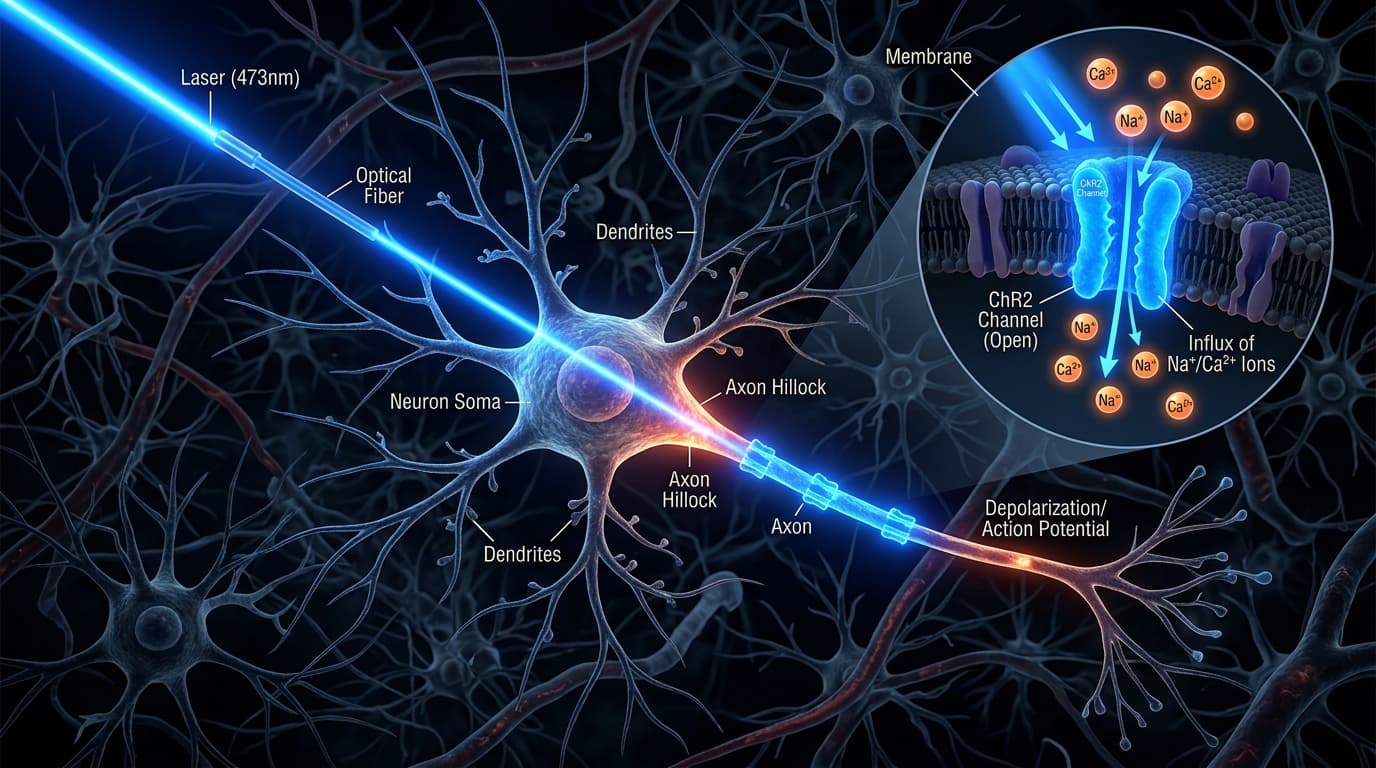
Karl Deisseroth, Peter Hegemann, and Georg Nagel have been awarded the Nobel Prize in Physiology or Medicine 2026 for their foundational work in optogenetics. This revolutionary technique utilizes light to control nerve cells, offering unprecedented insight into how the brain forms memories, emotions, and behaviors, and paving the way for new treatments for neurological conditions.
The Nobel-Winning Breakthrough
The Nobel Prize in Physiology or Medicine 2026 has been awarded to Karl Deisseroth, Peter Hegemann, and Georg Nagel for their discoveries concerning light-activated ion channels and optogenetics. This field combines genetic engineering and optical tools to precisely control and observe the activity of nerve cells using light, enabling scientists to map the brain with previously unimaginable detail. Before this breakthrough, understanding the brain's functions was often compared to a blurry photograph, as existing methods could not establish a definitive cause-and-effect relationship between specific nerve cell activity and behavior. Optogenetics has since transformed this understanding, allowing researchers to switch the activity of individual nerve cells in a living brain on or off, thereby revealing the neural circuits that govern behaviors, memories, and sensations relevant to neurological and psychiatric diseases. The Karolinska Institutet in Stockholm acknowledged their merit in laying the groundwork for this discipline, which allows for the control of nerve signals with light. This approach fulfills a vision once contemplated by molecular biologist Francis Crick, who shared the Nobel Prize in Medicine in 1962 for his work on DNA.
“Optogenetics has given us the opportunity to map the brain in a way we could previously only dream of.”
— Per Svenningsson, President of the Nobel Committee for Physiology or Medicine
“The ability to control behaviour raises ethical issues.”
— Cristian Ripoli, Professor of Physiology at the Catholic University of Rome
Discovering Channelrhodopsin
The journey toward optogenetics began with Peter Hegemann's research in the early 1990s, driven by his curiosity about how the unicellular alga Chlamydomonas could react so rapidly to light, enabling it to swim. Hegemann observed that an electrical impulse was generated within half a millisecond of light reaching the alga's eyespot, a reaction significantly faster than other biological systems, such as the human eye's 10-millisecond response time. He hypothesized that a single protein complex captured light and simultaneously acted as an ion channel, a protein that selectively permits ions to pass into or out of a cell. This idea was initially met with skepticism, as no known ion channels at the time were capable of reacting autonomously to light. However, in the early 2000s, working with Georg Nagel, Hegemann identified two genes in the alga's DNA that produced proteins called channelrhodopsin-1 and channelrhodopsin-2. Their collaborative work confirmed that these proteins were indeed ion channels that opened when exposed to light, validating Hegemann's hypothesis.
Engineering Light-Controlled Neurons
Channelrhodopsin-2 proved to be particularly vital for the development of optogenetics. When this protein is illuminated by blue light, a channel within it opens within 0.2 milliseconds, allowing charged ions to pass through. Karl Deisseroth then advanced this discovery by successfully transferring the gene for channelrhodopsin into the nerve cells of rats. By illuminating these genetically modified nerve cells with blue light, he was able to initiate a nerve signal. Further experiments demonstrated that this 'light switch' could control nerve cells in the brains of live mice, effectively transforming the protein into a precise tool for manipulating neuronal activity. This ability to activate or deactivate specific neurons with light has profoundly changed how scientists study brain function.
Transforming Neuroscience and Medicine
The development of optogenetics has profoundly changed our understanding of the brain, enabling scientists to explore its intricate workings with unprecedented detail. Per Svenningsson, president of the Nobel Committee for Physiology or Medicine, stated that optogenetics has provided the opportunity to map the brain in ways previously only dreamed of. The technique has already demonstrated significant clinical potential, such as partially restoring sight in individuals with retinitis pigmentosa by modifying their retinal cells to become light-sensitive. It also offers enormous translational potential, allowing for the activation of brain areas in neurodegenerative processes by bypassing functional anomalies. Cristian Ripoli, Professor of Physiology at the Catholic University of Rome, noted that while optogenetics opens "enormous perspectives," it also "poses ethical problems" due to the possibility of controlling behaviors. The technique has been in use for about 20 years, since 2005, making it easier to understand the link between specific brain areas and their functions.
The Patent Side of Optogenetics
The discoveries behind optogenetics are also protected intellectual property. Max Planck Innovation, the technology transfer arm of the Max Planck Society where Hegemann and Nagel carried out their work, offers licences on channelrhodopsin-based technologies, while Stanford University lists several channelrhodopsin inventions from Deisseroth's laboratory in its technology licensing catalogue. The Nobel recognition is likely to draw new attention to these patent portfolios as companies move optogenetic tools from the lab towards therapies.
The Scientists Behind the Discovery
Karl Deisseroth, born in the United States in 1971, is a Professor of Bioengineering, Psychiatry, and Behavioral Sciences at the Howard Hughes Medical Institute and Stanford University. Peter Hegemann, born in Germany in 1954, is a Professor of Neuroscience at Humboldt University of Berlin, with his Nobel-winning discoveries made at the Max-Planck-Institut für Biochemie. Georg Nagel, born in Germany in 1953, is a Professor of Molecular Plant Physiology at the University of Würzburg, having conducted his prize-winning work at the Max-Planck-Institut für Biophysik. Nagel, who received the Nobel call while on vacation in Italy, earned his PhD in biophysics in 1988. Hegemann studied chemistry and biochemistry before his PhD, and Deisseroth completed his biochemistry degree at Harvard in 1992 and his PhD in Neuroscience at Stanford, where he has directed his laboratory since 2004. The studies by Hegemann and Nagel were also partly funded by the European Union.