Northwestern traps a single positron to test antimatter symmetry
The particle was cooled to just above absolute zero and suspended in empty space, the first step toward the most precise comparison yet between an electron and its antimatter twin.
By Letizia Giugliano
3 min read

Physicists at Northwestern University have captured a single positron, the antimatter counterpart of the electron, and cooled it to a temperature just above absolute zero. The particle floats in a wall-free trap, held by electric and magnetic fields so it never touches ordinary matter. The team calls the system a one-positron quantum cyclotron. That system is the starting point for the most rigorous comparison yet between the electron and the positron, a test that could show where the Standard Model of particle physics breaks down.
A particle held in empty space, because any wall would destroy it
The positron did not arrive in a container. The Northwestern team took a positron produced in radioactive decay, slowed it down and cooled it to just above absolute zero, then confined it inside a near-perfect vacuum. The trap shapes that empty region with carefully configured electric and magnetic fields, so no solid surface ever touches the particle. Contact with ordinary matter would end it in annihilation.
"If we want to study antimatter, we must handle it carefully," said Gerald Gabrielse, who led the study. "To be clear, it's not dangerous. We don't have enough antimatter to make an explosion."
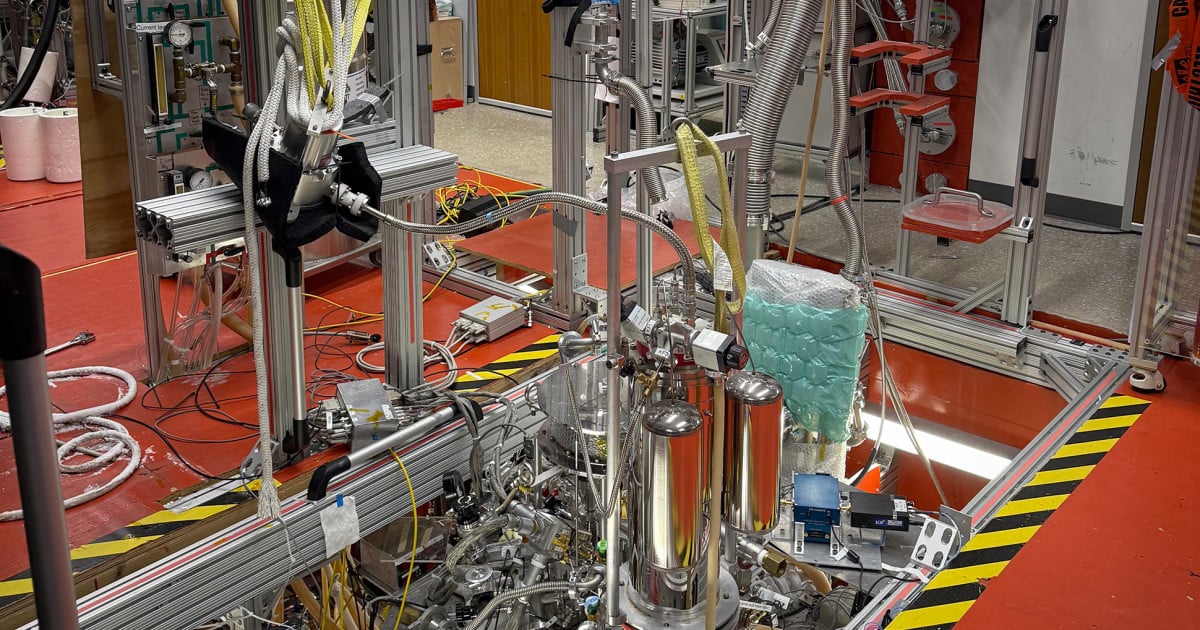 Photo: Northwestern
Read also on The Patent: Washington team models an Earth where life never appeared · A TU Wien switch with four states instead of two
The method is described in Physical Review Letters, in a paper titled One-Positron Quantum Cyclotron. Thomas Myers, a PhD student in Gabrielse's laboratory, is its first author, and five researchers appear on the author list.
Why one particle behaves like an artificial atom
A charged particle in a magnetic field circles around the field lines, an arrangement physicists call a cyclotron. Because the Northwestern device holds exactly one positron, its quantum energy levels can be addressed one at a time: inside the trap the particle behaves somewhat like an artificial atom, and the researchers can observe and manipulate those individual levels.
That is what separates this from earlier antimatter work. A cloud of particles returns average values. A single trapped particle gives a system whose state is known and can be measured without interference from neighbours.
Gabrielse is the Board of Trustees Professor of Physics at Northwestern's Weinberg College of Arts and Sciences and director of the university's Center for Fundamental Physics.
The magnetic measurement aimed at the Standard Model
The Standard Model describes the fundamental particles and three of the four fundamental forces: electromagnetic, strong nuclear and weak nuclear. It predicts that the electron and the positron are almost perfect mirror images of each other, and countless experiments have confirmed its predictions with high accuracy. The theory still cannot say why the observable universe holds so much more matter than antimatter.
The comparison now becomes possible because two research lines meet. Gabrielse's group spent decades isolating individual electrons and measuring their magnetic properties with exceptional precision. Gabrielse also helped establish low-energy antimatter research by pioneering techniques for slowing, capturing and cooling antiprotons. The new trap applies the electron methods to a single antiparticle.
What comes next is a magnetic measurement: the positron's properties, taken at the highest accuracy the method allows, set against the electron's. A difference the theory cannot absorb would point to physics beyond the Standard Model.
Equal amounts at the Big Bang, and almost nothing to show for it
"The big mystery of the universe is the Big Bang should have created equal amounts of matter and antimatter," Gabrielse said. "But, if that were true, it would annihilate, and we'd be left with nothing. There's clearly something wrong with that theory, and that's what we're trying to figure out."
He adds that the Standard Model has to be wrong somewhere, or at least incomplete, since it cannot predict why the universe exists. The Northwestern result does not answer that question. It gives the group the instrument to look for an answer, and the paper states the aim plainly: the most precise comparison yet between matter and antimatter, a level of precision that also drives progress in fields as varied as indoor solar cells and the 3d printed satellite market.
Human-Edited, AI-Assisted