MIT revives a 1985 three-sided zipper patent as a 3D-printed Y-zipper
The new fastener survived 18,000 open-and-close cycles in CSAIL tests and cuts pitching a tent from about six minutes to one minute and 20 seconds.
By Giovanni Sapere
4 min read
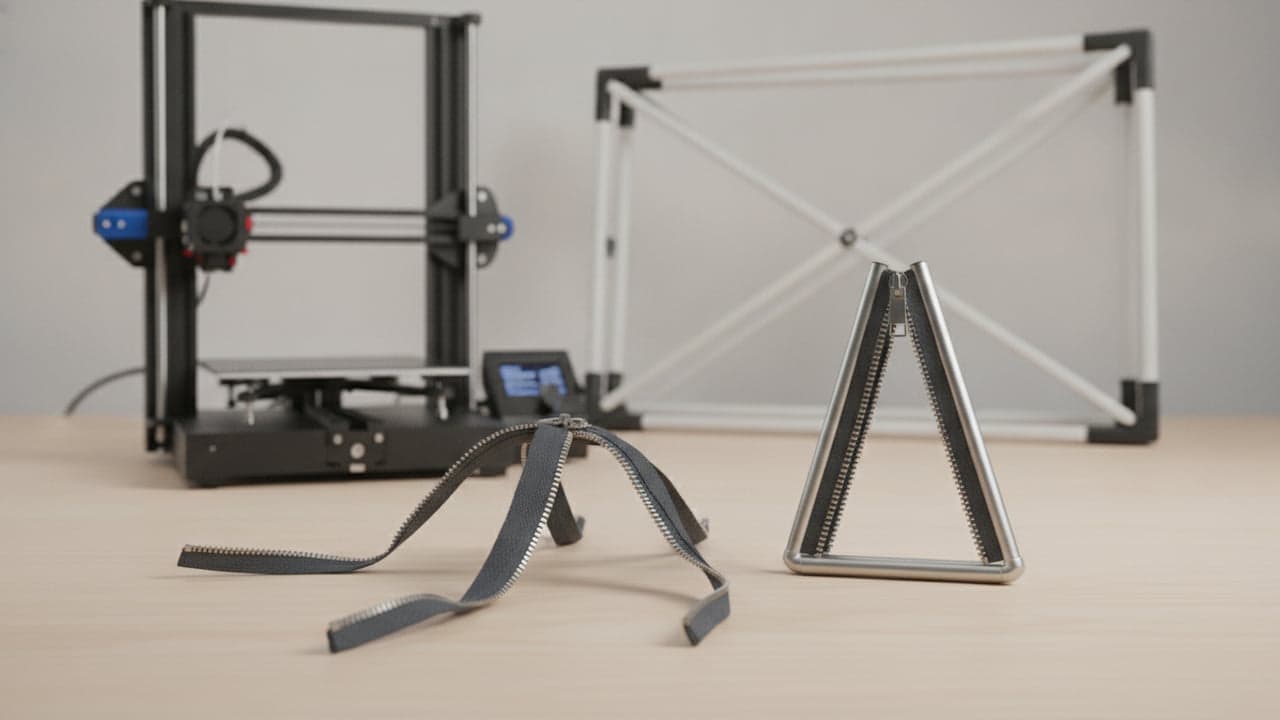
In 1985 an electrical engineer at Polaroid named William Freeman answered an advertisement in Scientific American with a drawing for a three-sided zipper. His proposal was turned down, but he patented the prototype and kept it in his garage. Nearly 40 years later, researchers at MIT's Computer Science and Artificial Intelligence Laboratory have turned that design into a working invention: a 3D-printed Y-zipper that flips objects between soft and rigid states.
An ad in Scientific American and a rejected proposal
The Innovative Design Fund placed an advertisement in Scientific American offering up to $10,000 to support clever prototypes for clothing, home decor and textiles, according to MIT News. Freeman, then an electrical engineer at Polaroid and now an MIT professor, sent in a three-sided zipper. Instead of closing a jacket, it worked like a switch that moved chairs, tents and purses between soft and rigid states so they could be packed and assembled more easily.
The blueprint looked like a normal zipper made triangular. Freeman fixed narrow wooden teeth to belts on three sides, and a slider wrapped around the device to fasten all three strips and straighten them into a triangular tube. The fund rejected the proposal. He patented the prototype anyway and stored it in his garage in case it proved useful later. The source gives no patent number for that filing.
Read also on The Patent: Columbia Chemists Upgrade stroboSCAT Microscope to Track Single Quantum Particles · Electric comb delivers genetic molecules to reverse hair loss in mice
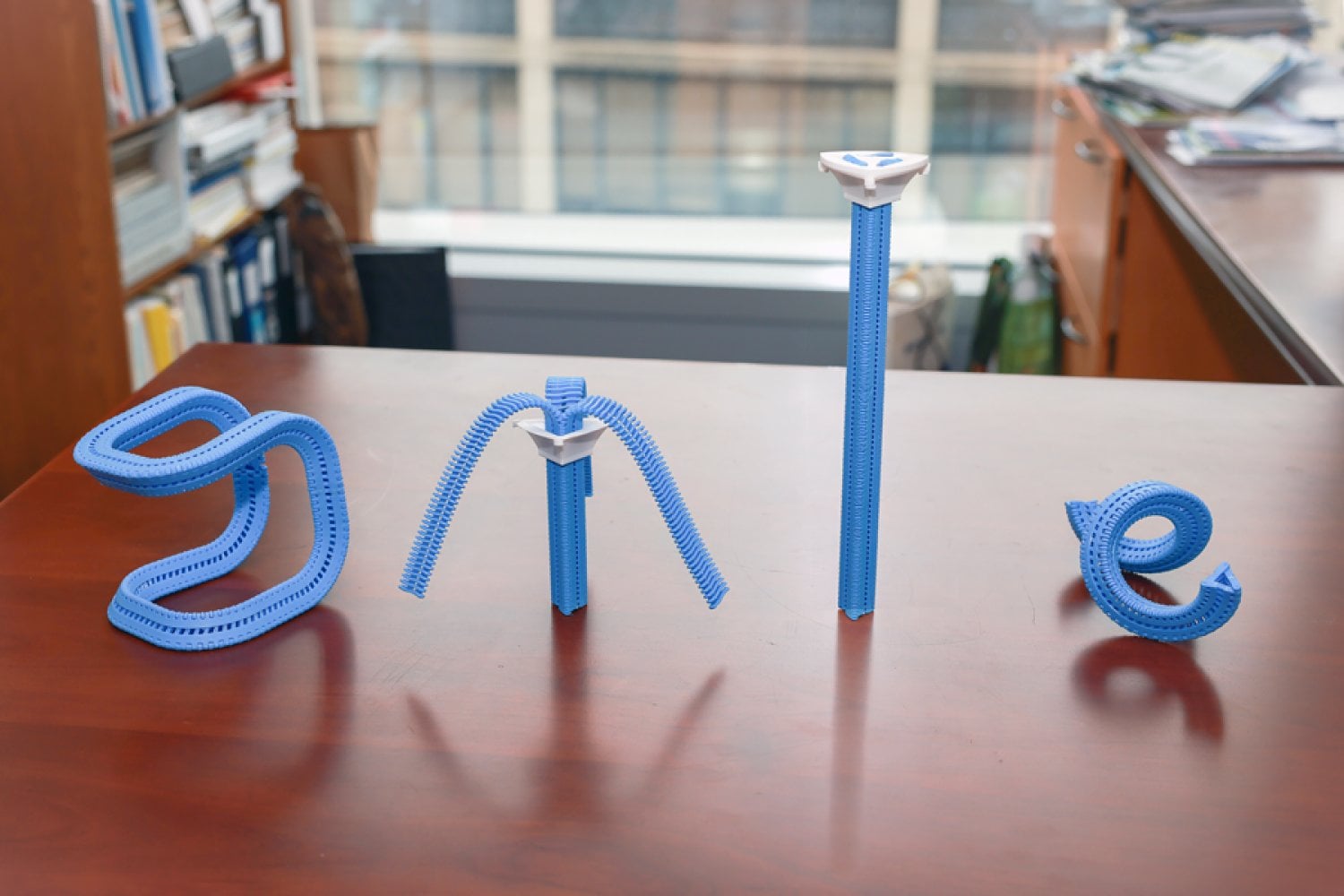 Photo: MIT
“A regular zipper is great for closing up flat objects, like a jacket, but Freeman ideated something more dynamic.”
— Jiaji Li, MIT postdoc and CSAIL researcher
Software, a 3D printer and four motion primitives
MIT CSAIL picked the idea up again to make objects with tunable stiffness. Earlier attempts at adjustable rigidity were hard to reverse or needed manual assembly, so the team wrote an automated design tool and built a matching fastener. Users choose the length of each strip and the direction and angle at which it bends, then pick one of four motion primitives for the zipped shape: straight, bent like an arch, coiled like a spring, or twisted like a screw. The program then sends the file to a 3D printer, which builds the device in plastics without further assembly. The parts can be attached to or embedded in camping equipment, medical gear, robots and art installations.
"A regular zipper is great for closing up flat objects, like a jacket, but Freeman ideated something more dynamic," says Jiaji Li, a postdoc at MIT and CSAIL who is a lead author on an open-access paper describing the work. Li says the team developed a process that builds objects shifting quickly from flexible to rigid, with confidence that they work in the real world.
A tent in 80 seconds, a cast that loosens at night
An unzipped Y-zipper can splay out like a squid with three tentacles; zipped, it becomes a compact rod. In one demonstration the team attached each arm to a side of a tent and supported the structure from the top. Pitching the tent alone takes up to six minutes, the researchers report; with the Y-zipper it took one minute and 20 seconds. In a medical example they wrapped the fastener around a wrist cast so the patient could loosen it during the day and zip it tight at night.
 Photo: MIT
A motor can be attached after printing to automate the motion. That produced an adaptive robotic quadruped whose legs could extend or shorten, a capability the team suggests could help a robot move over uneven ground in places such as canyons or forests. A static motor also drove a long, winding flower that opened for an art installation.
18,000 cycles before the teeth gave up
Durability was the open question. The team bent Y-zippers made of polylactic acid (PLA) and thermoplastic polyurethane (TPU), two common 3D printing plastics, and found PLA handled heavier loads while TPU was more pliable. An actuator then opened and closed the device until it failed: it broke after 18,000 cycles. Simulations of the 3D structure point to the elastic geometry, which spreads the stress of a load, as the reason it lasted that long.
Li sees room for a tougher version in stronger materials such as metal, and for larger zippers for bigger projects. Neither is possible on the group's current printing platform yet. Applications in space exploration remain untested, he adds, though the tentacle-like arms are the part he expects to matter there. The paper is published open access.
AI-assisted article