Leukaemia's first mutation can appear 50 years before diagnosis
Blood samples stored for up to 15 years show mutated cells doubling in weeks rather than years once four cancer-driving mutations accumulate
By Letizia Giugliano
5 min read

In two thirds of a group of women who developed acute myeloid leukaemia, the first mutation that helped drive the cancer appeared before the age of 20. A team at the University of Cambridge and University College London reconstructed that path from blood samples collected annually, some taken 15 years before diagnosis, and published the results in Nature. The finding suggests a warning window of decades in which the disease might be intercepted rather than treated.
Blood drawn years apart records the disease's slow start
The study drew on the UK Collaborative Trial of Ovarian Cancer Screening (UKCTOCS), in which around 50,000 women gave a blood sample every year for up to 11 years. From that collection the researchers took 47 women who later developed acute myeloid leukaemia (AML), an aggressive blood cancer, at an average age of 72, and matched samples from 46 women who stayed free of blood cancer.
Using ultra-sensitive DNA sequencing and mathematical modelling, the team worked backwards to date each mutation and measure how fast the affected cells multiplied. The University of Cambridge, which announced the results on 11 November 2026, described the samples as a record of the disease's development. AML affects around 2,700 people in the UK each year, and only about one in six survive five years after diagnosis.
 Photo: University of Cambridge
Read also on The Patent: Allergies may begin with energy-starved barrier cells, not immune misfires · A Berkeley compound burns fat in mice while sparing muscle · Nanoporous platinum electrodes restore 90% of muscle strength in animals · Neuroscience 2026: four new biomarker studies for Alzheimer's and depression
The study did not include samples taken at the moment of diagnosis, and all the participants were women diagnosed between the ages of 53 and 83.
“Serial blood samples are a fossil record of the blood's evolution. They let us go back in time and reconstruct when each mutation arose and how fast it grew.”
: Professor Jamie Blundell, Early Cancer Institute, University of Cambridge
“Once a clone is established, its growth rate today tells you where it will be years, even decades, from now.”
: Professor Jamie Blundell, Early Cancer Institute, University of Cambridge
“As a haematologist, I've seen how suddenly AML can change someone's life. This study shows that the changes leading to AML can build over decades.”
: Dr Caroline Watson, first author, Early Cancer Institute, University of Cambridge
Each extra mutation makes the cells grow two to three times faster
In two thirds of the women who developed AML, the earliest cancer-driving mutation was estimated to have arisen before their 20th birthday. With an average diagnosis age of 72, that placed the first step more than 50 years before the disease was found.
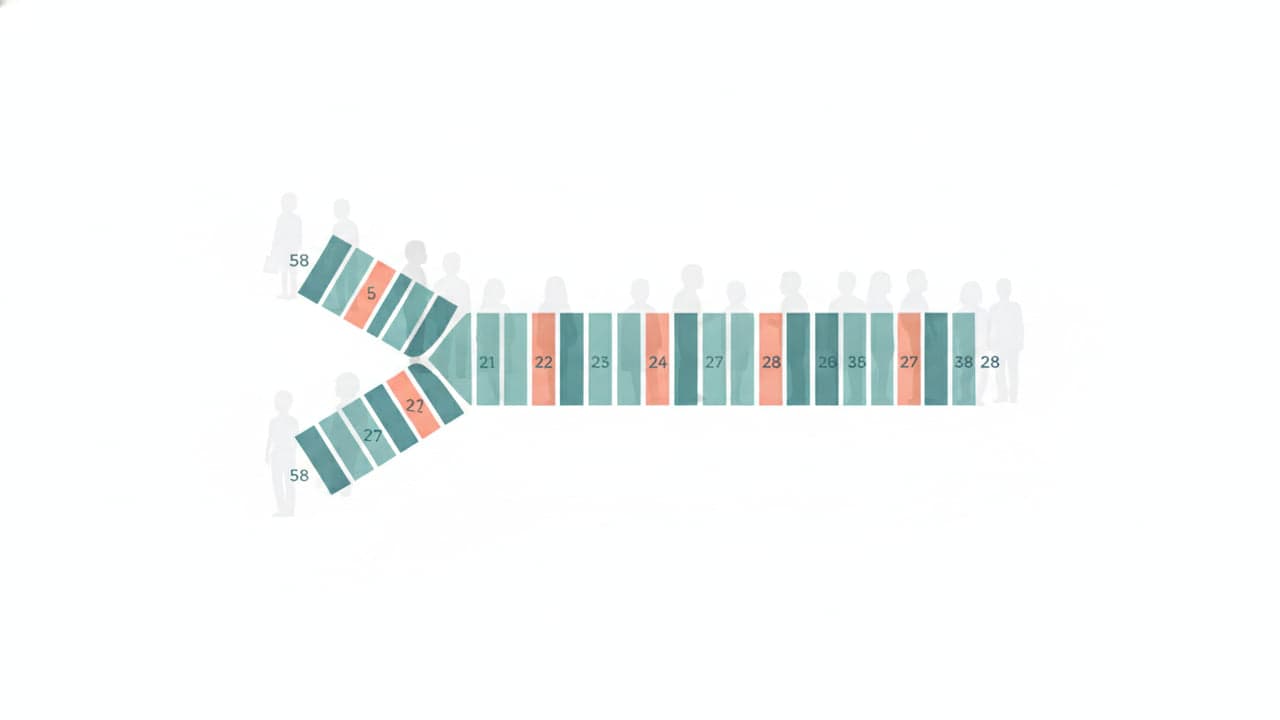
Growth at that stage was very slow: cells carrying the mutation took years just to double in number. Every additional mutation raised the growth rate roughly two- to three-fold. Cells carrying four cancer-driving mutations could double within weeks.
Once a clone, the name for a group of blood cells descended from one mutated cell, was established, its expansion was steady and predictable, slowing only when it ran out of space or was overtaken by a faster-growing clone. That regularity is what makes forecasting possible from a handful of blood samples.
A somatic sweep, a warning sign that standard tests overlook
In at least one third of the AML cases, one clone had grown so large that it dominated the blood years before diagnosis, a process the researchers call a somatic sweep. No such sweeps appeared in the women who remained blood cancer free.
The team checked the link against UK Biobank data and found that people with these sweeps faced a greatly increased risk of developing the disease. Standard genetic analysis often misses the signal, because the mutations involved can be mistaken for inherited variants.
The timetable is not universal. In around one in five cases, the expanding mutated cells were not detectable until one or two years before diagnosis, which points to a much shorter warning period.
What a window of ten years or more could be used for
Because the growth is exponential, the team argues that even a small, sustained reduction in the speed of a high-risk clone could lower the chance of progression, compounded over the decade or more between the second mutation and diagnosis.
Professor Jamie Blundell, who led the work at the Early Cancer Institute at the University of Cambridge, said the samples let the team go back in time, and that the predictability of clone growth surprised them most. Dr Caroline Watson, first author and an honorary consultant haematologist, sees patients at the Cambridge Clonal Haematopoiesis Clinic at Addenbrooke's Hospital, described in the announcement as the first clinic in Europe focused on leukaemia prevention.
The next step is to test whether slowing these clones can be done safely and effectively in people identified as high risk. No preventive treatment has yet been shown to work, a contrast with bcg vaccination's established role against tuberculosis.
A second study explains how a protein fusion switches genes on
Separate work published in Molecular Cell describes the mechanism behind a rare, aggressive subtype of AML caused by a chromosomal rearrangement that fuses two proteins, KAT6A and p300, both involved in adding chemical tags to histones, the proteins DNA wraps around.
Scientists in the Division of Cell and Molecular Biology at The Institute of Cancer Research, London, built the first mouse model in which the fusion arises in its natural genomic context, using CRISPR gene editing. The fusion created regions of histone hyperacetylation at genes that keep leukaemia cells growing. Those regions recruited a chromatin-remodelling complex called cBAF, made the DNA more accessible and drew in RNA polymerase II, the enzyme that starts transcription.
When the researchers removed the fusion, acetylation fell, cBAF recruitment dropped and the cancer-promoting gene expression switched off, as reported in the paper with joint first authors Alexandra Cooper and Grigory Zemlyanski. The institute states that the work is at an early stage and does not establish a new treatment.
Human-Edited, AI-Assisted