Algarve fossils push the rise of modern green algae back 30 million years
Fieldwork at Praia da Luz produced 18 charophyte species, among them a new genus, and pushed the spread of modern green algae back by roughly 30 million years.
By Giovanni Sapere
3 min read
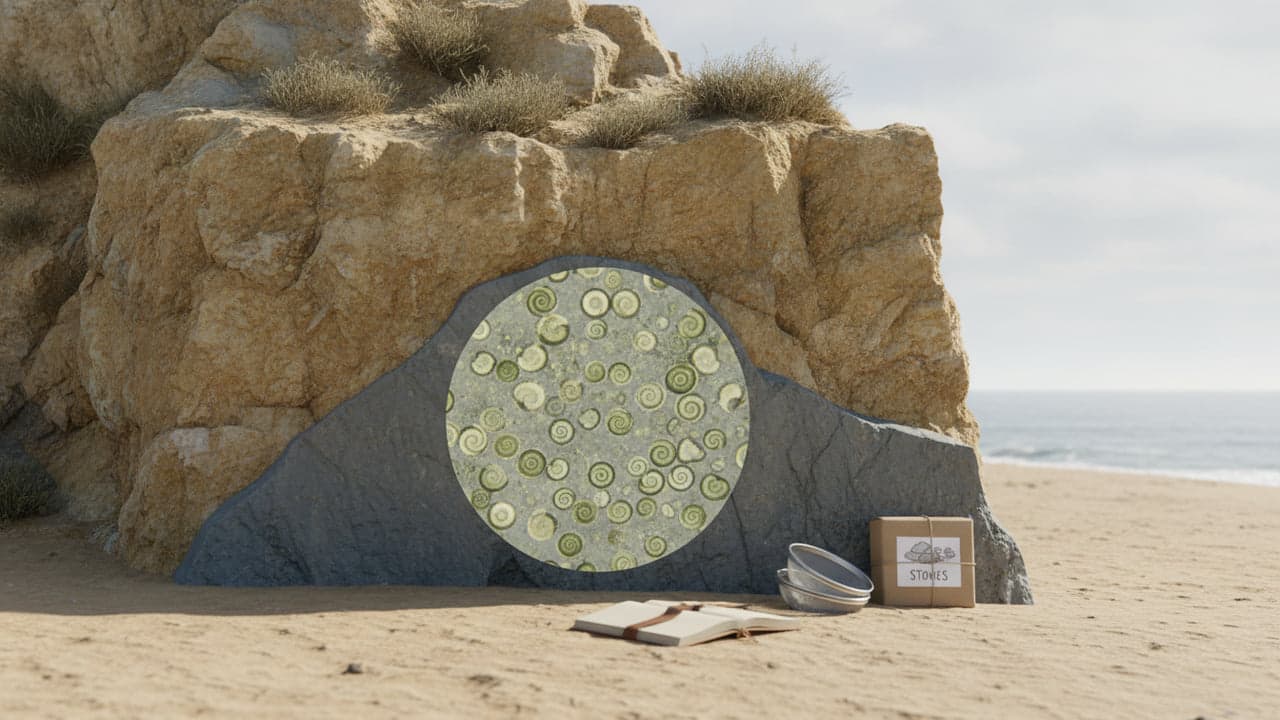
Jordi Pérez Cano travelled to the Algarve in spring 2024 to date rocks and came back with a new genus of green algae. The 120 kilograms of clay his team collected at Praia da Luz hold the oldest known specimens of several charophyte lineages, described in the journal Palaeontographica Abteilung B. The find moves the appearance of present-day genera from about 80 million years ago to 115 million years ago.
Stones in the post, a sorting tray in Barcelona
Charophytes are freshwater green algae, and the group includes the closest relatives of land plants. Geologists use them for biostratigraphy, the dating of rock layers by the microfossils they contain. Pérez Cano and his colleagues revisited Algarve sites first studied between the 1960s and the 1980s, and the fieldwork, described in the account accompanying the paper, began in the spring of 2024.
At Praia da Luz they collected 120 kg of rock, mostly clay, and sent the whole consignment to Barcelona, where a postal clerk in the town of Loulé had questioned the description on the parcel: stones. In the laboratory the samples were soaked in water until they broke apart, sieved, and the microfossils picked out one by one with fine brushes.
Four names, one of them wearing a Roman cap
The first surprise was an Echinochara, a genus of the extinct family Clavatoraceae that the author already knew well, with features wrong for its geological age. A friend's remark gave the species its name: Echinochara rebellis.
Read also on The Patent: XRP Ledger plans quantum-resistant accounts without a fee increase · How much does a patent cost? The bill year by year, country by country
Three more taxa followed. Lychnothamnus pileatus turned up in rocks 115 million years old, although the genus had been recorded only from deposits about 80 million years old in Europe, Asia and the Americas; the species name refers to the pileus, the hat that marked freed slaves in ancient Rome. Nitellopsis lilliputiensis, placed in the subgenus Campaniella, is far smaller than known members of the genus, whose earliest record came from 67-million-year-old rocks in the Catalan Pyrenees, and takes its name from the inhabitants of Lilliput in Gulliver's Travels.
The last is a genus new to science, Acroleptochara, meaning charophyte with a tapered upper part. Its apical cells, the cells that build the tips of shoots and roots, are thinner than in any comparable plant, a feature specialists in Barcelona, Montpellier, Argentina and China had never seen. The species is Acroleptochara cynetica, after the Cynetes, the earliest recorded inhabitants of the Algarve. Of the 18 species collected in total, several were known from elsewhere, but these are their oldest specimens.
Why a shrinking sea would suit these algae
The Clavatoraceae began to lose diversity around 110 million years ago and disappeared 66 million years ago. The Characeae family is older, dating back some 200 million years, yet most of its living genera were thought to have emerged about 80 million years ago. Finding them in 115-million-year-old clay removes that gap.
The team's explanation is climate. The Cretaceous (145 to 66 million years ago) is usually described as a warm, greenhouse period with high seas, but it was not uniform, and colder intervals lowered the water line. As the sea retreated, continents grew wider and lakes formed, which is where charophytes thrive. Their hypothesis is that a brief cold spell around 115 million years ago, brief meaning about 2 million years, created exactly those lakes.
The Algarve preserves no direct trace of the cooling itself. What the rocks do show is a continental setting with lakes. That matters because most European records of the period come from marine deposits, which leaves the Portuguese cliffs as an unusual window onto land environments of the time.
What a Latin name protects, and what it does not
The paper describes no patent and no patent application. The asset the authors build is different: a dated, peer-reviewed description with type material from a named locality, published in Palaeontographica Abteilung B, that other researchers can cite and check against new samples. In this field intellectual property works through priority of publication rather than exclusive rights, and a genus name is a scientific hypothesis as much as a label.
The claim that needs testing is the timing. If short cooling episodes really did drive the diversification of freshwater algae, comparable sections elsewhere should show the same pattern near the 115-million-year mark. The Algarve samples put the question on the table; they do not settle it.
AI-assisted article