University of Queensland sends a word through a brick wall using gravity
Each position of a 1.8-metric-ton counterweight stood for a binary digit, and the link carried one bit per minute
By Mattia Sapere
4 min read

Physicists at the University of Queensland have sent a message through a brick wall using gravity alone. The team encoded digital bits in the movement of a heavy elevator counterweight and read them back with a detector on the far side of the wall. The work, published in Science Advances, is a proof of concept for a channel that does not rely on electromagnetic waves.
A lift, a counterweight and a detector in a bathroom
The experiment ran inside the Parnell Building at the University of Queensland. Physicists moved an elevator between two floors, shifting its 1.8-metric-ton counterweight between two positions. Each position stood for one binary digit, a 0 or a 1. On the other side of a brick wall, a gravimeter sat in a nearby bathroom and measured the very small changes in gravitational pull produced by the moving mass. Decoding those readings returned a one-word message: "Gravity". The paper in Science Advances lists Andrew J. Groszek as lead author among five.
“Unlike the electromagnetic signals used in modern wireless communication, a gravitational signal cannot simply be screened out by placing ordinary material in its path.”
: Charles Woffinden, School of Mathematics and Physics, University of Queensland
“Our experiment transmitted just 1 bit per minute, meaning it took an hour to send a single word.”
: Andrew White, professor, University of Queensland
“It's not often that you get to demonstrate an entirely new way of communicating.”
: Matthew Davis, professor, University of Queensland
Why a brick does not stop this signal
Any object with mass produces a gravitational field, and moving the object changes the field around it. Those changes are far too small for a person to feel. A sensitive instrument can pick them up, and a controlled sequence of movements becomes a sequence of ones and zeros. Charles Woffinden, from the UQ School of Mathematics and Physics, described the appeal: "Unlike the electromagnetic signals used in modern wireless communication, a gravitational signal cannot simply be screened out by placing ordinary material in its path." He added that anyone who has lost phone reception in a tunnel or struggled with Wi-Fi through a solid wall will see the point.
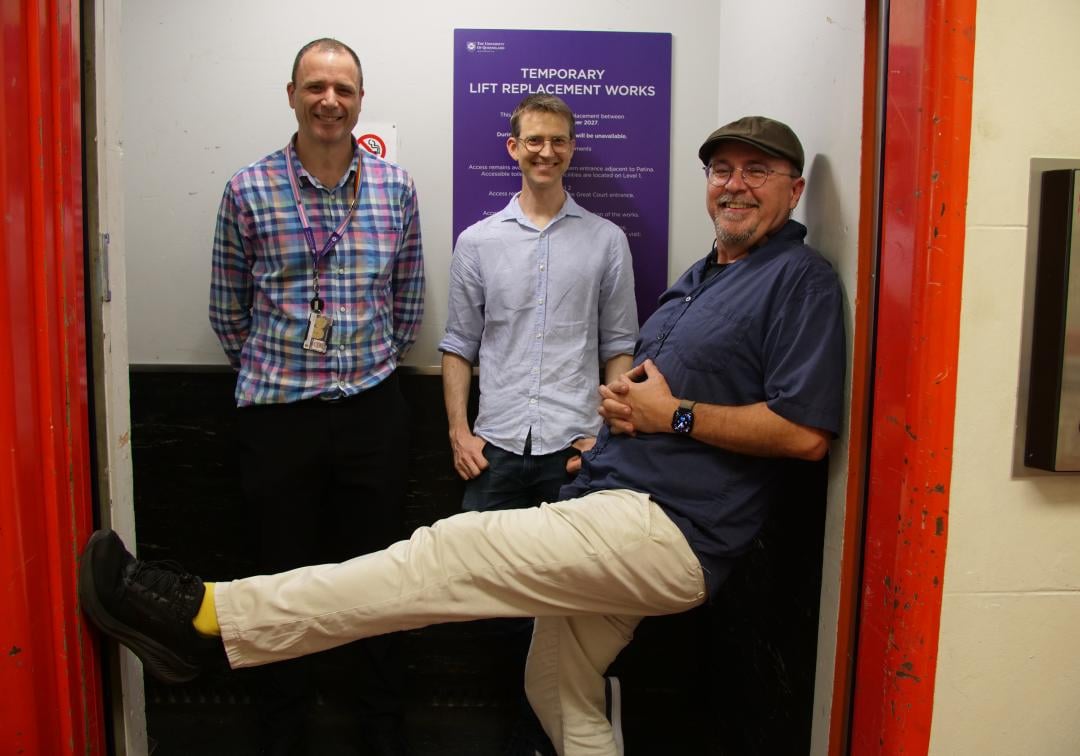 Photo: News
An hour to send a single word
Speed is the obvious weakness. Andrew White, a professor at UQ, said the elevator dates from the 1950s and moved slowly, so the link carried 1 bit per minute. A bit is the smallest unit of digital information, one 0 or one 1, and modern wireless systems move enormous numbers of bits every second. White said faster gravity communication would come down to three variables: how big the mass is, how fast it can be moved, and how sensitive the detector is.
The idea started as a weighbridge for trucks
Andrew Groszek said the team had been developing a contactless weighbridge, a system meant to weigh vehicles without making them drive onto a scale. "We were aiming to determine the mass of trucks and other large vehicles by measuring their tiny gravitational pull," he said. Once that worked, the researchers saw that the same physics could carry information. A detector able to register a truck's pull could also register deliberate shifts of a heavy object.
No patent mentioned, and a detector problem still open
Neither the Science Advances paper nor a University of Queensland summary of the work mentions a patent application, a granted patent or a licensing plan. What the researchers describe is a laboratory demonstration built on a conventional gravity sensor. Matthew Davis, another professor on the team, said the main achievement was showing that gravity can transmit information that can be recovered: "It's not often that you get to demonstrate an entirely new way of communicating." The university summary says more advanced sensors could eventually make the approach faster and able to work over greater distances. White offered a historical yardstick rather than a date: it took more than 100 years to go from the first telegraph system to the mobile phone. The result is a lab demonstration, not a commercial system: it sits far from the 3d printed satellite market, a patented solar fabric startup, nanobodies llama platforms, silver diamine fluoride independence work or an mcp driver application, and it shows how communications research can advance by rethinking the physical channel.
 Photo: News
Read also on The Patent: Washington team models an Earth where life never appeared · Electrons in graphene cross forbidden energy gaps at 100% probability · Hamster cells keep algal chromosomes for 155 generations
Human-Edited, AI-Assisted