Reversed peptides bind rare earths ten times better, German team finds
The result, which grew out of a peptide left in a freezer for several years, has won the German Chemical Society's Mario Markus Prize for Ludic Sciences.
By Giovanni Sapere
3 min read
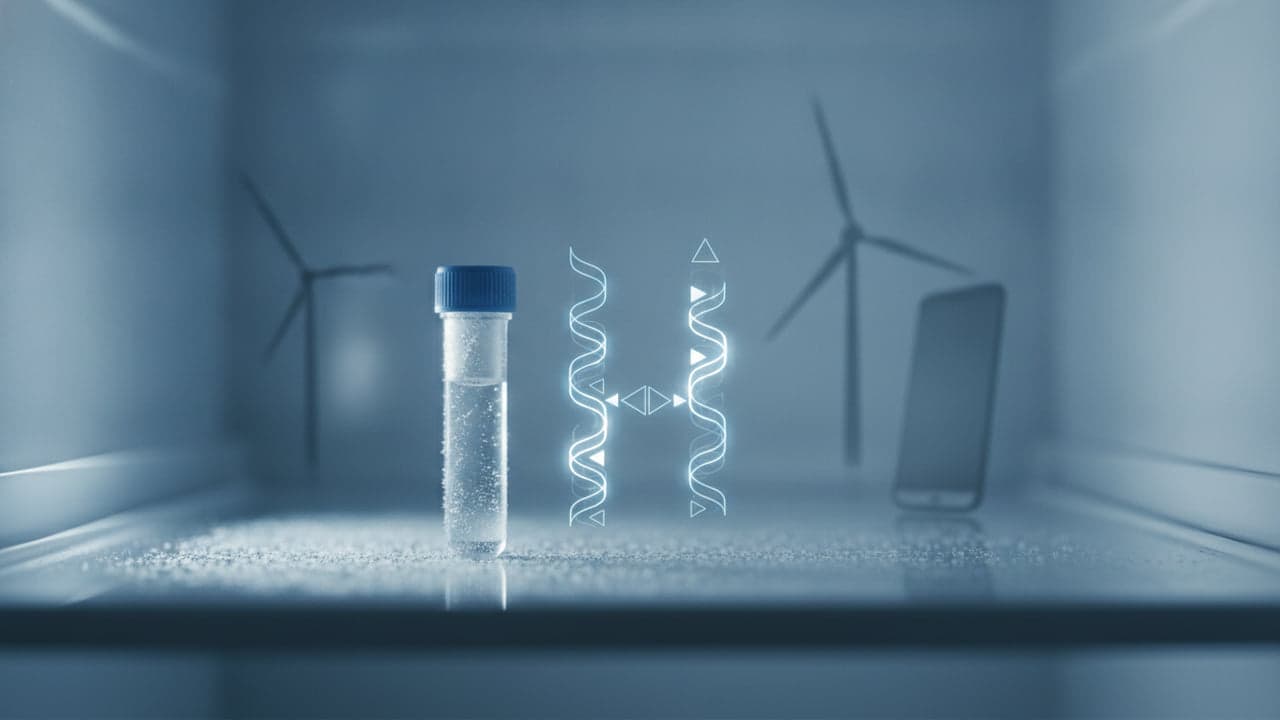
Six researchers at two German institutes report that peptides assembled in the wrong order bind lanthanides about 10 times more strongly than the natural sequence. The result grew out of a peptide left in a freezer for several years, and it has earned the group the German Chemical Society's Mario Markus Prize for Ludic Sciences.
A peptide built backwards, then forgotten in a freezer
The work began with lanmodulin, a bacterial protein that binds lanthanides, the group of 15 chemically similar metallic elements, with high affinity. Lena Daumann, a professor of bioinorganic chemistry at Heinrich Heine University Düsseldorf, and Sophie Marie Gutenthaler-Tietze reproduced the protein's metal-binding regions as peptides, short chains of amino acids.
With little experience at the time, they assembled their first peptide in reverse order. They spotted the mistake and stored the sample in a freezer, where it stayed for several years. Curiosity brought them back: if the number and spacing of the amino acids responsible for metal binding had not changed, did their order matter?
Read also on The Patent: Recycling Neodymium Magnets from Computer Drives with Ammonium Chloride · A metal-organic framework holds sulfuryl fluoride gas as a safer solid reagent · A light-powered catalyst lifts hydrogen peroxide output by 200% · Coffee grounds give up their oil in 60 minutes, Spanish chemists report · Chinese team finds a crystal that carries heat like liquid, glass and crystal
Joined by Björn Drobot, Jérôme Kretzschmar, Robin Steudtner and Satoru Tsushima at Helmholtz-Zentrum Dresden-Rossendorf, the group compared the frozen peptide with three other reversed variants. Three of the four held lanthanides far more tightly than peptides with natural sequences. The fourth showed no gain at first; after one amino acid was swapped, it reached an exceptionally high affinity for a peptide of its length.
“The team will receive a EUR 10,000 [USD 11,000] prize for a discovery made possible by a laboratory error.”
: German Chemical Society (GDCh), press release
What the reversed sequence changes, and what it does not
The effect comes from order, not from the residues themselves. The reversed peptides kept the amino acids that do the binding but changed how they sit relative to one another. The published account offers no structural explanation for why that rearrangement strengthens the grip on lanthanides.
The commercial backdrop is sizeable. The 17 rare earth elements go into smartphones, wind turbines, batteries, defence equipment, medical devices and indoor solar cells, and separating them is difficult without environmental damage, according to the researchers. Their hope is that peptides able to capture and separate specific lanthanides could make recovery of these raw materials cleaner. That is a chemical argument so far, made by the authors themselves.
No patent in sight, and no plant either
The public record here is a paper in Angewandte Chemie International Edition and an award from a scientific society. Nothing in the material describes a patent application, a granted patent or a filing, and no company is named as a partner or licensee. Protection, if it is ever sought, would have to start from a disclosure that is already published.
A second gap is technical. The researchers have not yet established whether these molecules can be used in real recycling processes, so the step from a binding measurement in a laboratory to an industrial separation stage is still open. As first reported by Interesting Engineering, the group frames the work as a possible route rather than a demonstrated method.
EUR 10,000 and a date in Frankfurt
The German Chemical Society (GDCh) gave the group the Mario Markus Prize for Ludic Sciences, citing the study's originality, scientific merit and playful approach. The award carries EUR 10,000, about USD 11,000.
The six researchers will receive it on December 15 in Frankfurt, where they will also present their findings. Their frozen sample, meanwhile, remains what it was when they opened the freezer: a short chain of amino acids that happens to hold rare earths tightly.
Human-Edited, AI-Assisted