X-rays show a Scottish fossil thought to be a reptile had gills
The Scottish specimen described in 1990 as one of the earliest reptiles had gills and a fish-like mouth with thousands of tiny teeth, a study in Nature reports.
By Giovanni Sapere
4 min read
A near-complete skeleton found in Scotland in 1984 belonged to an aquatic or amphibious animal, a team at the American Museum of Natural History and the University of Oxford says. Researchers had treated the skeleton as one of the earliest reptiles for three decades. X-ray imaging at the European Synchrotron Radiation Facility in Grenoble found gills and a fish-like jaw hidden inside the rock. The paper, published in Nature, also pushes the origin of claws and five-fingered hands back to animals that still lived in and out of water.
A lizard-shaped fossil with the wrong label
The specimen is Westlothiana lizziae, a species known from a single, nearly complete skeleton preserved in two crushed slabs of rock. It was found in Scotland in 1984 and nicknamed Lizzie for its likeness to a lizard. When scientists described it in 1990, they worked from features visible on the surface: four limbs, fingers and toes, and tips that looked like claws.
Those traits set it apart from animals of the same age whose limbs looked more like fins, and the fossil became a standard reference for the origin of amniotes, the vertebrate group that includes reptiles, birds and mammals. Xavier Jenkins, a postdoctoral fellow in the Museum's Division of Paleontology and co-lead author, said the animal had held that place for a long time: "Lizzie has been an icon for the early evolution of amniotes for decades." The crushed state of the slabs had always made the anatomy hard to read.
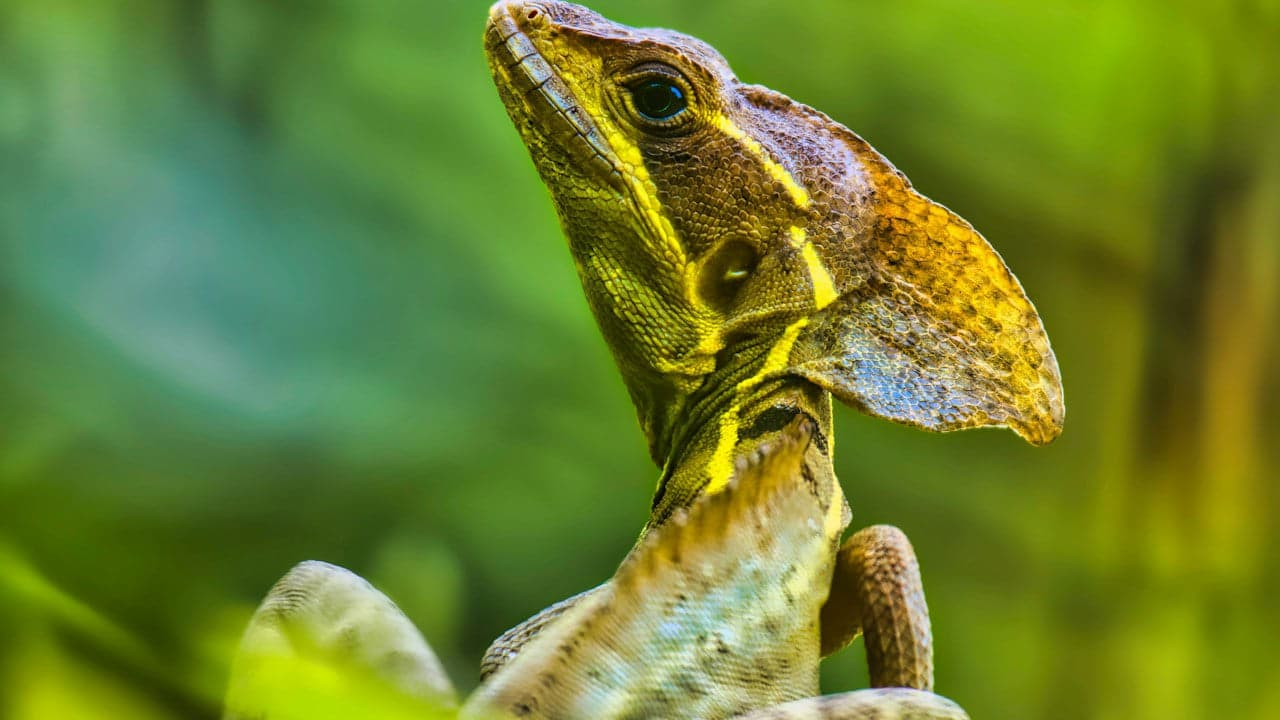
 Photo: What's Up Caribe / Unsplash
“Lizzie has been an icon for the early evolution of amniotes for decades.”
: Xavier Jenkins, postdoctoral fellow, American Museum of Natural History
“It turns out looks can be deceiving, and Lizzie lived a completely different lifestyle than we previously thought.”
: Ben Igielman, co-lead author of the study
What the synchrotron saw under the surface
The team took the fossil to the European Synchrotron Radiation Facility in Grenoble, France, and used high-energy X-ray imaging to map the parts of the skeleton still locked in stone. Inside, the animal had a primitive skull, internal gills containing bone, and a mouth built like a fish's, with thousands of tiny teeth.
Read also on The Patent: Texas A&M finds mosaic genomes in Galápagos tree finches · Algarve fossils push the rise of modern green algae back 30 million years · University of Michigan finds how bacteria survive making cancer drug doxorubicin · Human immune cells can engulf amoebae, Louisville study finds
None of that fits an early reptile, and the authors remove Westlothiana from the lineage leading to reptiles. Co-lead author Ben Igielman, who began the work during graduate studies at Oxford, put it plainly: "It turns out looks can be deceiving, and Lizzie lived a completely different lifestyle than we previously thought." Scanning of this kind has become routine in the study of extinction+technology, reading internal anatomy without splitting or damaging the specimen.
Nothing reported in the study concerns a patent or a commercial product. The claim is a reclassification, argued from anatomy, and the instrument behind it is a shared research facility rather than a protected invention.
Claws and five fingers came before life on land
The reclassification changes the timing of several traits that palaeontologists had tied to vertebrates moving onto dry land. Teeth and bones suggest that claws, and the arrangement of five digits on each hand and foot, had already appeared in earlier animals still closely associated with water. Those animals sat in the lineage leading to tetrapods, the broader group of four-limbed vertebrates that contains both amphibians and amniotes.
"Some of the traits of reptiles were already there in the ancestor of both amphibians and reptiles," said co-author Roger Benson, the Museum's Macaulay Curator of Paleontology. The pattern, as the authors describe it, is one of features accumulating piecemeal in relatives of tetrapods rather than arriving together with a move to land.
Footprints that no longer prove a Devonian reptile
The result reaches beyond one specimen. Recently discovered trackways, impressions of a four-limbed animal with apparently clawed digits, have been used as evidence that amniotes appeared during the Devonian Period, more than 359 million years ago. If close relatives of tetrapods such as Westlothiana also had claws, those tracks stop being proof on their own.
Some trackways attributed to early amniotes may instead have been left by amphibious animals of the tetrapod lineage. "Terrestrial-looking traits, such as a reptile-like foot, a weight-bearing forelimb, and claw-like phalanges were not unique features of tetrapods," Jenkins said. The study also credits Jason Head of the University of Cambridge, Vincent Fernandez of the European Synchrotron Radiation Facility, Lucy Roberts of the Natural History Museum in London and other contributors. The next test is whether the trackways, read again against the new anatomy, still support a Devonian origin for amniotes, a question the paper leaves open.
Human-Edited, AI-Assisted