University of Bath builds custom electroluminescent displays with an airbrush and laser
The Spray and Etch method fabricates 50.8 PPI pixel arrays on curved surfaces without cleanroom tools
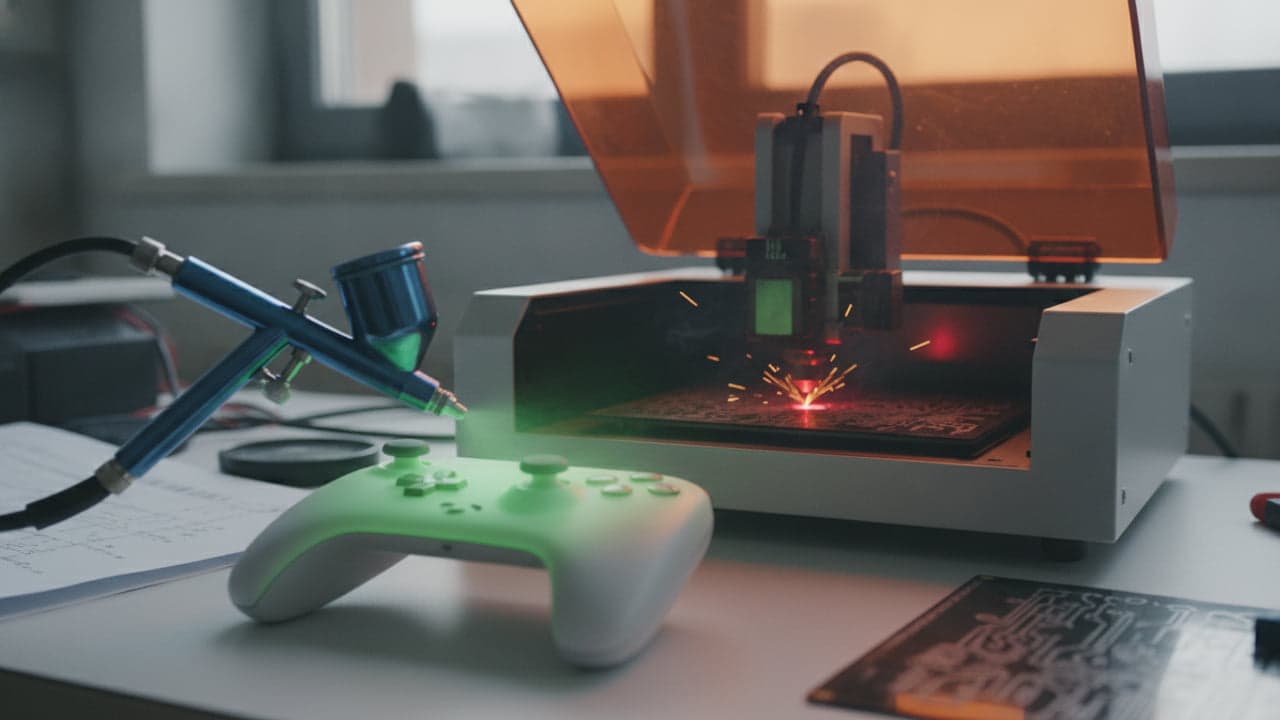
Researchers at the University of Bath have developed Spray and Etch, a method to fabricate functional electroluminescent screens using common workshop tools. The invention allows makers to create custom addressable displays on flat and curved items without relying on standard commercial panels.
Multilayer fabrication with desktop tools
Display production typically relies on cleanrooms, industrial photolithography, and expensive vacuum equipment. To lower this barrier, a research team led by C. Wu at the University of Bath developed a fabrication innovation that pairs an airbrush with a standard, unmodified CO2 laser cutter, as detailed by Hackster.io News.
The process begins by spraying a thin layer of conductive copper-based ink onto a target surface. The laser cutter then vaporizes selected sections of the metal film to delineate the base electrode tracks. Next, the user sprays sequential layers of dielectric material, electroluminescent phosphor, and a transparent conductive top coating. A second laser etching cycle defines the remaining electrode lines, completing the circuit.
Depth control yields 50.8 pixels per inch
The technical core of the system is what the researchers call depth-selective laser etching. By adjusting the laser beam focus, speed, and power settings, the machine ablates a single material layer while leaving the underlying coating intact. This removes the need for physical shadow masks or chemical resist stripping between steps.
To test the process, the team built a functional 32×32-pixel electroluminescent display prototype, according to Hackster.io News. Each individual pixel measures 0.4 mm across. The resulting grid delivers an image density of 50.8 pixels per inch (PPI). Earlier attempts at DIY electroluminescent fabrication reached between 16 and 30 PPI.
Testing illuminated interfaces on curved shapes
Because the deposition relies on spraying rather than rigid glass substrates, the method adapts to three-dimensional objects. The researchers demonstrated this versatility by forming active electroluminescent features directly onto curved surfaces, including a game controller, glasses, and an artificial fingernail, as reported by Hackster.io News.
Practical challenges remain before workshop fabrication becomes standard. The team attempted to stack distinct phosphor chemistries to produce multicolored pixels, but tests revealed degraded brightness and poor color separation. Consistent production will also require stricter laser calibration protocols and wider validation of ink formulations before the invention can move toward wider adoption.
Read also on The Patent: Ben Krasnow 3D prints a clear Einstein-Szilard refrigerator powered by flame · Making Photovoltaic Solar Cells at Home Using a Microwave Kiln